

(fourth in an occasional series on BOOKS THAT MATTER & THE PEOPLE WHO LOVE THEM)
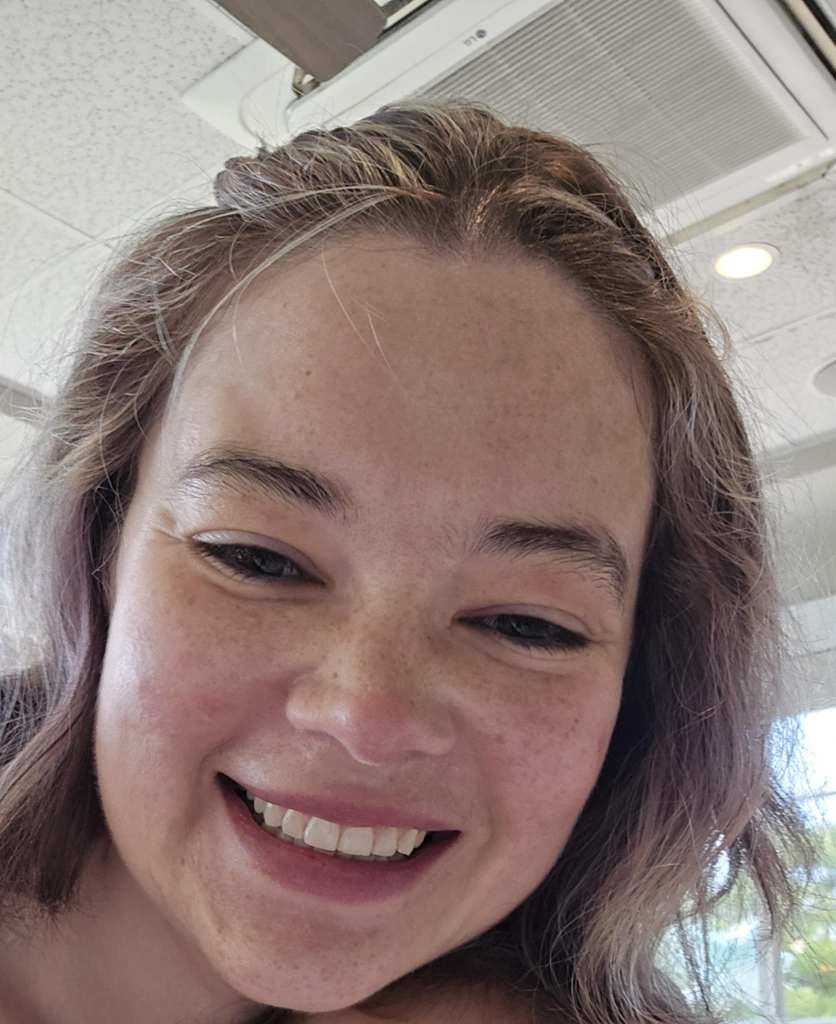
Forecasters had called for up to three inches of snow and high winds the mid-February day I spoke with Abigail Greenwood. A cozy fire flickered against one wall of her virtual background, while through the windows of another, a cheerful snowman embraced softly falling snow. She apologized for being late. Her six-year-old daughter had been sick the previous day and she’d been debating sending her to school, thinking with the impending storm the district would close or at least delay opening. Yet neither occurred, and she rushed getting her daughter ready and on time for school.
The last time Abby and I had spoken at length, she was a student herself, a sophomore in my Honors English, and I was the frazzled mom trying to get my kiddos out the door. I remembered her as a quiet, diligent student, more focused on science than literature yet always eager to invigorate our discussions with thoughtful, insightful commentary. We’d reconnected over Facebook some years after she graduated, exchanging only occasional comments as ‘friends’ do on social media. Imagine my delight then, when she began posting original poetry and art and asking for feedback. She’d created a blog and a website, and now a page for her creative endeavors using the pen name Mindful Muser.
Of course I wanted to know more.
Smiling, she adjusted her ponytail. “I’ve been writing for years,” she said. “But it took me a while to openly share what I write because it’s so personal.” Now, she “[likes] to prove people wrong,” but her younger self was more of a pleaser, lacking confidence and unwilling to speak out in class or ask questions when unsure of her understanding.
She attributes much of that hesitation to her struggles with reading and grammar in first grade, when she was nearly made to repeat the year. “Reading became work then,” as she tried, successfully, to keep herself from being held back. However, she loved being read to and recalled with much fondness the variety of stories her librarian grandmother shared. “She just never wanted to limit me,” Abby said. “She wanted me to see how big the world really is” and would offer African folktales alongside Stewart Little and Abby’s favorite book about rocks and minerals.
It’s an approach she now takes with her own daughter. While Abby shares childhood favorites and books that reflect her and her daughter’s experiences, she also shares titles representative of disparate cultures and worldviews as a way to develop empathy and encourage conversations about difficult topics. “I want her to see things from all different angles,” she said. “Age appropriately, of course.”
Abby recognizes the role that literature has played in helping her to find her voice and recalled a pivotal moment during our study of Harper Lee’s To Kill a Mockingbird. My sophomores typically misread the scene in which Bob Ewell dies, incorrectly concluding–like Atticus Finch–that Sheriff Tate’s official version of events is a coverup intended to shield adolescent Jem Finch from prosecution. Sometimes I would act out the scene for them. Sometimes I would call on students to play each role, directing them as if on stage to act out Scout Finch’s in-the-moment narration.
Breaking down the scene like that allowed them not only to see events unfold as Scout does and identify Bob’s killer, but also to understand why Bob’s death must be determined accidental. For Abby, understanding went further. She began to see books differently, not merely as informational texts nor for entertainment, but as puzzles. A way to further her understanding of herself and the world beyond her own experience of it. “I also found myself admiring [authors’] different writing styles. [Doing so] gave me insight as to how I wanted to cultivate my writing style.”
I saw that insight evidenced in our post Mockingbird research project. Assigned to investigate an element of 1930s American culture, Abby wrote a series of carefully researched and compelling letters detailing a fictional character’s struggle with her mixed race heritage, which was published in an edition of our school’s newspaper and literary magazine. (Then, I was also its advisor.)
However, although she enjoyed writing creatively and wanted to devote more time to it, the demands of college and career took precedence. Eventually, she told herself, she would prioritize her writing, but it wasn’t until her daughter’s birth that “eventually became now.”
And just a few weeks ago, she self-published an e-book of her poetry, Built With Broken Pieces, a debut several years in the making and attributed to her pen name, Mindful Muser. Each of its 27 somewhat autobiographical poems meditates on her complex relationship with love’s many manifestations, and arose, in part, from a desire to face her fears and “lingering self-doubt. To build self-confidence [and] push past [her] insecurities.” She also hopes that sharing her writing will encourage others to “feel seen” and share their own stories, which experience has taught her requires tremendous courage.
I love that, and I love that her creative journey continues. Currently, she is developing short story ideas on Wattpad and working on a print edition of Pieces that will include additional poems.
“I also want to write children’s books,” Abby said. Unlike her writing to date, however, “I won’t be using my pen name for those.”
Her younger self would be justifiably proud.
*****
ABIGAIL GREENWOOD is an aspiring author and poet who enjoys books that make her think,
especially those that ask tough questions about civilizations’ ugly chapters. “Seeing different perspectives helps us see and feel the humanity of the experience and to understand why people do what they do–even the bad guys. It helps us understand life’s ‘grays’ and act accordingly.”
She also enjoys books devoted to self-help, self-care, parenting, meditation, and DIY. A recent favorite was Gardening for Dummies. “This is not a joke,” she said. “I really killed every plant I owned, including bamboo.”
Connect with her at Siren Song Poetry, through TikTok or on her Facebook page, “Don’t Talk. Just Write.”
a few BOOKS THAT MATTER to Abigail Greenwood
For children:
How to Train Your Dragon series by Cressida Cowell
My Bed by Rebecca Bond (pictures by Salley Mavor)
Love You Forever by Robert Munsch
What Would Darla Do? by Ganit & Adir Levy
For anyone:
The Book of Night Women by Marlon James
The Painted Girls by Cathy Marie Buchanan
Sarah’s Key by Tatiana de Rosnay
Looking for more posts in this series?
You can find them HERE, HERE, and HERE.
Coming up on MY NAME WAS SUPPOSED TO BE ELIZABETH ANN–
It’s A Matter of Perspective: On omniscience, unreliable narrators, and the ownership of ‘TRUTH’
Thanks for reading!
Discover more from My Name was Supposed to be Elizabeth Ann
Subscribe to get the latest posts sent to your email.
 My Name was Supposed to be Elizabeth Ann
One thought on “LET ME INTRODUCE YOU TO MY READER FRIEND ABBY”