My Name was Supposed to be Elizabeth Ann

I write stories about stories–Reading them, writing them, living them

Decorating the tree has always been my favorite Christmas tradition. 

When I was a kid, we always bought our tree a few days before Christmas, at Robinson’s Market up the street from our house on Claster Boulevard, then placed it in a bucket with some water until Christmas Eve. Christmas Eve Day, our parents brought it inside and strung the lights, but we five overly excited children were only ever allowed to watch, not help, and Christmas morning when we awoke, the tree was fully lit and decorated, presents piled beneath its branches. 

Santa!! 

For the first two years of our marriage, Hubby and I lived in an apartment that forbade live trees, so I spent $4.00 to buy a two-foot artificial tree that moved with us to our first house, which we moved into, literally, on Christmas Eve Day. Most years after that, Hubby cut one from a tree farm near his parents’ home in northwest PA, when he traveled there for hunting season, one or both of our kids in tow. One year, we experienced our own Charlie Brown near-disaster. I don’t recall why, but his travel plans changed and we opted to get our tree from a nearby nursery. Three days before Christmas, we awakened to a carpet of needles and fallen ornaments. Even though I’d watered it faithfully, our tree had died seemingly overnight. The kids, four and six, were devastated. What would Santa do, without a tree?

So, of course I undecorated and vacuumed and we found another nursery and picked another tree and, after Hubby helped me restring the lights, the kiddos helped me redecorate, after which I re-redecorated their decorations. They tended, as kids do, to clump all their ornaments in one spot.

The kiddos on the hunt for the perfect Christmas tree with Grandpa Reisinger, 2003

I miss Christmas, when they were little and still lived at home. When they were little, each claimed a side of the tree to decorate. His faced the front door, so that anyone visiting would see his ornaments first. Hers faced the living room, so that everyone seated around the tree or in the kitchen or walking through to the upstairs could see hers first. My side (a mix of my ornaments and Hubby’s) faced my spot on the couch where I drank my morning coffee, because that was the only side left besides the one facing the street which was–by default–the side that mattered least. Later, when we moved from that house to here, they continued to claim their same territory, until they grew up and moved out, and I sorted their ornaments into red and green totes so they could decorate their own trees in their own homes. 

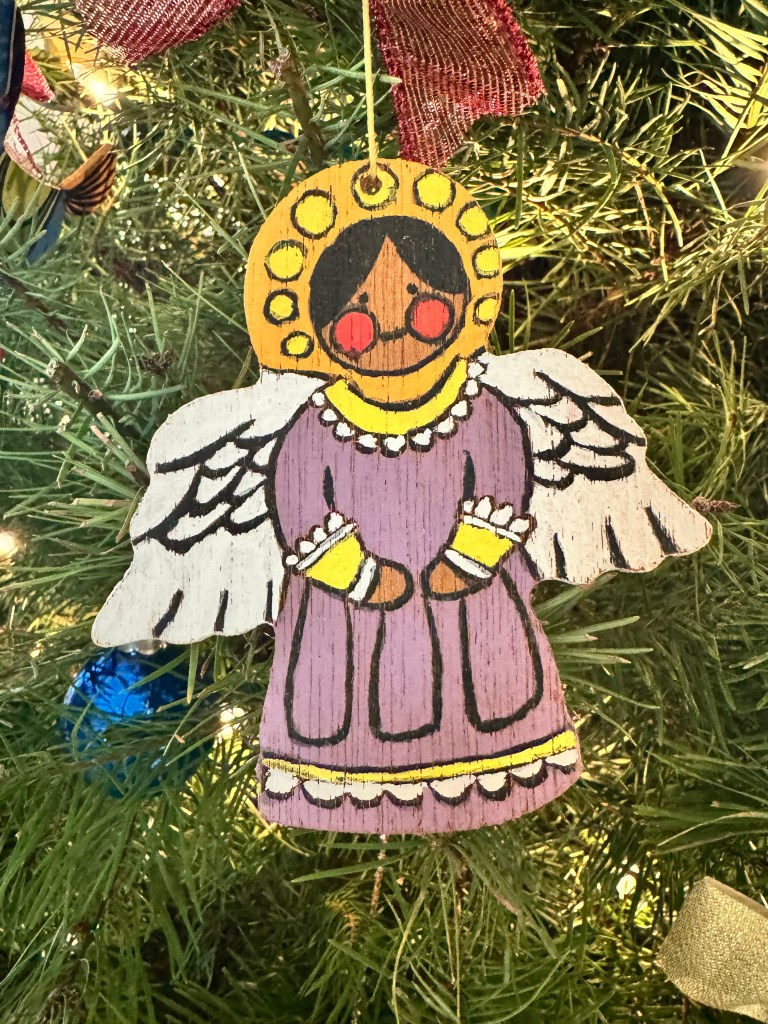
Here are my three favorite ornaments, arranged oldest to youngest:

The kiddos–Anthony, Alexandria, and Albert

My kiddos made the top two when they were in kindergarten. My son-in-law made the bottom one, though when he cannot recall. All I know is that SOMEONE in his family intended to THROW IT OUT and I said, Don’t you dare.

I hang all three of them first, on ‘my’ side of the tree so I can see them each morning when I drink my coffee.  

See, it’s not merely the act of decorating a tree that I love, it’s the ornaments themselves, the stories of how they were made or acquired and the loved ones they call to mind. My mother-in-law used to gift her grandchildren a Hallmark ornament each year. My mom used to paint ornaments for my childhood tree, and I continued those traditions (somewhat modified) with my family. Each year I would stitch or paint the kids and Hubby a handmade ornament they picked out, or some years when life was just too, too jam-crammed crazy, we would go to the Hallmark store and select Keepsakes. Christmas Eve, after the kids hung their stockings, they could hang their ornaments then snuggle into their new Christmas pajamas to eat cookies and watch holiday movies and wait for Santa. 

We still do that, even now. Well, except for the Santa part. And the snuggling. I still make or buy everyone new ornaments, however, and I still give them pajamas each year.  Our son-in-law, too. 

Of course. 

Because the thing about traditions is that they aren’t immutable. They evolve, as families and circumstances change, which can be sad, I know, but also I think, enriching. A new source of joy, if you allow it. Our tree contains ornaments from before Hubby and I ever met, from before our children ever existed, and from now that we are empty-nesters. Each is a chapter in the story of the life we’ve built together, and each December I anticipate rereading them. Even the bittersweet ones, because they remind me to appreciate all of life’s moments and the people with whom I share them.  

How bare our tree–our lives–would be otherwise.

*****

A few more favorites…

My mom Helen painted this one for me when I was in high school. Dauphin also used to be home to a ceramics studio:

Mom painted this one, too, from a kit when I was in elementary school. It became mine after she passed.

Anthony made this for me when he was in preschool, and I still hang it on ‘his’ side of the tree.

In 2016, my father-in-law passed, and when Hubby brought my mother-in-law to our home for Christmas she gifted him some of her mother’s ornaments from Poland. The gold one pictured is one of them. It’s now super delicate and has lost its hook, and I’m unsure whether I’ll repair it or just display it. I’m awed by the years and miles it has travelled to us. The Santas, I painted.

.

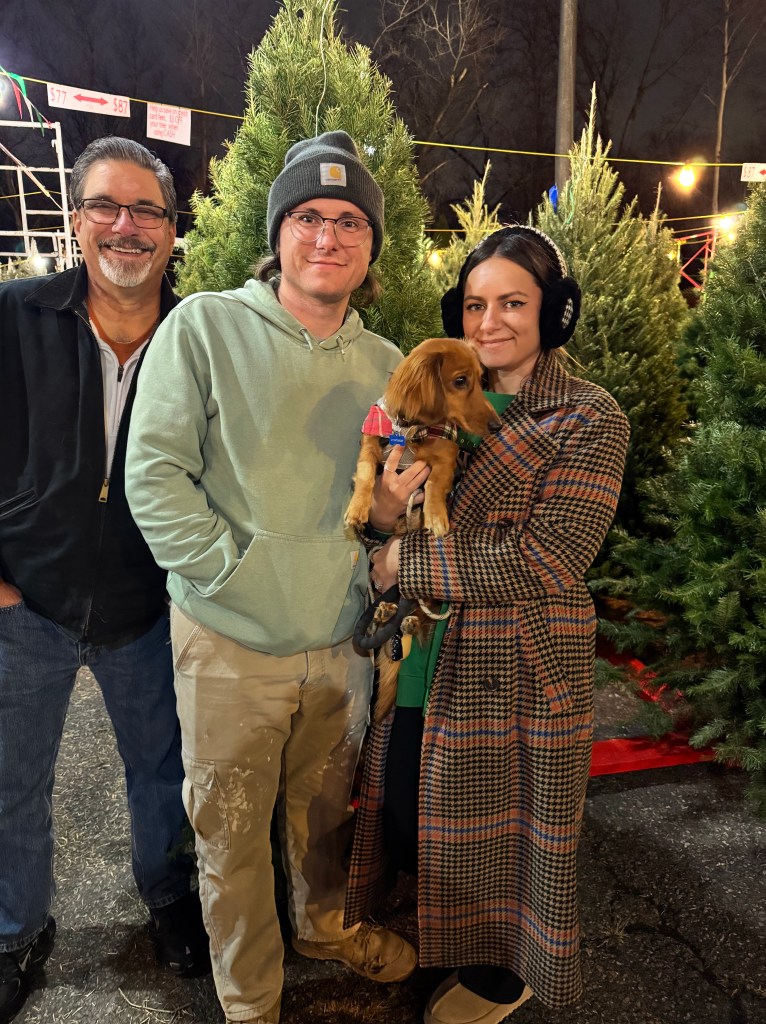
A new tradition…helping Alexandria, Albert, and puppy Ezra pick their tree. Puppers is not quite sure what to make of all this hubbub.

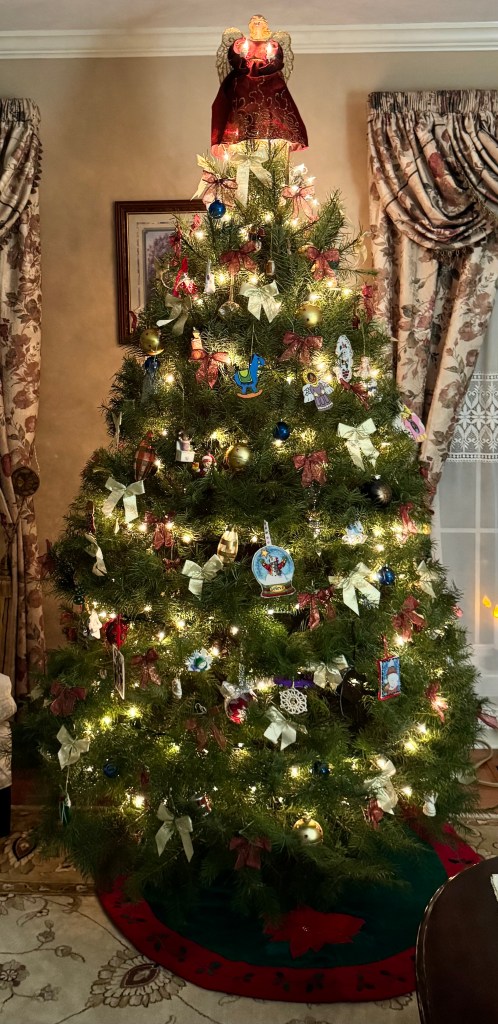
Last year’s tree. This year’s is still a work in progress, but that’s another post, lol!

WHAT I’M READING NOW…

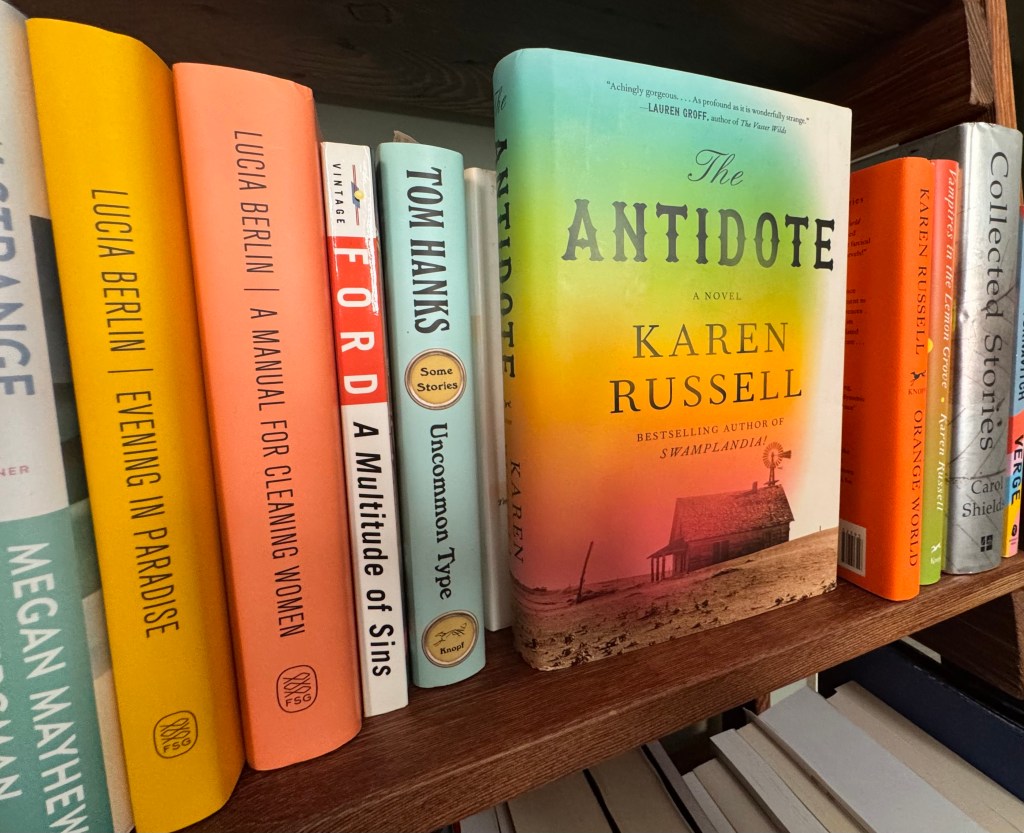
The Antidote by Karen Russell. Although I was not the reader for her first novel, Swamplandia, I love her short stories enough that I was more than willing to give her second novel a read. About 100 pages in and I am enthralled!

Side note, Vampires in the Lemon Grove is my favorite Russell collection, followed by Orange World.

A Manual for Cleaning Women by Lucia Berlin and Carol Shields’ Collected Stories are two of my favorite short story collections.

WHAT I’M READING NEXT…

Never Caught by Erica Armstrong Dunbar because it’s the next book for one of my in-person book clubs. I am reeeally curious about this one, as you might be able to guess from its full title.

If you haven’t already, check out James Loewen’s books, which detail factual errors in some US history books and historical markers.

Also, something from my recent library haul…

Because all three are on my Want To Read list, and all three were available when I stopped in. Sometimes the library gods just know!

RECENT READS AND RECOMMENDATIONS…

Blood Moon by Britney S. Lewis, a recent selection for another in-person book club. Vampires, werewolves, a missing mother and an angry daughter. Oh, and an enemies to (maybe) lovers plot. Lots to like, but I just … didn’t. No matter how much I wanted to, I just could not suspend my disbelief enough. With apologies, dear author, but I am not the reader for this book.

Buckeye by Patrick Ryan. I expected this one to be a bit weirder than it was, considering one of the characters communicates with the dead. A terrific read, about the weight and cost of secrets kept, and the inevitability of disaster when they are at last revealed.

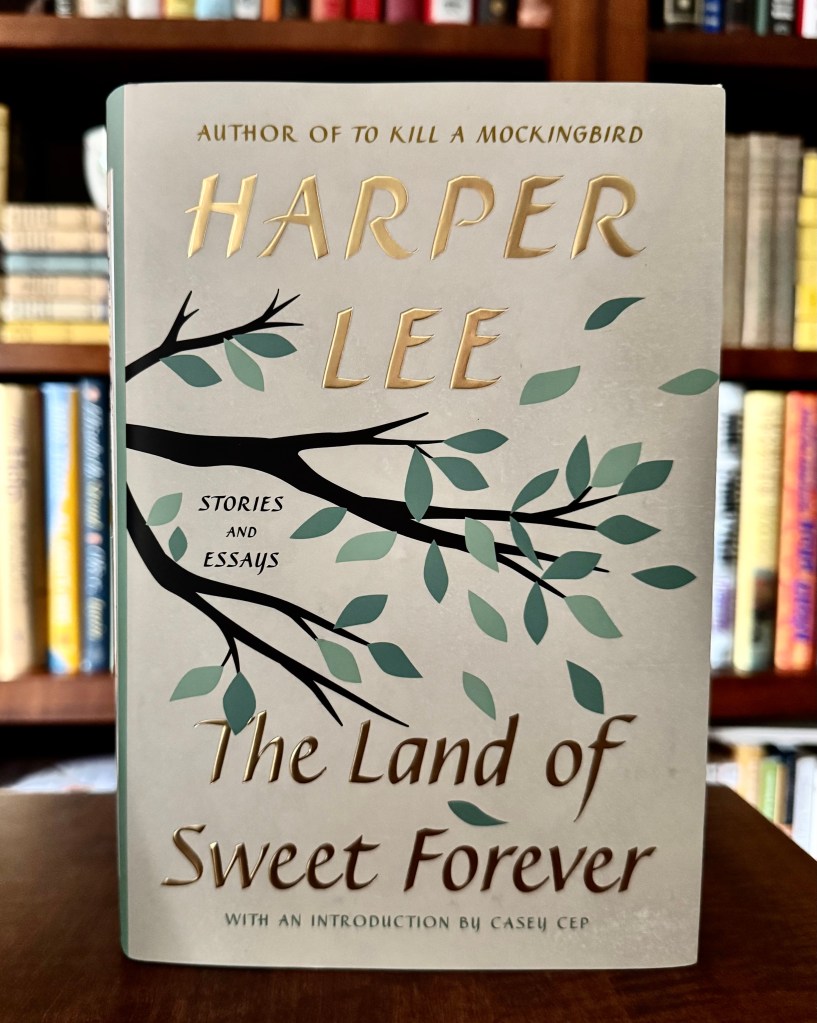
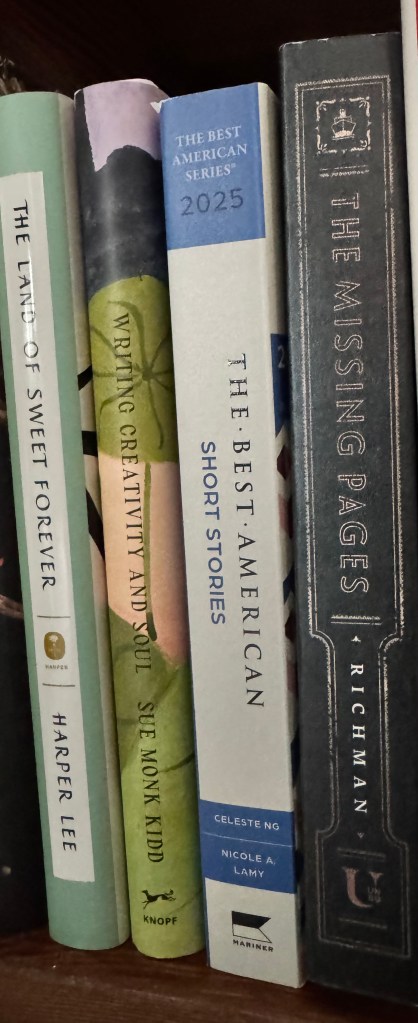
The Land of Sweet Forever by Harper Lee. Such a delight, hearing once more from one of my all-time favorite writers! Speaking of Christmas trees, “Christmas to Me” recalls the best present Lee ever received, when friends Michael and Joy Brown hung a letter to their ‘Nelle’ on their tree. “You have one year off from your job to write whatever you please. Merry Christmas,” it read. Can you guess what she devoted her year to writing?

The Once and Future Witches by Alix E. Harrow. This book is girl power on magical steroids. A bit overwrought at times and not entirely credible, but I did not care. I thought it a wickedly fun read. 

Slavery, Friends, and Freedom in Bucks County by Patricia L. Mervine and Joseph Coleman. I picked this one up on a whim at one of my new favorite indie bookshops, a few days after a friend and I were discussing how we’d recently learned some of our favorite places had ties to the Underground Railroad. It took me forever to read, and nearly a full pad of post-its, because I kept stopping to look up places referenced and whether I could visit them, whether they even still exist. Now, you may not be interested in this particular region’s history, but I highly recommend delving into your own region’s stories to understand not merely what happened long ago but how what happened long ago shapes what’s happening right now. After all, our history does not occur in a bubble any more than our present does. I found this book, quite frankly, transformative.

So Far Gone by Jess Walter. This one hit a little too close to home, considering our current political and cultural divide. It’s always the children who suffer most from their adults’ mistakes, isn’t it? This is a “madcap journey” as the book’s blurb asserts, but it’s also a serious take on that divide’s toxicity. I appreciated the nuance, even if it was, at times, a bit preachy.

We Are All Guilty Here by Karin Slaughter. I started watching the Will Trent series before I learned he originated in a book series, which of course I had to read. One of them at least, After That Night. Both were well-done within their genre, and I get why her books are so popular. I’ll probably read more, eventually. In moderation. They were both a bit too dark for my liking.

WHAT I RECENTLY ADDED TO MY TBR SHELF…

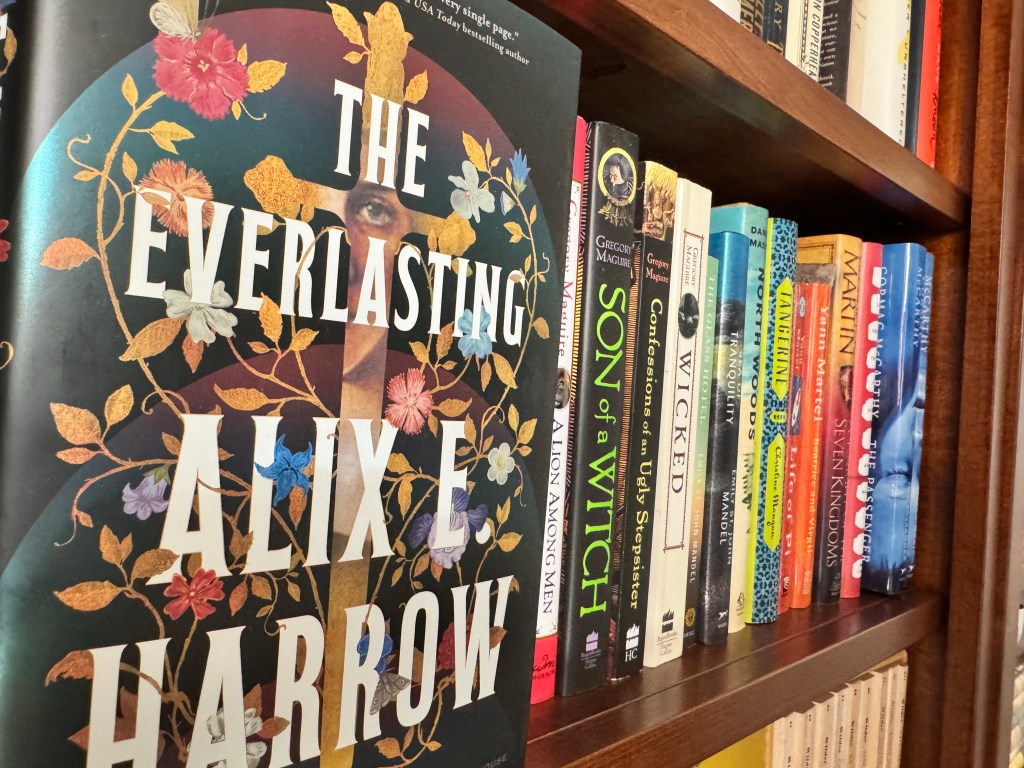
The first and last books have been on my Want to Read list for months! The middle three were impulse buys to support some of my favorite local indies, Fable Tree Bookshop in Titusville, PA, and Commonplace Reader in Yardley, PA.

And …

Funny story about The Everlasting, which I’ll share next month.

Yes, I’ve read all of Maguire’s The Wicked Years series. Yes, I’ve seen the musical adaptation and the film. Both parts. Ignore the critics, Wicked: For Good is great fun.

COMING UP NEXT ON MY NAME WAS SUPPOSED TO BE ELIZABETH ANN…

I’m working on a new look for my website, which has remained the same since 2019 when I introduced it.

And speaking of Christmas, look for January’s post a week later. My sister and her family will be visiting over the holidays, and my daughter (a nurse at a Philly hospital) has to work Christmas Eve AND Christmas Day. Twelve hour shifts each day, which is typical for hospital staffing. Remember that, please, and be kind if/when you or a loved one is hospitalized. Nursing is a ridiculously overworked and underappreciated profession and we should be more grateful to those in the field.

All of which is to say, I plan to enjoy my time with my loved ones, however the days unfold. I hope you’re able to do the same!!

Now You Tell Me…

What are some of your favorite traditions?

Thanks for reading! Thanks for sharing! And a very HAPPY NEW YEAR to you and yours 🎉

A few days before StoryADay’s October Critique Week,  founder Julie Duffy scheduled a workshop called Critique Best Practices for the Superstars community. Fellow writer and community member Walter Lawn had graciously offered to facilitate the hour-long online meeting, sharing his experiences and insights developed, in part, through his ongoing role as co-leader of a critique group separate from StoryADay. The workshop focused not only on how to critique another writer’s work, but also on how to receive others’ feedback on our own. The goal of both efforts being, How can I help this piece become even better? 

While prior commitments prevented me from participating live, I watched the recorded replay several times, each time gleaning valuable insights for our upcoming week of reading and discussing each other’s submissions. However, one point resonated with me the most and governed, I felt, both roles in critiquing: The writer is the boss of their own story.

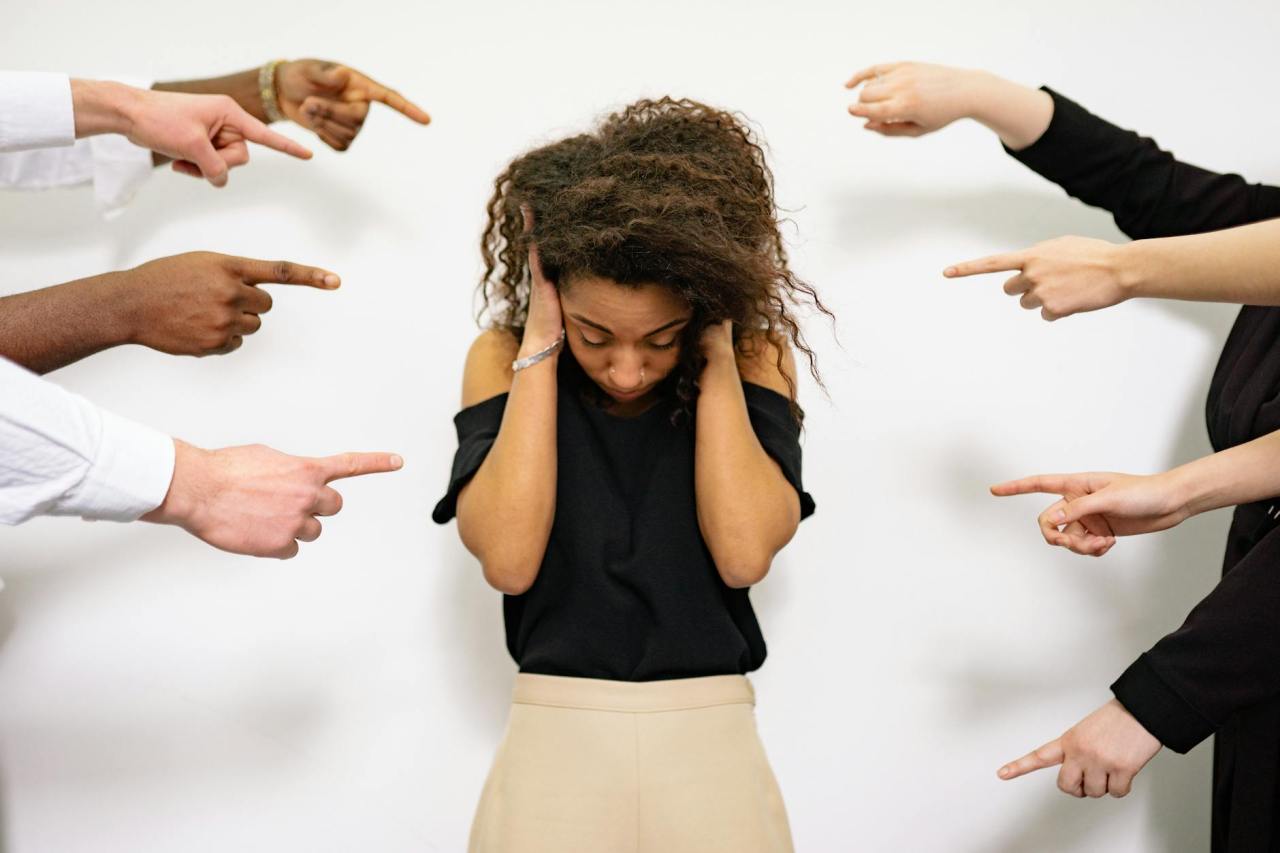
See, when you tell people you’re a writer, critics often come out of the woodwork like cockroaches. They want to know when and where you’ve been published and how much you’ve earned. They make assumptions about your output, about how easily they could do what you’re doing if only they had your time or resources or set-up. They apply their own calculus to evaluating your worth, whether the effort you’ve expended would have been better spent on more practical (or lucrative) endeavors, and find you sorely lacking in comparison to what they would have done. 

At least, that’s been an unfortunate part of my experience.

The problem, of course, with such criticisms is that they are destructive rather than constructive. Creating and building are always more difficult and time-consuming than tearing things down. Just ask any construction worker or bully. You don’t have to finesse a wrecking ball. 

And sometimes, unfortunately, we’re our own wrecking balls. We sabotage ourselves. We have these wonderful ideas, wonderful dreams, and yet… We can’t bring them to life. The fault, therefore, must be within us. We aren’t good enough. Talented enough. Accomplished enough. The universe has given us a sign, it was not meant to be–and so we quit.

Which is okay, I suppose. If that’s what you want. If that makes you happy. If quitting the thing that isn’t working leads you to the thing that does. You are, after all, the boss of your own story. You can decide what to do and how to do it, but…

What if you DON’T know either of those things? What if you know you don’t want to quit but you’re stuck and can’t see your way forward?

That’s when you call in reinforcements. That’s why I share my work, whenever I can, during Critique Week. Because I might be the boss, but I’m not a be-all, end-all, know-all expert. I need help, perspectives besides my own, objectivity. My critique cohort needs that from me, too.

Putting yourself out there, however, asking for help and trusting others to provide it? That can be daunting. True story: I’ve had some lousy experiences with critique groups pre-Superstars, and fellow writers, unfortunately, can be the worst kinds of critics. Not so, those I’ve met through StoryADay. As I shared here last month, I was both excited and nervous to submit chapters from my novel, but not worried, because their feedback is consistently helpful and encouraging. I finished the week eager to write, eager to continue the story. And I have been, every day since.

See, no one in the group ever says, You don’t belong here. You should shut up, throw this away. Quit. 

Instead, they recognize that, while we all have stories we want to tell, we don’t all have the same needs or goals or preferences. Except, we all want someone to listen. Respectfully, seriously, and with open minds. We want cheerleaders, yes, but not false praise. We all want to be the boss of  our own stories. Absolutely. However, none of us want to be Anderson’s Emperor or his tailor. Those two evil-doers are the real imposters.

That’s a good philosophy for life, too, I think.

*****

SPEAKING OF STORYADAY…

The demise of NaNoWriMo has left some writers wondering how to flex their creative muscles this November, and StoryADay May is rising to the challenge (ha! ha!) with its November reboot. Check out all the details HERE and sign up to receive a story prompt each day throughout the month.

WHAT I’M READING NOW…

Don’t forget to read the introduction by Casey Cep, which provides a fascinating glimpse into Lee’s pre-Mockingbird life.

To Kill a Mockingbird is one of my all-time, absolute favorite books EVER, to read and to teach, so OF COURSE I had to pick up a copy of this collection as soon as it was released.

WHAT I’M READING NEXT…

Something from my library pile. I added all three titles to my TBR list earlier this year and lucked out that all three were available on a recent visit.

RECENT READS AND RECOMMENDATIONS…

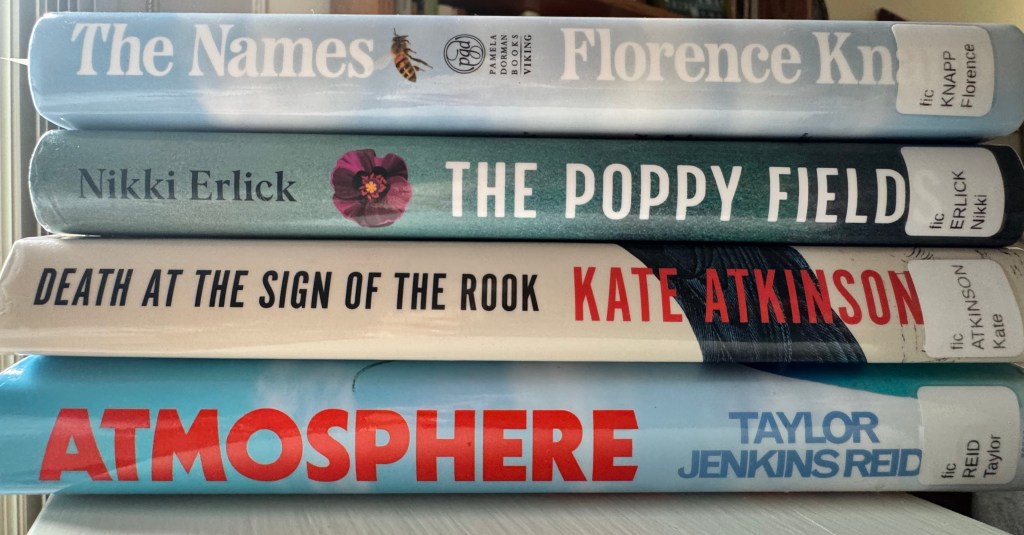
I’m a huge fan of well-written books that make me think and make me care. Bonus points if they stick their endings. Of the four above, only The Names accomplished all of that and was therefore my favorite. I didn’t buy the premise or character motivation of The Poppy Fields. Death at the Sign of the Rook lacked sufficient cohesion for my liking, and I figured out the ending of Atmosphere by the end of the first chapter. 

Beatriz Williams is one of my go-tos when I just want a good, entertaining read, and Our Woman in Moscow did not disappoint. That said, its title telegraphs its ending a little too obviously. 

I love Joan Didion and have been looking forward to reading the posthumous Notes to John. However, I DNF after about thirty pages because the subject matter was so personal I felt uncomfortably voyeuristic. 

I almost DNF Good Material because the protagonist Andy seemed so whiny and immature, the tropes predictable and ho-hum. Let’s just say it got better and I’m glad I stuck with it.

Also,

Britt-Marie Was Here by Fredrik Backman, which was a recent pick for my online book club. Britt-Marie made an appearance in an earlier Backman I’d read, so I had a suspicion about how her story would unfold. There were some nice surprises, but I wasn’t wrong.

Mrs. Lincoln’s Dressmaker by Jennifer Chiaverini. I recently joined a local in-person book club and this was the first title. While it read more like non-fiction than fiction, I appreciated the author’s meticulous depiction of seamstress and former slave Elizabeth Hobbs Keckley and her contributions to American history. 

I Am Not Sidney Poitier by Percival Everett, a reread. I rushed through the first time, missed most of its subtlety, and was underwhelmed by its satire. Not so the second read. Everett is, quite frankly, brilliant.

Katabasis by R.F. Kuang. This wasn’t quite the rollicking romp through Hell the book jacket suggests it is. It’s quite a bit darker and more esoteric than I anticipated, but I enjoyed the dynamic between Alice and Peter as they teamed up on their dangerous and unusual quest.

When the Cranes Fly South by Lisa Ridzen. Two thumbs way up. Bo’s story isn’t merely about his dying but about his living, and while the plot is relatively simple and straightforward, in Ridzen’s compassionate and insightful telling it becomes extraordinary.

The Woman in Cabin 10 by Ruth Ware. I heard the buzz about the movie and wanted to read the book first. I ALWAYS read the book first, excepting Forrest Gump because somehow I missed the memo.

WHAT I RECENTLY ADDED TO MY TBR SHELF…

Popped into a local indie bookshop for The Land of Sweet Forever and somehow ended up with three more. No clue how that happened, no clue at all!! 😂

COMING UP NEXT ON MY NAME WAS SUPPOSED TO BE ELIZABETH ANN…

I’m working on a few different ideas and haven’t quite figured out which one to queue up next. Stop back next month and let’s both be surprised.

Now You Tell Me…

What piece of advice helps you ignore the naysayers? How do you battle your own version of imposter syndrome? I’d love to hear the story!!

*****

Thanks for reading! Thanks for sharing! 

If you follow these things like I do, you’ll know the Booker Prize shortlist was announced September 23, and one of the six nominees, Kiran Desai, previously won the prestigious award in 2006. 

I haven’t yet read any of this year’s titles, but I’ve read multiple reviews and so was not surprised by Desai’s inclusion, even though I’ve also not read her winning novel, The Inheritance of Loss. According to a recent New York Times profile1, that novel took nearly eight years to write. 

Her latest, The Loneliness of Sonia and Sunny, took nearly twenty and once reached an astonishing 5000 pages. In its early stages her book had no structure, no center to focus her complex narratives, and she worried she would not ever be able to finish, that her publisher would lose faith. 

Turns out it’s really difficult to write a book. Harder still to write a really good one, even if you’ve written one before and have earned one of the world’s top literary prizes. I mean, I knew that already, but I didn’t understand how difficult and challenging the task, until I set myself that goal back in January. The sheer number of decisions you have to make and evaluate is astronomical, and the process itself can be quite frankly paralyzing.

At least, it has been for me.

So how do you move past those obstacles?

The NYT profile said little about Desai’s daily practice, but I’ll share what’s been working for me.

You know the saying about journeys and steps? Well, that’s been my creative writing year, except my journey has involved lots of backtracking and detouring. I would write toward a scene, then reach a roadblock, then try to devise a workaround, then discover that the workaround led to yet another roadblock on and on, seemingly ad infinitum. Often the reason I found myself  stuck ‘here’ was because I’d derailed my characters ‘there’ or hadn’t laid sufficient groundwork. So I would return to the break in the line–AFTER I’d spent many minutes determining where the break occurred–and I would try to figure out why the ‘whatever’ wasn’t working and how to fix it. Sometimes that meant staring blankly at a wall, and sometimes that meant writing pages of brainstorming notes. Once, that meant rewriting a POV character’s narrative voice from first to third limited because I couldn’t ‘hear’ her anymore, and once that meant reducing my three alternating POV characters to two.

All of which is to say, my progress throughout these nine-ish months is difficult to quantify, other than to say I have made progress. The story is stronger, the characters and their conflicts more rounded and realistic. The plot holes that existed in January have for the most part been plugged, and I do have a complete, though very (very!) rough draft. By that metric alone, I’ve accomplished what I set out to do and I can walk away from it now. I can move on to other projects.

Except, I don’t want to move on to other projects. Not yet. This one refuses to let me, much like Desai’s refused to let her.  Which is not to say I believe my writing on par with hers, or that my story is Booker-worthy. I don’t and it isn’t. I just think I’ve come up with a  pretty cool story and I think you might like it, too. I want to hear what you think.

That said, I am 58 years old. I am a slow writer and I need deadlines and I am not devoting twenty years to this project, even if I knew I had twenty years to devote to this project. Instead, I’m giving myself about eighteen months more, which is about the time I think I need to develop what I’ve written so far into a cohesive, readable, publishable narrative. Which is also about the time I’ll turn 60 (yikes!) and I’m thinking this will be the kind of happy-birthday-to-me present that will take the sting out of that  admittedly startling number. You know, bucket list kind of stuff.

See, I’ve not only always wanted to write a book, I’ve always wanted one published, and that’s what I now intend for this one. Whether that means through traditional means or self-publishing, or even taking a page from one of my favorite Victorians, Charles Dickens, and serializing it here, on my website. I don’t know, but I’ll figure it out. I just want my story out there in the world.

I wonder how much of that desire played a role in Desai’s motivation? She credits others for their support–mentor, mother, and novelist Anita Desai, and financial backing from her publisher and writing residencies–but nowhere does she credit herself. Out loud, at least. At least, not in the profile, or maybe the profile’s author chose not to include such statements. Self-aggrandizement–braggadocio, you know–leaves such a sour taste in the mouth. At least it does in mine.

However, believing in yourself, showing up and doing the work for an end goal maybe only you can see2? I think that’s worth celebrating.  I’m trying, in a small way, to do that here, by sharing my story with you, and I hope that whatever goals you’ve set for yourself you’ll also set aside time to celebrate your milestones.

Meanwhile, I’m working toward my goal nearly every day, and later this month I’ll be sharing a chapter with members of my online writing community, StoryADay’s Superstars, during one of our thrice-yearly Critique Weeks. I’m both excited and nervous. They’ve seen its prologue but nothing from this POV character, and I’m unsure how it will land.

No worries. I’m sure whatever feedback they offer will be tremendously helpful and encouraging, and I know I’ll do my best to reciprocate for them. We’re big on that, over at StoryADay, and I’m grateful.

Stop by next month and I’ll keep you posted!!

*****

  1. ‘She Won the Booker Prize. Then She Disappeared for 20 Years’ by Alexandra Alter. The New York Times,  4 September 2025.
  2. Unless, of course, your goal is world domination or the destruction of democracy and basic human decency. Then I say, knock it off. (I say some other words, too, but I won’t repeat them here.)

WHAT I’M READING NOW…

Fable Tree’s owner recommended it as her favorite by this author. I wasn’t the right reader for Mexican Gothic, but I’m enjoying this one a lot so far!

Hubby and I spent some time in NW Pennsylvania recently, and while meandering the historic streets of Titusville I discovered newly opened Fable Tree Bookshop. It’s tiny–about 144 square feet–but cozy and crammed floor to ceiling with books. Fantasy and romance to the right, children’s and young adult to the left. Of course I had to buy something 😀 Of course I’ll have to go back soon!!

I’m also annotating my way through Nexus: A Brief History of Information Networks from the Stone Age to AI by Yuval Noah Harari. Like his Sapiens, Nexus is a thorough, intelligent, and fascinating assessment of human development. I’m definitely taking my time with this one.

WHAT I’M READING NEXT…

Something from last week’s library pile:

RECENT READS AND RECOMMENDATIONS…

Three that have been sitting on my TBR shelf for some time–

Harlem Shuffle by Colson Whitehead. I’m a huge fan, and this one (‘a family saga masquerading as a crime novel’) did not disappoint.

The Covenant of Water by Abraham Verghese. This too is a family saga, but over three generations. So many characters, so many story lines, but they weave together brilliantly.

The Friend by Sigrid Nunez. ‘A meditation on loss and a celebration of human-canine devotion,’ I’d picked it up on a whim and didn’t think I’d really like it. I loved it. 

And one random library grab–

Under the Stars by Beatriz Williams. An entertaining mix of history, mystery, and family drama–she just tells a good story. Recently, I was a bit under the weather (which is why this is coming to you a bit late) and this one kept me company on my sick-couch.

WHAT I RECENTLY ADDED TO MY TBR SHELF…

See that blue one, second to last? Figured if it was twenty years in the making, the least I could do was buy a copy.

COMING UP NEXT ON MY NAME WAS SUPPOSED TO BE ELIZABETH ANN…

Critics, Criticism, and Critique Week: Some Thoughts on Battling Imposter Syndrome

Also, I’m playing around with a new look for my website, which has remained pretty much the same since 2019 when I started. Look for that come January 2026!!

Now You Tell Me…

What is your passion project? What’s on your bucket list? In January, I asked you to share your goals for 2025–How are you making out? I’d love to celebrate with you.

*****

Thanks for reading! Thanks for sharing! 🙂

Dear Stephen Colbert:

You don’t know me, but I’ve been a fan for almost twenty years, since The Colbert Report on Comedy Central, and Hubby and I have been faithful Late Show viewers since you took over as host (though, to be honest, I usually watch the recordings. 11:30 is way past my bedtime.) Often when the world seems  bleak and glum (these days, every day), I binge recordings, needing a good belly laugh, and like many viewers, I was upset to learn of your show’s suspect cancellation. 

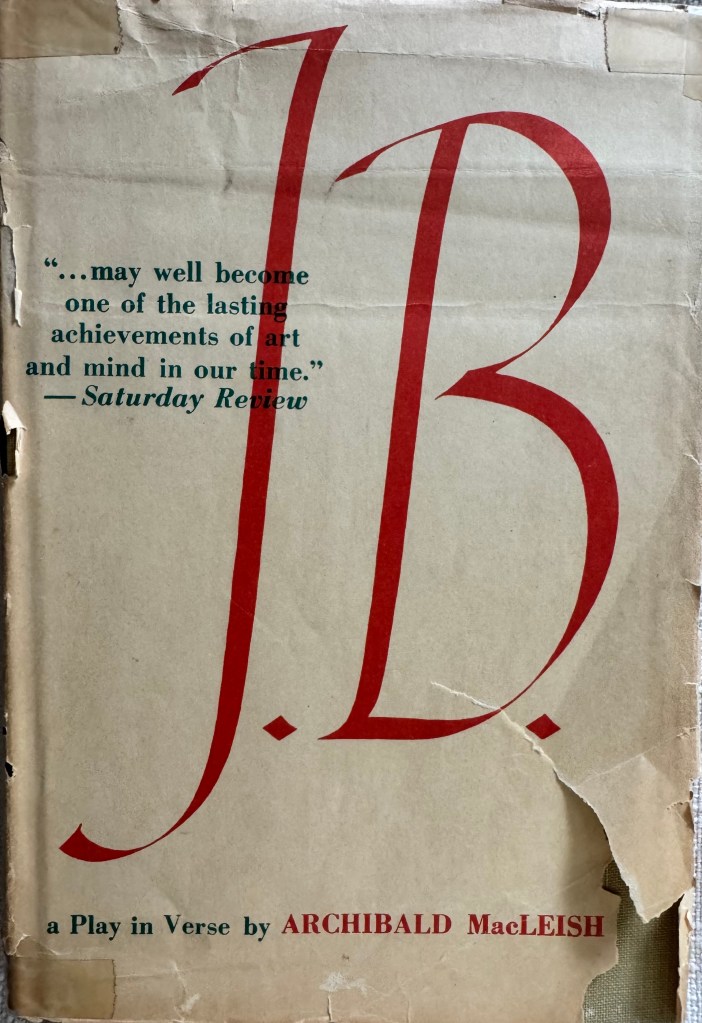
Recently, I’ve been thinking about your flipped interview with Jon Stewart which aired November 27, 2018, specifically when about halfway through he asked you to name your favorite Biblical character.  At first you picked Aaron, but then you picked Job because Job, you said, never cursed God despite his tribulations. And then you recited your favorite lines from J.B., Archibald MacLeish’s Pulitzer-prize winning play, which reimagines Job as a prosperous American businessman:

“I heard upon his dry dung heap
That man cry out who cannot sleep:
‘If God is God He is not good,
If God is good He is not God;
Take the even, take the odd, 
I would not sleep here if I could
Except for the little green leaves in the wood 
And the wind on the water.’”

You recited the lines a bit differently, however, but that’s okay. In 2018, shortly after I watched that episode’s recording for the first time, I looked it up, because although I had read both the play and Biblical versions several times, I did not recall that bit, per se, which Nickles says to Mr. Zuss as they prepare to stage Job/J.B.’s misery. I looked it up, because I was also curious about why you chose those lines. Lines which, on the surface, suggest a greater positivity than those I recalled from my first reading of the play in AP Lit senior year, some 40 years ago.

Before I share with you my favorite lines and why I’m just writing to you now, let me say, I have never liked Job’s story. Or rather, I have never liked God in Job’s story. Job is a good guy, King James asserts, “perfect… upright and [eschewing] evil,” yet God—at Satan’s urging—agrees to test him.  He literally makes a bet with Satan that allows him to torture Job in every way imaginable except–Satan must spare Job’s life. This is the same God (all dogma aside) described in Matthew 7 as a benevolent Father who answers prayer not according to what we children think we need but what he knows we need. 

Okaaay, now imagine explaining that bet to Child Services. 

Anyway, because I was curious, I decided to reread the play. Only, I couldn’t find my copy, which my teacher had gifted me senior year, when I asked if I could please keep it. MacLeish’s retelling had left such an impact on my eighteen-year-old worldview. 

But I couldn’t find that copy and instead reread this copy:

Houghton Mifflin, c. 1986

Which I’d bought for my classroom library, when I began teaching AP Lit.

That copy contained your lines but not mine, so I read this copy:

Houghton Mifflin, c. 1958

Thinking, maybe my lines had been edited out? Maybe I’d read a different, earlier edition?

Again, however, that edition contained only your line, and I started to think maybe I’d imagined ‘my’ lines, or misremembered where I’d read them? By this time, I had skimmed both copies multiple times just to be sure I hadn’t somehow missed them. I hadn’t, and Google was little to no help at all.

Why even bother? 

Because when I read J.B. senior year, I was suffering through some pretty serious stuff, none of which made sense or was justified. None of which by any measure I ‘deserved,’ and I wondered–like we all do when we suffer–Why me? 

You’re a reader. And you suffered too, as a young person, more than one should be expected to bear. You’ll understand then when I say, Those lines I’d memorized built a lifeboat. Teenaged me had clung to it, desperately. Adult me couldn’t bear to have lost it. Which is why I resumed searching for ‘my’ J.B. and found it–FINALLY–in a box way in the back of a shelf in our guest room closet. How it got there, I have no clue. I needed a stepladder to reach it.

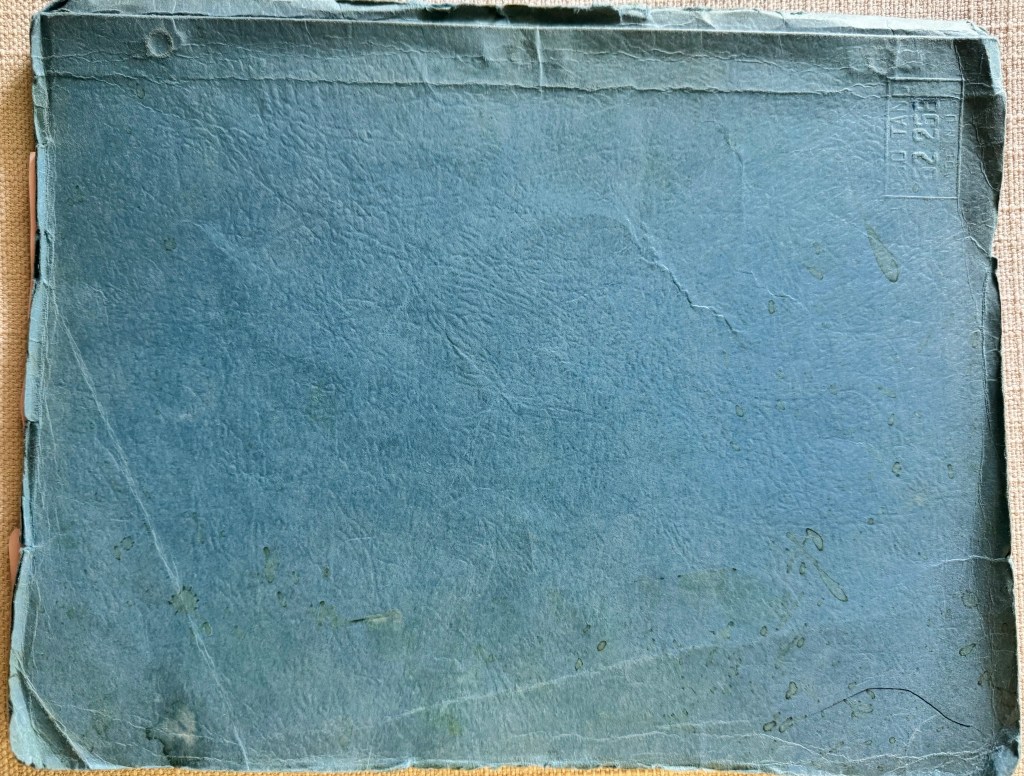
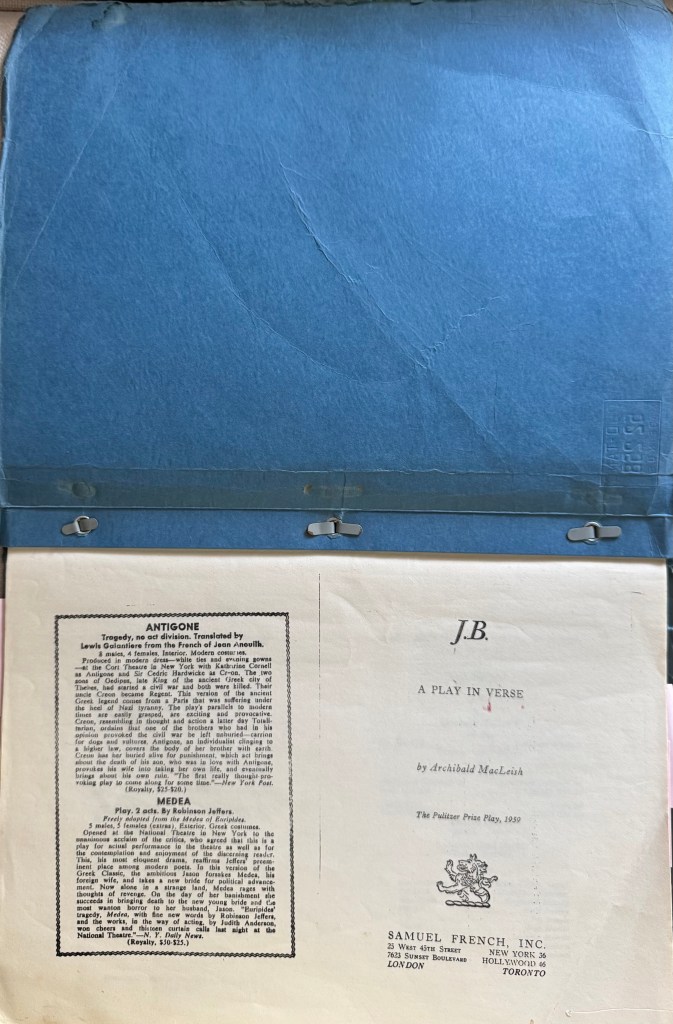
Here it is, a xeroxed copy* of the BROADWAY PLAY (not the book), which MacLeish had revised for the stage and which Elia Kazan** produced. I hadn’t realized until multiple rereads how radically different those versions from each other.

Think I should replace the cover?
Samuel French, Inc., c.1958

I’m curious which versions you’ve read, and whether you recall my favorite lines?

Whereas yours occur at the beginning, mine occur near the end, when J.B., dumbfounded, opens the door to discover his wife Sarah has returned to him, and Mr. Zuss, positioned “a bit above” the couple, “flings off [the robe he wore to play God] in a gesture of triumph,” anticipating J.B.’s capitulation. “You’ve found / The answer at the end!… / We take what God has sent.”

In other words, God’s answer to why we suffer–to why even children suffer–is Because I said so. “We take what God has sent.”

Ummm, no?

Zuss continues:

“There is no resolution of the mystery 
Of unintelligible suffering but the dumb
Bowed head that makes injustice just 
By yielding to the Will that willed it–
Yielding to the Will that willed 
A world where there can be injustice.”

And they’re some of my favorite lines in the play, because Zuss’ explanation is correct but not right, and because his non-answer infuriates J.B.  He rejects it. He will not curse God, but neither will he acquiesce. He pushes back, telling Zuss:

“I will not
Duck my head again to thunder–
That bullwhip crackling at my ears!--although
He kill me with it.”

Even Nickles receives a tongue-lashing:

“Life is a filthy farce, you say,
And nothing but a bloody stage
Can bring the curtain down and men
Must have ironic hearts and perish
Laughing…. Well, I will not laugh!”

He turns back to Zuss, then excoriates them both:

“And neither will I weep among
The obedient who lie down to die
In meek relinquishment protesting
Nothing, questioning nothing, asking
Nothing but to rise again and
bow!
Neither the bowing nor the blood 
Will make an end for me now!
Neither the
Yes in ignorance … 
the No in spite…. 
Neither of them!”

Such FURY in those lines, such disdain for those worldviews! I hear the whip crack in J.B.’s delivery. So forceful is his rejection of Zuss and Nickles’ interpretations of his suffering that they are silenced for the play’s remainder, relegated to downstage ramps and merely observing but not participating in J.B. and Sarah’s reconciliation.

Such subtle yet powerful blocking, I think, because it suggests a necessary shift in POV.

In power.

The onus to forge a path forward falls on J.B. and, by extension,

Us.

That was the lesson teenaged me took into the world–‘Why me’ is the wrong question.

The right question is, WHAT’S NEXT?

Recall, God’s wager does not unfold in isolation. What about Sarah and her murdered children? Their suffering matters less than J.B.’s?

I’m thinking MacLeish wondered about them, too, because SPOILER ALERT: His ending to the play is not his ending to the book. Yes, only J.B. and Sarah speak, but the dialogue and its speakers differ, as does the action. Even punctuation edits influence understanding.***

I’m curious how a third ending might look, one that merges the best of both versions. Curious, too, how Sarah’s version might be staged. What their children might say, if allowed a voice.

That’s why–sort of–I’m writing now, nearly eight years after your interview with Jon Stewart aired.

See, I’m still not a fan of Job’s story, but I love J.B. And I love your story, that you pushed back, too, despite your family’s “unintelligible suffering.” You struggled, I’ve read–perhaps you struggle still–but you did not acquiesce. You strived, as J.B. does, toward love and life, not despair and retribution, and look where that path has taken you. Look at the stage upon which you now speak. As you explained to Jon Stewart, you picked Job as your favorite biblical character because “[His] is the gratitude you have to have in life no matter what dung heap you lie on.” I admire that outlook, tremendously.

Even more so, I admire that you ACT on that gratitude in your professional life when you call BS on anyone–like Nickles and our current administration–who creates and delights in others’ suffering.

Keep doing that, please, no matter the next version of your story. As a satirist and entertainer, yes, but more importantly as a human being. Our world needs more people like that, people who reject their own and others’ ignorance and spite.

You can bet on it.

Sincerely,

A fan from Pennsylvania

*****

Postscripts…

* With apologies to publisher Samuel French, Inc.

American public schools have been chronically under- and inequitably funded since their inception and needs must. I’m sure Mr. Oberholtzer purchased at least a few copies. He was a stickler that way. All excerpts quoted above are taken from the Samuel French edition.

** Such irony, I later realized, considering Kazan’s participation in McCarthy’s witch hunt.

*** One such example is the line “Blow on the coal of the heart,” which both characters say in different ways, at different times in the scene, AND with different punctuation. I’m curious how you interpret those changes?

WHAT I’M READING NOW…

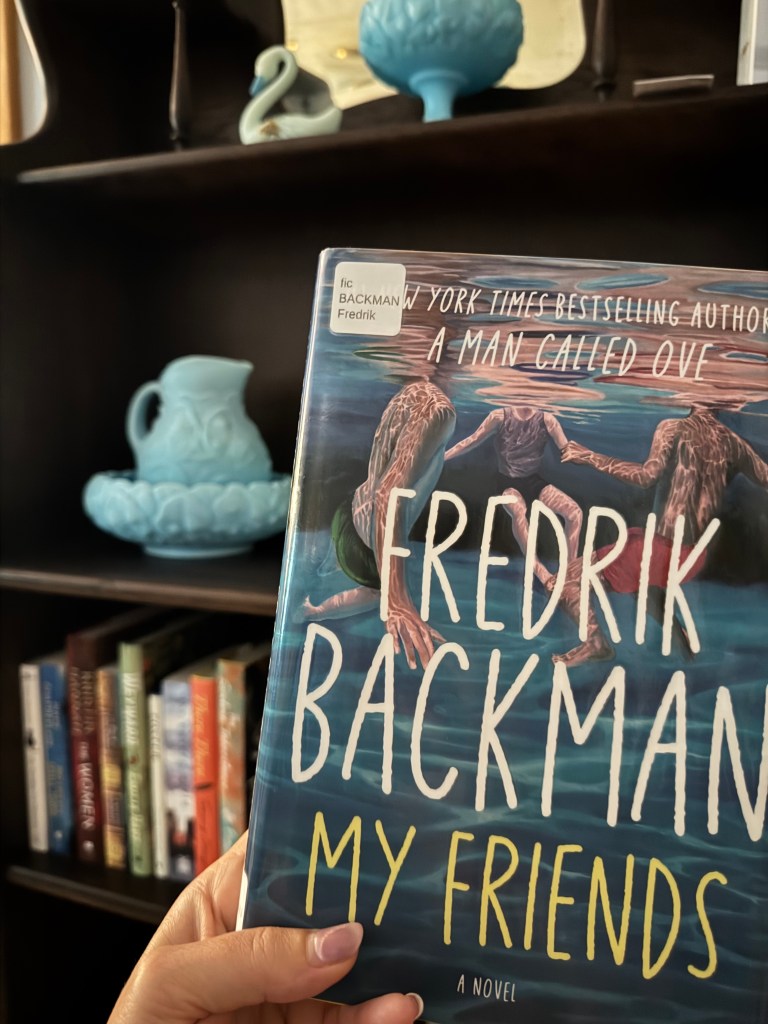
I loved A Man Called Ove and have read a few of his other books, so I grabbed this one from the ‘Just In’ shelf:

So far, so very good.

WHAT I’M READING NEXT…

Something from last week’s library pile:

Also, Nexus, Harlem Shuffle, and The Covenant of Water have spent an embarrassing amount of time on my TBR shelf. I’m thinking I’ll work my way through my loans, then start on them.

Unless, of course, some of my holds come in 🙂

RECENT READS AND RECOMMENDATIONS…

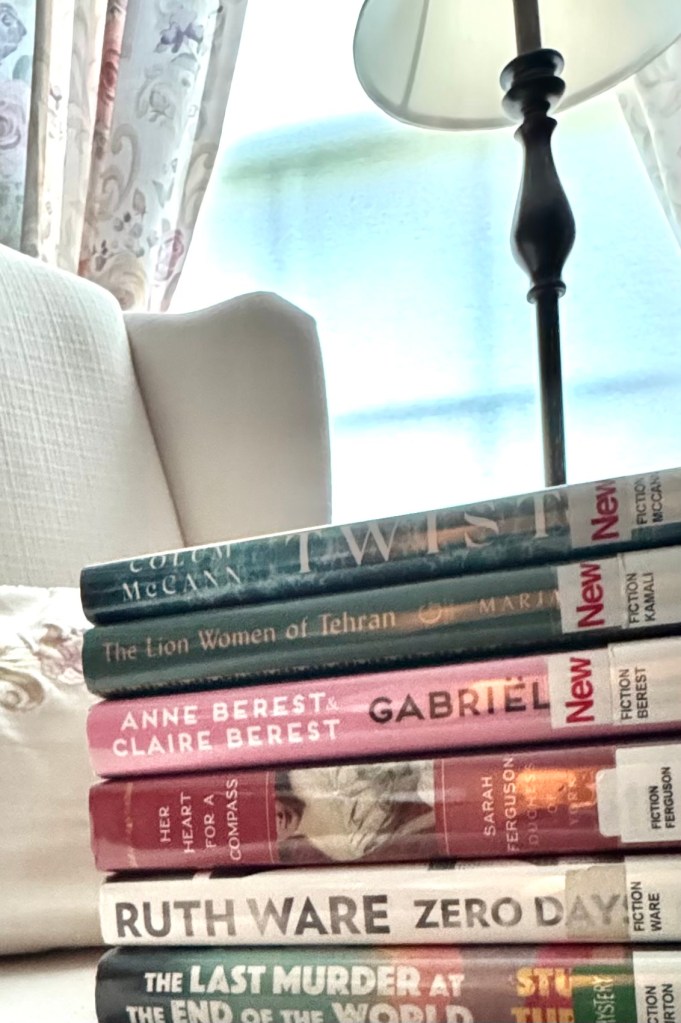
From last month’s library pile:

Twist–A broken man meets another broken man whose job entails diving deep beneath the ocean to repair broken information cables. But will they figure out how to repair themselves? Quiet, meditative and gorgeous writing, the payoff at novel’s end made up for its slow start. I’ve been wanting to read this one for awhile and am glad I finally got the chance.

The Lion Women of Tehran–I knew how Ellie and Homa’s story had to end. I loved their story anyway.

Her Heart for a Compass–I watched Diana marry Charles and Sarah marry Andrew, so of course I had to read for myself whether Fergie could write a novel. She can, but it was not my cup of tea. 

Zero Days–Predictable villain, though a quick and entertaining whodunit. I hadn’t read any of her books before, but will add her to my list.

The Last Murder at the End of the World–Loved the premise but wasn’t really drawn to the characters and so, DNF🥺Apologies, sir, but I am not the reader for this book.

Built with Broken Pieces by Mindful Muser, the pen name of a former student. Her lovely poetry collection testifies to the healing power of imagination, verse, and speaking one’s truth. 

COMING UP NEXT ON MY NAME WAS SUPPOSED TO BE ELIZABETH ANN…

‘Reading, Writing, and Resolutions’: An Update. In January, I made several promises to myself and you. Think I kept them? Check back next month and I’ll tell you 😉

Now You Tell Me…

Who is your favorite author? What book of theirs would you suggest to someone who’s never read any? I’m always looking for recommendations!!

*****

Thanks for reading! Thanks for sharing!

Late June, Hubby and I were preparing for our trip to Alaska and the Yukon, an adventure over one year in the making. He’d traveled to Alaska before, on a fishing trip with a buddy years ago, but I’d never been and was both excited about all we’d planned and anxious about being away from home so long, nearly a month. My to-do list seemed never ending and, wanting a distraction, I began rereading Kate Morton’s The Forgotten Garden a few days before our Vancouver flight.

I’ve been the Australian’s fan since 2014, when a friend recommended Garden, and have since read all seven of Morton’s booksTheir chapters alternate among timelines and POV characters, each a compelling blend of history, mystery, and family, and the myriad ways in which secrets forge and link characters. 

Like in real life, but with neater resolutions.

My mother loved Kate Morton, too, once I’d introduced them. I bought us copies of each book as they were released, and we used to conduct impromptu book chats during our long-distance phone calls, guessing at motivations, culling clues to explain how the POV characters’ stories were connected. Sometimes we figured out the patterns. And sometimes in our rush to The End, we missed them. We speculated about how Morton kept track of the story threads as she wrote and whether we could spot them better with a rereading. We never reread any of them, however. Too many books, too little time. You know?

It was Mom’s copy of The Forgotten Garden that I pulled from my shelf. 

My copy is on the right.

I am an unapologetic homebody, but when I travel Hubby teases I become adult Dora the Explorer, studying maps and reading signs, chatting up strangers and trying to uncover the mysteries of each destination. 

I also take pictures. Lots of pictures. 

This trip, I snapped nearly 2000. I am slooowly culling and organizing.

Here’s one of my favorites:

Boarding the train from Whittier to Anchorage. We did eight days at sea, then a land tour.

Here’s another: 

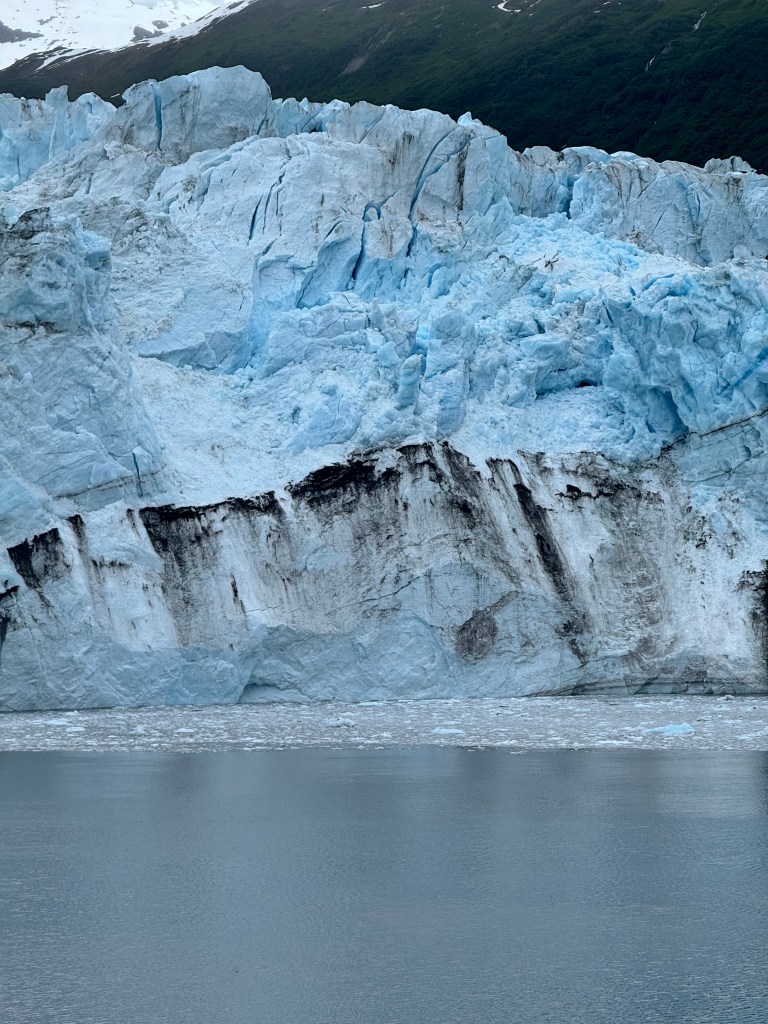
Harvard Glacier, College Fjord. Our ship floated one-quarter mile from its face, which stretches about 1.5 miles wide and 300 feet high. And yes, it really is that blue!

And here’s a third:

The ‘Mystery Pole’ at Totem Bight State Historical Park in Ketchikan, Alaska

In Ketchikan, our trolley driver/tour guide ferried us up the town’s steep, sinuous hills to Totem Bight State Historical Park, home to fifteen salvaged, restored, or duplicated totem poles from once thriving Native villages. As Luke explained, stories commemorated by each symbol and its placement remain known only to a pole’s artisan while carving, their significance to be revealed at a ceremony celebrating the completed pole’s installation. However, no one knows what or who inspired the pole in my photograph.  Guides refer to it as ‘the mystery pole’ because its craftsman died before that ceremony, and the stories he intended to share remain buried.  

Only later in Anchorage—five days and six stops too late—did I think to ask, Is that why the park’s brochure claims it’s home to fifteen poles, but only fourteen origin stories are included? What can we infer about the mystery pole’s creation, based on what’s known about when and where it was located? And, what might its creator have done differently with his stories, had he known they would die with him? 

So many questions, so little time.

Speaking of questions, when you’re travelling, visitors and locals alike ask strangers, Where do you call home, and What brings you to this corner of the world.

I asked too, and learned that, while some native Alaskans live up north year round (like ‘Klondike Kate’ in Skagway and Fairbanks’ Riverboat Discovery captain and crew), most who live and work its tourism industry migrate seasonally from the lower 48 and beyond. Much like the 1896 Gold Rush stampeders who flooded Alaska’s and Canada’s Klondike region (like Call of the Wild’s Jack London), they come seeking opportunity and adventure, often leaving homes and families for six to eight month stretches before ‘over-wintering’ in less hostile climes.

Luke hails from Utah, where he drives a school bus. Jubilee works the cruise ship’s omelette station, calls the Philippines home, and called me Mama Elizabeth.  Arief waits tables in the ship’s dining room, originates from Indonesia and, before boarding, had celebrated his favorite niece’s wedding back home. Married musicians Jake and Laura drove from Dayton, Ohio, to entertain cruisetour guests at Denali Square, and Courtney from Arkansas leaves her elementary-aged daughters back home with her mother while she leads covered wagon tours through the Alaskan backcountry. 

Meanwhile, Josie from Georgia had never flown nor left her state and one day decided on a whim to do both, becoming a zip line guide in Ketchikan and Skagway. We met her in Denali, where she conducts nature talks and walks along the park’s trails. She looks twelve and could, as Hubby said, split a raindrop she is so tiny. More importantly, she is brilliant and funny and passionate about her subject, contagiously so. She calls herself an “environmental educator” and a huge “rock nerd,” and in the years since leaving Georgia, she’s earned several degrees and is considering her doctorate. Now, she can’t ever imagine returning to Georgia fulltime. Alaska has become home.

Like the glaciers advancing and retreating along the mountains and waterways, sometimes we see only people’s faces, not the ice shelf beneath the water or the ice river that stretches miles into the forest, nor how what we do or say Here affects what is done or said There. When the Harvard Glacier (above) calved one quarter mile from our ship’s bow, we heard the ice scream before it split, saw the avalanche before hearing its roar, felt its waves percuss the ship before the ship teetered and we grasped its rail for balance.

Here’s another favorite picture:

Crew members onboard the Nieuw Amsterdam admiring the ring of glaciers in College Fjord

So rare and magnificent are the North’s natural wonders, they awed even the ship’s crew, who alternated turns among their crew mates to marvel with us passengers. Some even turned upward, to wave at us and cheer.

We are part of each other’s stories, and not only in the singular moment during which our paths directly cross. I’m grateful to be reminded and grateful to carry their stories with me.

Remember Courtney? Eric was her wagon teamster, leading us and horses Jay and Turbo along the trails, and though he has lived in South Korea with his Korean-born wife for nearly twenty years, he was born and raised in Pennsylvania, about 30 miles from where Hubby and I now live, and graduated Philadelphia’s Temple University.

Also in our wagon? Four retired couples and a widow whose name I, sadly, cannot recall. 

So many people, so little time.

But this woman–also retired, and the oldest in our group–she has lived in Australia her entire life and since her husband’s death has refused to wallow but has become a solitary world traveler, including to Lancaster, Pennsylvania, relatively equidistant between my childhood and adulthood homes. She was, she shared, delighted with the Aim-ish way of life and also an avid reader who delighted–like I had–to discover that her cruise ship housed a well-stocked library. Though to be honest, she said, she read mainly Australian writers and had been too busy, this trip, to read much of anything.

Me, too. So much to explore, so little time.

Oh, I said, leaning forward eagerly. Have you ever read Kate Morton?

She had not. She had never even heard of Kate Morton, but jotted the writer’s name in her phone and wondered which title I would recommend she start.

So I explained that I’d recently reread The Forgotten Garden and had packed it in my carry-on and would have given it to her had I not already given it away. See, when my mother died I asked for her books and since then, I’ve been slooowly sorting and organizing her collection. Some, I’ve been reading and some I’ve been keeping, and some I’ve been leaving in Little Free Libraries as I travel.

I left Mom’s copy in Vancouver, British Columbia, the day before we boarded our ship. 

The widow and I chatted a bit more before returning our attention to the mountain view and Courtney’s travelogue, eventually of course continuing our separate travels. We will most likely never meet again (What are the odds?), yet I wonder whether she’ll follow up on my recommendation and whether she will think of me if she does, the American woman she met on a covered wagon in Alaska, whose name she cannot recall.

And I wonder about whoever finds Mom’s Garden, whether someone already has.

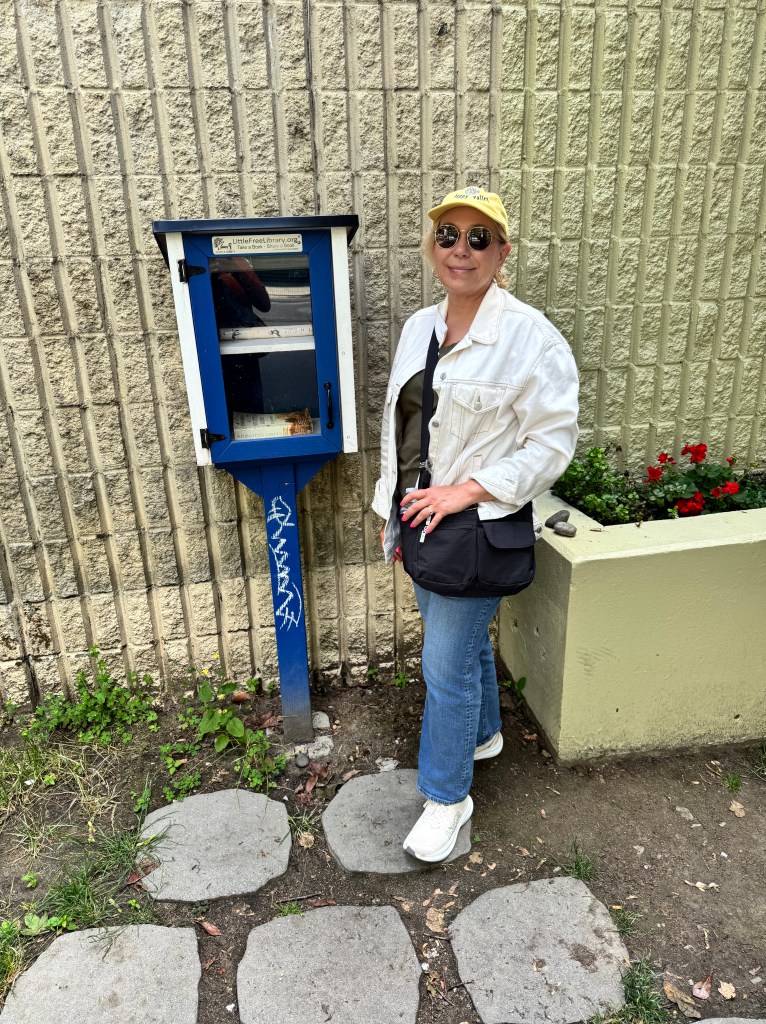
Because what I did not tell the widow from Australia but will share with you now, was that when I approached the Barclay Street LFL in Vancouver and prepared to place Mom’s Garden inside, I felt briefly overcome, my vision teary, and I thought for a moment to keep her book for myself. Losing it seemed, irrationally I know, like losing her again. Instead, I placed it inside and smiled when Hubby took my picture. See, Mom had never been further west than Ohio and would, as Hubby said, get a kick out of my scattering her beloved stories.

Honestly, I’m getting a kick out of scattering her stories.

Amicae Co-op Little Library, 1047 Barclay Street, Vancouver BC, Canada. I used my LFL app to locate it and record my donation.

Another detail I did not tell the widow is that on the book’s inside cover Mom had written my name, that I had given the book to her for Christmas 2014. Beside that inscription, I’d adhered a bookplate with Mom’s name, Helen Judith Miller, and below that, for good measure, written Dauphin, Pennsylvania, USA, so whoever finds it will know, I hope, that the book mattered to someone and that someone mattered to someone else, and that their love and that book traveled a long, long way to be plucked by a stranger from that little library’s shelf.

If it’s you who finds it, would you tell me?

I’d love to know your name. I’d love to hear your story.

*****

MORE ON TOTEM BIGHT…

A few weeks after our visit, the park installed a new pole, with the help of hundreds of Native community members. Four more were installed in the surrounding area. How wonderful is that?

WHAT I’M READING NOW…

Good Time Girls: Of the Alaska/Yukon Gold Rush, by Lael Morgan

On our last day in Dawson City, YT Canada, I spent several lovely hours meandering the city museum and its adjacent Klondike Mines Railway Locomotive Shelter and discovered Morgan’s book in the gift shop. So much is known and celebrated about the men who mined the north. I want to know more about the women.

Waiting for the coach to take us to Dawson City’s airport

WHAT I’M READING NEXT…

Mansfield Park, by Jane Austen. A reread, because it’s next up in my book club and I’m sketchy on the details.

Built with Broken Pieces, by Mindful Muser (the pen name of a former student) because… ❤

Then–decisions, decisions–something from my library pile. Any thoughts?

Twist and The Lion Women of Tehran were already on my Want to Read list. The rest just looked good! I’ll let you know 🙂

RECENT READS & RECOMMENDATIONS…

Heartwood, by Amity Gage. Beautiful writing, interesting characters, about a woman who goes missing while hiking on the Appalachian Trail and the search efforts to find her before it’s too late.

My writer friend Fallon Brown writes romance, mystery, and fantasy and just released Muffin to Die For, the first in their latest series ‘Cat in the Bakery.’ You can check them out here.

COMING UP NEXT ON MY NAME WAS SUPPOSED TO BE ELIZABETH ANN …

Dear Stephen Colbert, ‘There is No Resolution of the Mystery’: A Literary Scavenger Hunt

*****

Thanks for reading! Thanks for sharing!

(an original short story)

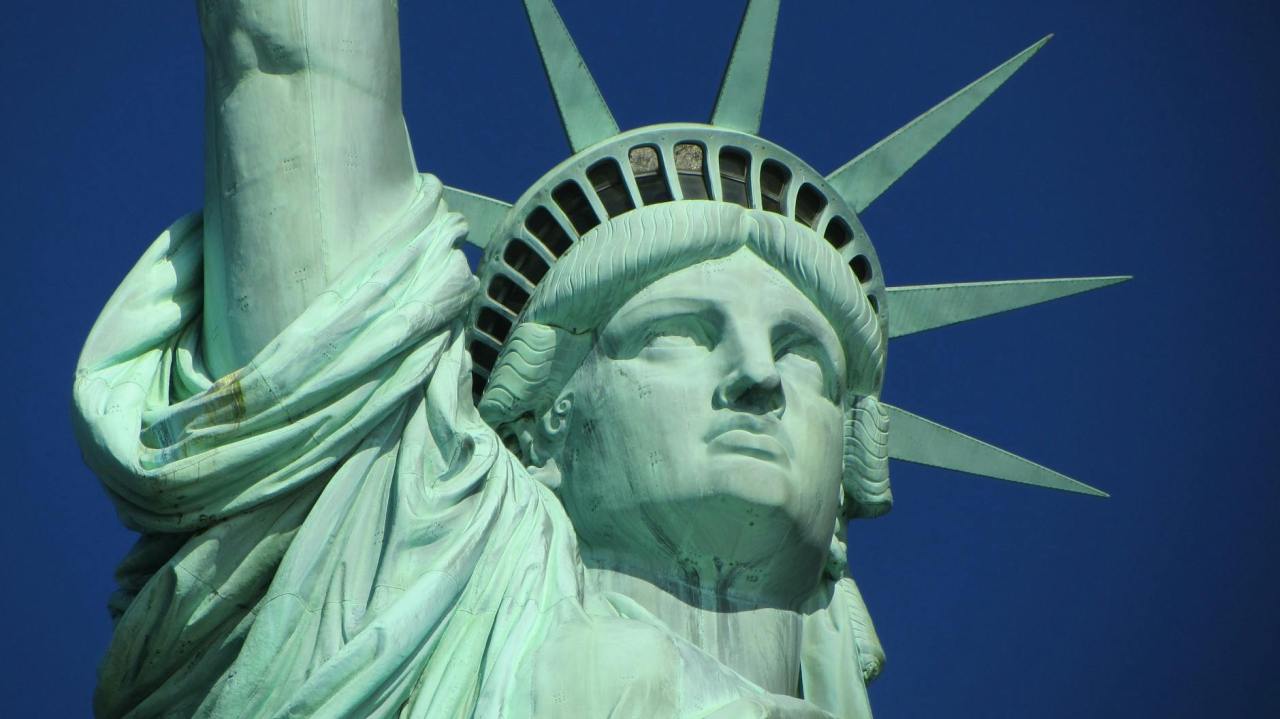
Two days before the bicentennial and Madeline Harper’s tenth birthday, someone rowed an eighteen-foot Statue of Liberty constructed entirely of Venetian blinds and plywood across the rocky Susquehannock River and mounted it atop a crumbling stone railroad pier two hundred yards from shore. No one knows how it got there. Not the police, not the residents tucked astride the hill overlooking the waterway.  Not even Crazy Man who usually walks his dog along the shoreline long past midnight. 

“Mom says had to be more than one someone, you’d most likely kill yourself otherwise,” Maddie’s best and only friend George Peters says between mouthfuls of Quisp. He and Maddie wait impatiently in Maddie’s kitchen for their mothers to walk them down. His mother knows a lot and doesn’t mind reminding folks, though she and much of the town had slept like the dead through the statue’s resurrection. Some drivers do nearly kill themselves. Startled at the merge just outside of town by the unexpected sight of the gleaming white Lady rising from the river bed, they forget to brake and crash into cars slowing for a better view.

Their faint metal squeal cuts through the kitchen window as Mom finishes braiding Maddie’s pigtails too tight. Like braids are ropes and Maddie likely to fly off into the clouds like Aunt Nell or her dad. MIA, says the letter taped to the fridge. Mom says Maddie has his eyes, but Maddie isn’t convinced. His blurry boot camp picture hangs beside the letter, his features indistinct no matter how closely Maddie presses her nose, how thinly she stretches her lids. Mom keeps another picture framed in silver on her dresser. They pose on their wedding day months after graduating high school, his head thrown back in laughter, hers bent shyly to the ground. He wears a borrowed suit, she her best blue dress. There wasn’t time for more than a backyard service, Mom explained once, the draft notice forcing events neither of them anticipated. Nine months later, the sky alight with fireworks, Maddie was born. Bright blue eyes, all red and squalling. “My own Miss Independent,” Mom says each year when Maddie blows out her candles and puzzles over her meaning, over Mom’s mismatched face—smiling mouth, bleary eyes.

Breakfast over, George loops his binoculars around his neck and follows Maddie outside. When they finally arrive riverside, reporters with cameras and pens behind their ears mill among the growing crowd. Maddie and George sprint across the bank.

“Don’t get any closer, you two. It’s low tide now but you fall in, the current’ll get you.” Hatless, Mom blinks in the glare. Sometimes she’s like the butterflies hovering near the schoolyard milkweed—beautiful, soft and fragile. And sometimes she’s like the osprey that nest along the shore, alternately circling and swooping in search of prey. Sometimes Maddie wonders what Mom would be like if Dad weren’t lost, if she’d pick or become something else altogether. Maddie misses her dad, but her missing is fuzzy, like opening her eyes underwater or trying to focus on the smudgy edges of faraway stars.  Nell, however? Mom’s former teacher had claimed Mom and Maddie as her own when Mom’s grief had sunk her into a black so deep no light could penetrate its core.  Nell was more grandmother than the stiff-backed woman Mom took Maddie to visit one disastrous time, and Maddie misses her and the home they used to share with a keen, raw yearning that manifests in the shadowed corners of her new room and sets her feet to running.

She and George stand along the riverbank, toes squishing in the mud as they goggle at the statue. “Isn’t she something? She looks just like the real one. My aunt took me once.” 

Their shoes lie in a heap near Mom, who chats with Mrs. Peters and the ladies from church. The women have a way of studying Maddie that says her father had sinned mighty fierce in first leaving, then neglecting to return home, a sin transferred to Maddie in his unrelenting absence, Mom doing the best she could, considering. Her tongue worries a loose tooth until its socket throbs. A few months before the end of fourth grade, a grim-faced man in shiny shoes had stood in Nell’s kitchen and said they had to leave. Now Nell had passed, the bank was taking over. Maddie kicked his shins and bit his flailing hand hard enough to draw blood. Hard enough to make Mom holler. Not hard enough to change the bank man’s mind. Mom found a new job and moved them across the river into the old Claster house. Her classmates were first curious, then cruel, until Maddie had tired of defending her missing father, her sudden arrival, and walloped Johnny Mack at recess. Fists clenched, unrepentant, she stood in front of the principal’s desk and refused the explanation both he and Mom demanded, but George, who lived next door and saw everything while he and the other boys played kickball, insisted Johnny said a bad word and pushed her first.  Mom cried, the principal reconsidered, and Maddie and George, formerly aloof, became inseparable.

A group of older boys, arms outstretched, pick their way along an outcropping of rock meandering like a bridge from the shore to a few yards beyond the statue’s base. “I betcha I could do that,” Maddie says, mimicking their gestures. “Then I could really see what she looks like. Betcha she’s perfect.”

George brushes off a lens, then lifts his binoculars.  “Nah, you’d fall in and drown. And you’re wrong, she ain’t perfect. Look. Her torch don’t shine. The real one, she’s got a light in her, don’t she?”

Maddie peeks over her shoulder at Mom before inching closer to the water. “I still can’t see. Gimme those, you’re hogging.” Tugging the binoculars from his grasp, she twists them into focus. George shakes his head, sighing. The Lady resembles an accordion or a storybook bumblebee’s giant hive, ribs and arms arranged around a metal skeleton and held aloft on a wooden cross base. Only her face is solid. “Hey, you’re right. Wonder why they went and forgot the light? How you s’posed to know where to go?”

“I d’know. Guess they forgot.” George pulls a skipping rock from the muck and throws. It splashes twice before sinking.

“You’re not doing it right. Here, I’ll show you.” She digs another, draws back her wrist and flicks the stone just hard enough to skip it seven times. One of the boys on the outcropping salutes, and Maddie grins. She walks along the shore in their direction. “Told you. C’mon, let’s get closer. I want to see.”

A low, gravelly bark startles them to a halt.  “Crazy Man,” George says, as a man and his dog scatter the crowd ahead. He lives in a cabin deep within the mountain woods and rarely ventures into town, his dog a beast that gnaws on nosy children. Least that what Johnny says.  Johnny had called Maddie’s dad crazy, too, and names whose meanings she couldn’t ever ask Mom. Up close, however, she struggles to reconcile the man they’re supposed to fear with the man who haunts the riverside. Once, she’d seen his wanderings when– sleepless, restless, her new old house creaking like bones in the damp and chill of night–she’d sneaked out through the window and made her way to the river across which home and Aunt Nell called. A man and his dog had paced the shoreline, the man stopping every so often to pry a stone from the silt and skip it into the waves in longer and longer arcs.

Then as now, Crazy Man wears an olive coat and heavy black boots, tightly laced.  Young, but with old, old eyes, his rough beard covers one end of a scar that scores the ridge of his cheek. Hernandez, Maddie reads along one pocket. He leans heavily on a cane, his German shepherd thumping its tail beside him, and spits into the dirt. “What’re you gawping at, kid?”

Photo by Polina Tankilevitch on Pexels.com

Late morning as they breach the hill heading home, a blue-suited man exits a shiny black car idling in the drive. Mom stills. “Go on and play, you two. Mrs. Peters will be along soon.”

Maddie swallows her protest. Mom looks grey, and one hand tugs her blouse hem straight. George, oblivious, lowers cross-legged to the grass and polishes his binoculars with a corner of his shirt.  “So who you think did it?” 

“Did what?” Maddie strains to hear what the man tells Mom, but the cicadas’ frantic buzz and the bum-bump of her heart dull their voices to an indistinct murmur. He looks like the man at Nell’s house but bendy, rocking forwards and back on his heels like the Towers in New York she visited with Nell last year. Stepping out of the elevator, Maddie had felt the floor shift with the wind’s insistent rhythm and pressed her clammy hands against a wall, refusing to step toward the bubbled observation deck until Nell coaxed her fingers free. This stranger man, fingers splayed on Mom’s back as they ascend the porch, makes Maddie sick and dizzy, too. She sits, then thrusts her fingers into the matted grass at her feet.

“You okay? You look kinda funny.” George’s brow scrunches. “I said, who you think built the statue? I bet it was Crazy Man. Mom says he ain’t got but the one real leg, but he’s strong he is. Not strong enough to do it himself, though. Bet they dragged it to the boat and rowed it across. Ain’t no other way I can figure.”

“Nah. Maybe. Why they call him that anyway?” After chastising George for being nosy, Crazy Man had hobbled with his dog to the water’s edge while Mrs. Peters announced the police said someone reported a missing boat and boot prints alongside the dock. Someone else heard splashing, followed by the burp and fizz of pop tabs, and raucous, young laughter. The man with the missing boat? His neighbor’s neighbor saw several hunched shadows near the launch, one of which limped. Crazy Man’s mouth had twitched as he studied the Lady.

“Cause he is, I guess. Least that’s what my mom says.  She says something about the jungle turned his brain to mush. He wasn’t never the same after it. That’s why you ain’t hardly ever see him. Mom says he don’t like people much. Makes him jumpy.”

Maddie frowns. Not crazy, Mom had explained as they walked home from the Lady. Broken. Like his heart was a puzzle and he’d returned stateside missing pieces.  When Maddie had sneaked out, she’d watched him skipping stones as the sky turned gray, then pink and gold. She finally slept, then woke with leaves in her hair and a long smudge of soil on her cheek. No dog, no man, but at her feet lay a pile of smooth stones as if conjured. She’d cocked her wrist like his and hurled rocks until guilt and a gurgling stomach urged her home.  Mom grounded her for a week. “That’s stupid,” she says to George. “He’s not crazy. He’s got a name.”

“Everybody’s got a name. We should fix it, don’t you think? Make her torch shine?”

Maddie tugs a loose clutch of grass, tossing it toward the stone drive. Shortly after their trip to New York, Aunt Nell fell sick and never got better. Maddie knows all about missing pieces, about homes as foreign and faraway as jungles. Standing, she climbs the porch and peers through the door’s honeycomb screen to the kitchen. A chair scrapes the linoleum, metal plinks against the ceramic edge of a coffee cup.  Mom’s shoulders, hunched toward the table, contradict the rigid angle of her spine. The man leans against the counter and raises a mug to his lips. Maddie stomps down the steps. “Fix it? Now who’s crazy?”

Photo by Erika Quirino on Pexels.com

Long past dark, Maddie listens to the house breathe and her mother’s soft, open-mouth snores. She pushes against her wiggly tooth until it pops free, then tucks it under her pillow and makes a wish. After the man had left and Mrs. Peters collected George, Maddie helped her mom ice her birthday cake. Without candles, its chocolate face looks like the surface of the moon outside her window, all swirls and dips and shadows. Maddie pictures herself flying to the moon, bouncing between stars and peering into the black where souls float.

Is that where Nell and Dad are, Maddie asked, but Mom just sighed and tried drawing Maddie to her lap.  Then she explained the man was a lawyer she’d hired after Aunt Nell’s passing. He told Mom that Nell meant her house for them, but meaning and doing weren’t the same, at least according to the bank. This is our home now, Mom said. No more fighting and no more running. 

Maddie’s throat squeezes. She’d nodded, then knotted her fingers behind her back. This isn’t the same as running, she tells the stars. It’s…finding. Sliding out of bed fully clothed, she retrieves her sneakers and a bulging, canvas rucksack from the closet, slinging the latter about her shoulders. She wedges the window open and shimmies along the porch roof and down the oak whose branches weave a ladder to the back yard. Heat lightning sparks in the distance. The wind stills, heavy and hot, then punctured in intermittent bursts by thin fingers of cold that announce the approaching storm. Digging a toehold in the fence, she swings into George’s yard and whistles at his window. 

A few minutes later George appears, hair in spikes and mouth cracked in a yawn, binoculars once more around his neck. “What the heck you doing here? Don’t you know it’s the middle of the darn night?” Yawning again, he knuckles his eyes, then bends to lace his shoes.

“Course I do. We can’t very well do it in the daytime when everyone’s watching, now can we?” She heads around the corner to the road. “You coming?”

 “Do what? What are you talking about, Maddie? Wait up!” 

“Hush! You want to wake the whole world?” She remains silent until they reach the edge of the block and cross to the baseball fields, down the hill from which the river flows. “I been thinking about what you said. How’s anyone going to know where to go if the Lady’s missing her torch?”

 “Yeah, so? What’s that got to do with anything?”

Maddie rattles her bag. “Don’t you remember what you said?”

“Hunh?”

“At the river? We’re going to fix the Lady’s torch so it shines.”  She drops the bag and rifles inside. “I think I got everything.”

George nudges her aside. “Lemme see. Flashlight… sparklers… tin foil. Hey, where’d you get the lantern? You got batteries?”

“Yup. Matches, too.” Worry skitters like spiders in her stomach. She’d slipped them from the kitchen drawer while Mom washed up the icing, the rest while she thought Maddie sleeping.

“You know we’re gonna get in trouble or killed, I bet. How come you changed your mind?”

“I told you I been thinking.” About Nell and the Lady and Crazy Man’s jumbled heart. About how things can be in two places at once, yet neither whole nor home in either. “How come they put it out there all sneaky like? Like it’s a secret?”

“I d’know. Maybe–”

“And how come she’s broken? She doesn’t have a body either, not really. Maybe whoever made her wants us to fix her. Not just us. Us and everybody else.”

George’s eyes widen. “Yeah. And maybe if her light’s shining…”

 “We can make her perfect like the real one.”

They hurry sideways down the hill, its minor hazards obscured by thickening clouds that  extinguish the moon.

“Aw, man,” says George, slowing as they approach.  The river looks much different at night, breathing and pulsing like a living thing and grabbing with greedy fingers at the scrub along the shore as the tide rises. “Ain’t no way we can get out there now, half the rocks ain’t even showing the water’s so high.”

Maddie huffs through her nose. Her throat hurts worse and the spiders are like the waves slapping the Lady’s base. She fists the bag’s straps tighter.  “You chicken? I told you, all I have to do is walk across those rocks there. I can jump that last little bit and climb on up. Easy as pie. I’ll be careful. Just keep a lookout.”

George scans the shoreline. “I d’know. Mom said the police’re watching. Maybe they’ll think it’s us.”

“Maybe. And maybe they’ll help. Ever think of that?” She walks to the river’s edge, listening for sirens as George follows. Water sloshes against her ankles, filling her sneakers with heavy, slimy muck. She toes them off and kicks them behind George. Following the shoreline to the rock bridge, she pictures the statue illuminated by fireworks, Mom and the townsfolk oohing and ahhing at the Lady’s glistening lamp. Nell had loved fireworks. Said Maddie shouldn’t be scared, they were like flowers bursting into bloom, just louder because they’re celebrating. Not just you, sweetie. All of us. 

A loose stone rolls her ankle. She winces, simultaneously startled by a rumble of thunder and a flicker of movement through the trees. “Hey,” she calls. “Who’s there?”

“You okay?” George, footsteps splashing, sounds thin and faraway.

“Thought I saw something is all.” Maddie strains for a glimpse of the shiny, moving thing, but seeing nothing, turns her attention to the river. Overlapping flashes illuminate the Lady until she glows. With Mom, the path between the statue and the shore had appeared smooth and solid, its edges snug and interlocking as the boys attempted their crossing. Now, the bridge isn’t a bridge at all but a gaping row of broken, jagged teeth through which the water hisses. At least a foot of water covers them, the rock step closest to the Lady slick with mud and bits of river algae that mar its dimpled face and slither shoreward. Dizzy again, Maddie loosens her grip on the bag and lets it fall. She and Nell never got to see the real Lady. The swaying Towers, booming fireworks and jostling crowds made Maddie cry and Nell promise next year as they waited for the train back home. Except next year is today and Nell is gone and the secondhand Lady’s Venetian bones rattle in the storm’s rising wind. 

Maddie holds her breath and jumps.  

Later, she will explain she lost her balance. Thunder cracked and someone yelled and Maddie, mid-step, slipped and fell headfirst into the water, choking on muck and flailing against its sharp and spongy bottom. 

Later, George will say he heard the yelling and next thing he knew Crazy Man was dragging Maddie from the water and pounding her back while Beast howled and growled until Crazy Man whistled, Sit. I thought we were dead for sure, he’ll say, and Maddie will tell him that’s not what happened. Sergeant would’ve never let her drown.

Because in the split second between the jump and the yell and right before the thunder, shadows coalesced into a canoe near where she’d watched him skipping stones, and she remembered something else Nell had said because Mom had said something like it too. That running is good when you’re running to something, like all those yearning souls heading toward the Lady. But running away and blaming? You’ll never find your way home.

 “That’s why you did it,” Maddie says between coughs. She elbows upright, spitting a mouthful of silt. “You’re running like me.”

“What the hell are you talking about? You trying to get yourself killed?” He crouches awkwardly, mouth drawn, cane abandoned between the woods and the river. Beast zig-zags along the shore emitting sharp barks.

George, binoculars tangled from running, launches himself at the man’s back. “Leave her alone or I’ll–”

“You’ll what, kid? Beast, stay.” The dog drops to his haunches, tail thumping, as the man reaches behind him and pries George loose. He Vs their arms upward. “Your friend always this crazy?”

“Hey, lemme go!”

“You finished jumping on me?” 

Maddie laughs. “Nah, he’s not so bad, sir. Honest. Sgt. Hernandez, this is George. I’m Maddie. Told you he’s got a name.”

He releases George and extends a hand to Maddie first, then George who eyes it warily before shaking. “You going to tell me what you’re doing out here?”

She confesses everything then, her words a river spilling its banks, the Lady a bridge spanning the flood.  “You ever been to the real one? My aunt said you can see for miles inside her. Everything looks little, even those skyscrapers. Aunt Nell said things always look different when you stand different. Even scary things.”

“Did she now? She sounds like quite a lady.” His voice rasps like sandpaper on metal. “Speaking of standing…” He thrusts his chin toward the trees. “George, right? I dropped my cane. You mind?”

“Yes, sir. I mean, no sir. I’ll get it.” 

George scurries to retrieve his cane while Maddie rummages through her discarded sack.

“You’re lucky I was here, kid.”

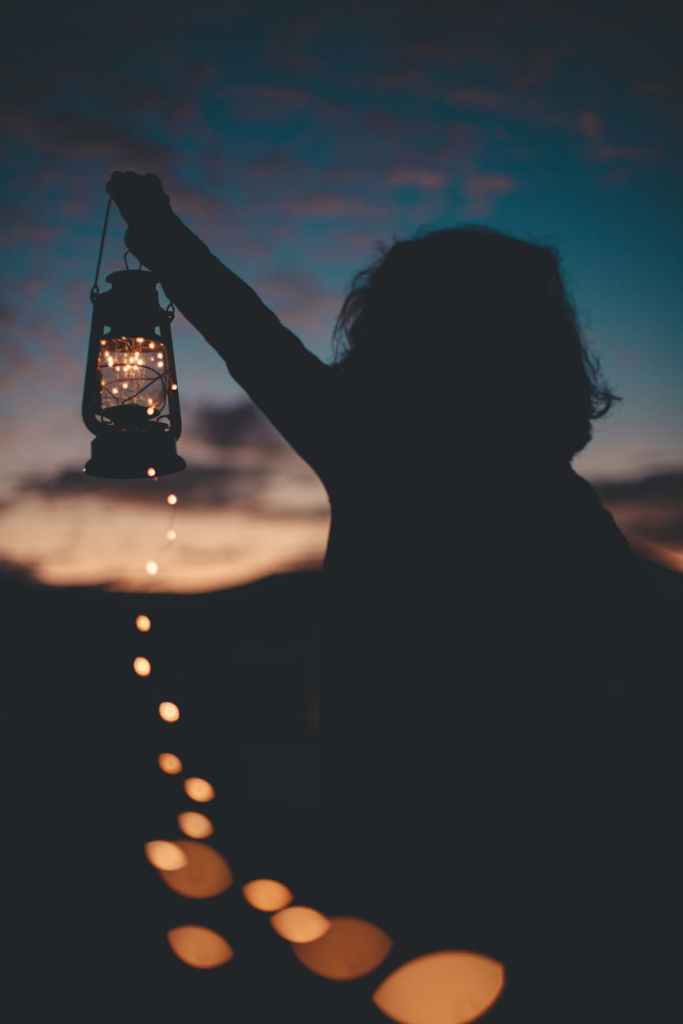
“Uh uh. You’re lucky I was.” She holds out her lantern. 

“What’s that for?”

She gestures toward the statue. “You forgot her light.”

“Me? What makes you think I had anything to do with–?”

“Cause she’s us, isn’t she?”

“Us? What’re you talking about, kid?”

“The Lady.  She’s got holes in her, but she’s not moving.”

“Yeah, so?”

“I told you. She’s us.”

He clears his throat. Beast whines, ears twitching. “Yeah well some things can’t be fixed, kid. Bout time you learned that.”

Maddie shrugs and sets the lantern at his feet. “Maybe. Mom says try anyway.” 

 George returns holding the cane and Maddie’s sneakers, just as the clouds burst in a humid shower. “We should prob’ly get back,” he says. “Before our moms see we’re missing.” 

He heads for the road, leaving Maddie to follow. She shoves her sneakers into the bag, slinging it once more over her shoulders. It feels both heavier and lighter without the lantern, but her throat doesn’t hurt and the dizzy is gone.

The sergeant rolls onto all fours and, using his cane for balance, rises to a stand. Lightning outlines him and the Lady behind as if they are one. “You called me sergeant. How’d you know?”

She points to the patch on his jacket. “My dad had one of those. You look like him.”

He knocks his heels together and salutes. “Go on now.”

Maddie grins, then sprints toward George waiting at the bottom of the hill. She glances toward the river, but Sgt. Hernandez and Beast have vanished along with her lantern, the crunch of boots, the snap of yielding tree limbs proof she hadn’t conjured them with wishing. She wonders where they live, whether George’ll help her find them again. She pictures him and George in her kitchen, Mom slicing birthday cake in four thick slabs, while on the porch Beast laps water from a silver bowl. And when Mom’s not looking, she’ll whisper how perfect the Lady looks with her torch. Our secret, she’ll say, and Sergeant’s mouth will twitch.

Meanwhile, she and George trudge home in silence. The storm, its fury ended, retreats behind the mountains. At Maddie’s house, the kitchen light illuminates her mother pacing the floor, phone cord stretched taut then twisted about her middle. 

“Uh oh,” George says. His own house slumbers black and still. “I can come in with you if you want. She might not be so mad.”

She shakes her head. “Thanks. But I got to fix it myself, I guess.” She heads toward the porch, then turns back. “George? I’m sorry I hogged your binoculars.”

He grins. “S’okay. See you tomorrow?”

“Yeah. See you tomorrow.”

Maddie climbs the steps to where her mother waits.

*****

THE STORY OF THIS STORY

“Bring Me Your Yearning” originally appeared in Dreamers Creative Writing (15 May 2020) and received Honorable Mention in its Stories of Migration, Sense of Place and Home contest.

The Venetian blind Statue of Liberty ACTUALLY existed near my childhood home in Dauphin, Pennsylvania, although I changed the date of its creation to fit Maddie’s timeline. You can see and learn more about that Statue HERE and more about the origins of “Bring Me Your Yearning” HERE.

WHAT I’M READING NOW…

Bury Our Bones in the Midnight Soil by V. E. Schwab.

Earlier this year, I mentioned looking forward to reading it when released and put a library hold on it soon thereafter. Whelp, it didn’t come in and didn’t come in, so I finally bought a copy… the day BEFORE my hold came in.

So far, it’s really good. Darker than what I anticipated, but gorgeous writing, intriguing characters, and a compelling read.

WHAT I’M READING NEXT…

Something from this pile, but I’m unsure which one. Thoughts?

RECENT READS & RECOMMENDATIONS…

I’d never heard of Chris Whitaker until a friend recommended All the Colors of the Dark, which was marvelous. This one, however? Wow.

AND A SHOUTOUT TO…

Neha Mediratta, a writing friend in my StoryADay community, who shared some of her poetry during the Delhi Poetry Slam World Poetry Project Anthology. Take a listen at 1:02:19.

*****

Thanks for reading! Thanks for sharing!

Dear Graduating Class of 2020, 

I hope this letter finds you well. I hope this letter finds you. 

It’s been awhile, since we were all together. Friday, March 13, 2020, to be exact, the last day of our pre-pandemic world. That night, New Jersey’s governor closed our school for two weeks. Two weeks became five, then the remainder of the year. You lost prom and senior trip, the last few precious months of childhood. July’s socially distanced graduation lacked its celebratory soundtrack, its audience, and even many of the usual participants. 

You know all that, yes? You remember?

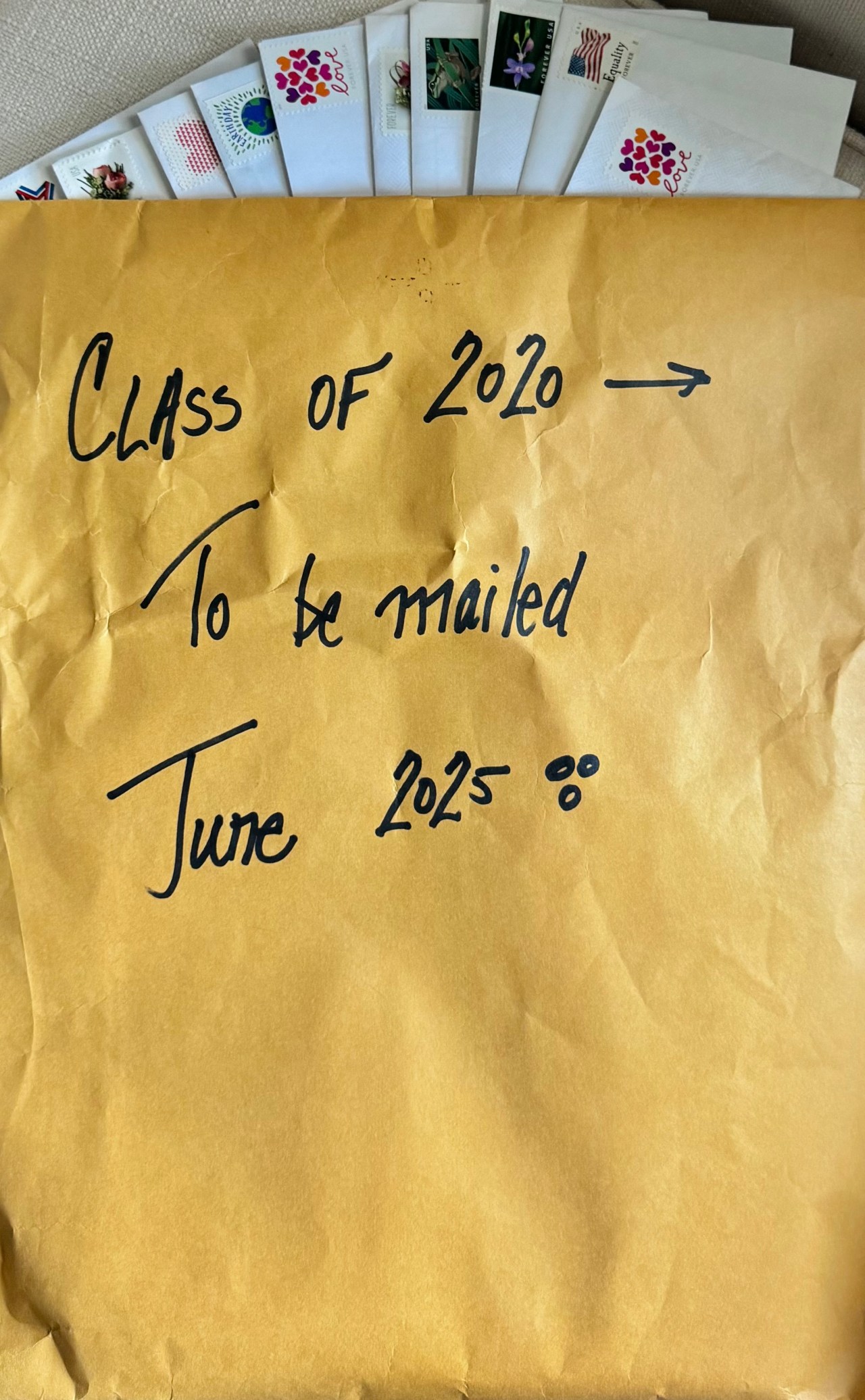
I’m curious, however, whether you remember Santiago and Amir? Do you recall your five-year letters?

It’s okay if you don’t. There’s no quiz and no need to study, though I would like to tell you a story, if you have a few minutes? 

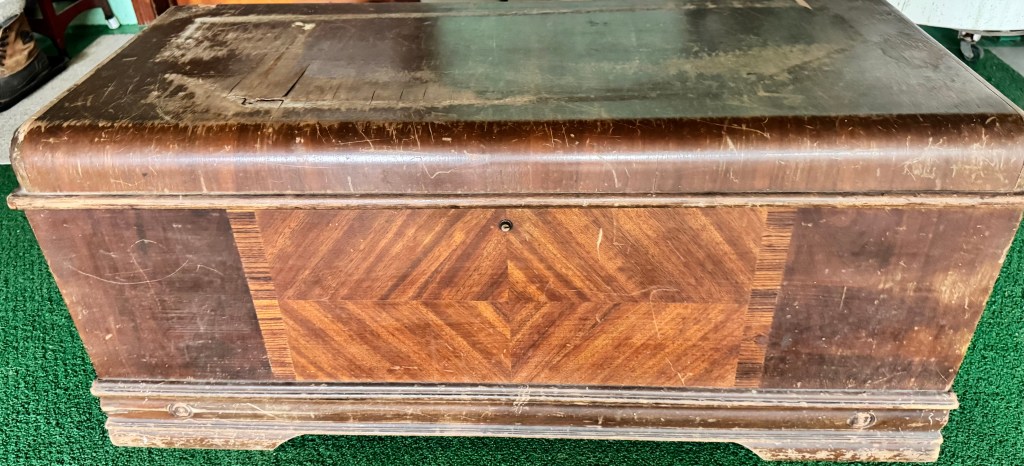
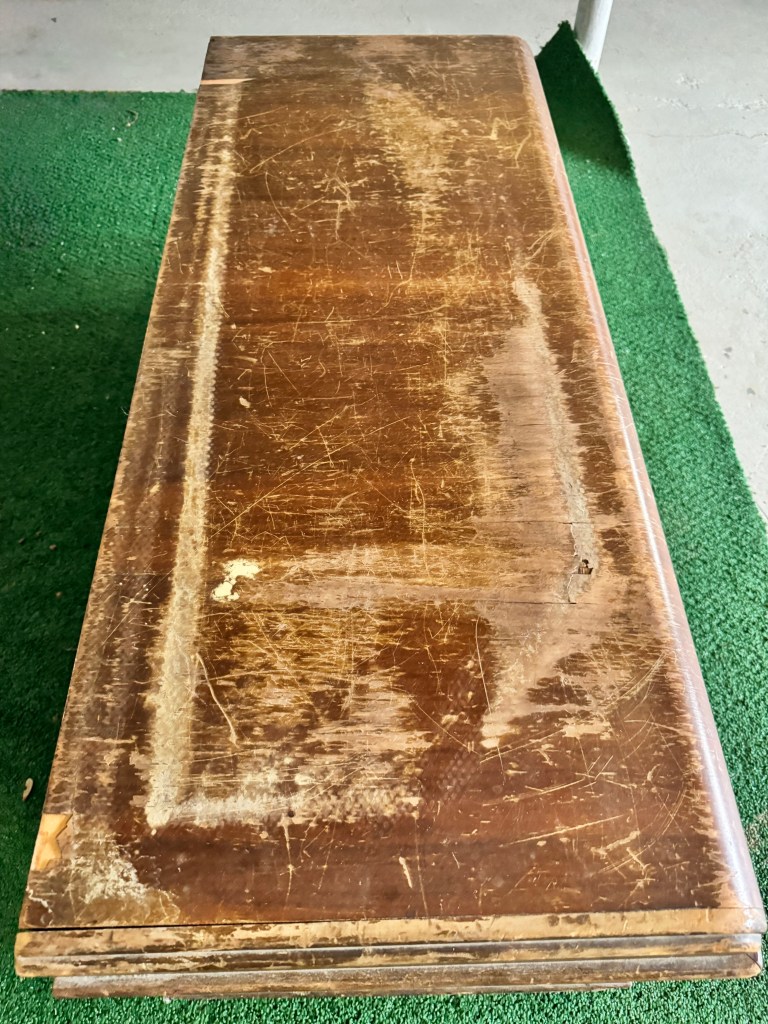
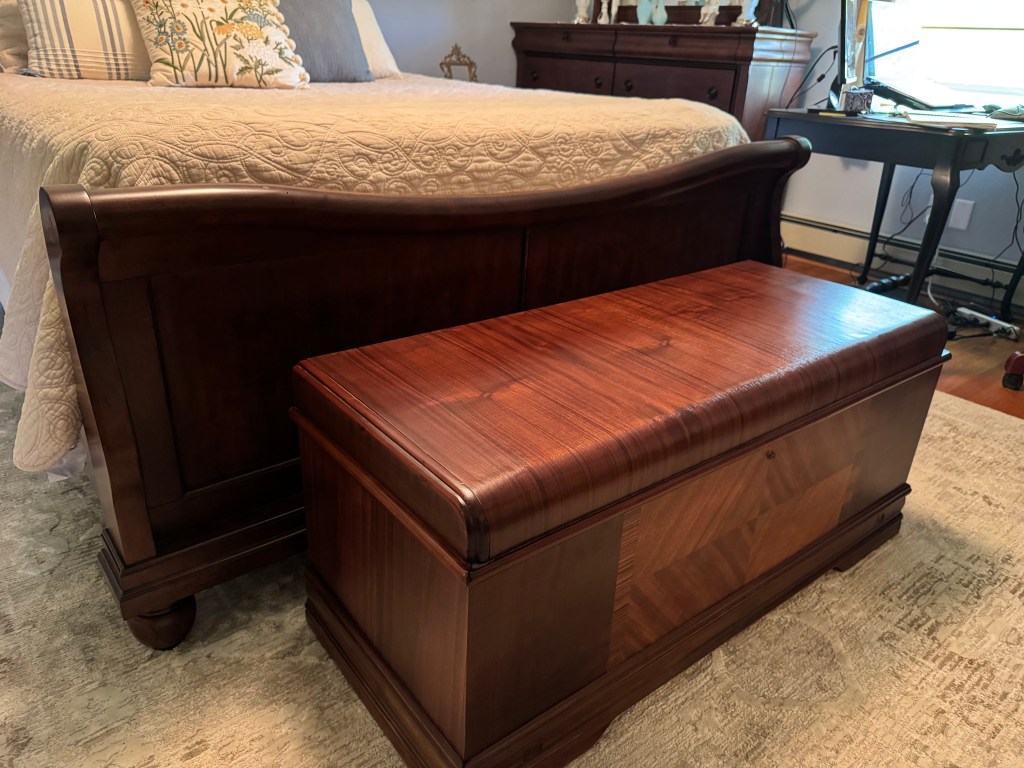
When I was a kid, my father bought a fish tank, filled it with tropical fish, and set it atop my mother’s hope chest, in the basement family room of our Dauphin, PA house. Mom did not want the tank placed there. The chest had belonged to her mother, who had died of ovarian cancer, aged 30, when my mother was only two. My father, however, was a bully. Spiteful and mean and always blaming others for his self-wrought tribulations, so of course he ignored Mom’s wishes and of course the tank leaked and ruined the chest’s beautiful art deco veneer.

She never forgave him.

Because of course, he never apologized for his damage nor repaired it–he didn’t even try–and my mother’s warped hope chest migrated throughout the house, then to Maryland and Florida when—decades later—Mom became unable to live independently and moved in with my younger sister. Somedays, she stored her mementoes inside. Somedays, blankets and clothes. And someday, Mom told me, the chest would become mine. By then, my parents had divorced, and I had married and had refinished a few pieces of furniture that graced our new home. Surely I could restore Mom’s piece, someday.

But, I neither needed nor wanted my mother’s hope chest. 

At all.

Because it was, I thought, beyond repair. Because it smelled not of cedar but decay and evoked memories that wafted like poison through my well-being. I wanted none of that in my house, in my life. If ever she gave it to me, I would store it … somewhere, or set it by the curb on trash day and not tell her. She would be devasted otherwise, I knew.

See, I did not want my mother’s hope chest, but I also did not want to hurt my mother by refusing her gift. Because it was a gift, an irreplaceable symbol of our shared and troubled history, and she had faith in me that I would care for them–both the object and its stories–in ways that she could not.

What to do?

Remember how Amir asks Baba that same question in The Kite Runner, when Baba is diagnosed with cancer? Remember how Santiago asks the Alchemist, when the tribesmen threaten to kill him if he doesn’t turn himself into the wind?

Funny, isn’t it, how you can be at one stage of your life and think you have all the information you need to decide… whatever it is you need to decide… while at the same moment you’re thinking about the future and realizing you have zero idea what’s for dinner today let alone where you’ll be and what you’ll be doing five months or even years from now. 

Many of you were like that, five years ago when I assigned you to write a letter to your future selves, which I would keep and mail in June 2025. 

In June 2020, you knew only what had been stolen from you. What you had lost. You were grieving and you were angry and you had no guarantees–none of us did–about whether or when or how the pandemic would end. About whether or when life would return to normal. Whether ‘normal’ would ever again exist.

Now, five years later, you know. 

You’ve lived it. 

Though not in the same ways as I lived it or any of your other classmates.

Yet here we are in 2025, and I’m wondering, What will your reactions be upon receiving your five-year letters? Upon reading what you wrote to yourselves, what you hoped, in June 2020?

I hoped, as the pandemic unfolded, that our shared catastrophe would serve to unite us. To make us better human beings.

I was wrong.

Five years later, our country seems more divided–more selfish and destructive–than ever. More focused on being right than living right. 

More like my father, whose worldview still sickens me.  His world only had space for those who looked like him, believed like him, spoke like him.

He died January 2023. We hadn’t spoken in nearly twenty years.

My mother died January 2024. We spoke nearly every week.

You know, yes? That the story I just shared isn’t merely about an old piece of furniture?

By the time my sister drove from Tampa to Pennsylvania in June 2024 to deliver Mom’s hope chest filled with her books, I’d long ago decided I would restore it somehow. I would make the chest beautiful again, the way our mother’s mother would have recalled it when she was young and beautiful and life stretched before her in all its infinite glories.

I decided I would restore it, because I’d long ago decided that the answer to every iteration of the question ‘What to do’ must be to create, not destroy. To hope, not to despair. To act, not to wallow, and in so doing effect a world wherein achieving your ‘personal legend’ isn’t merely a dream but a possibility.

For all of us. 

I have faith in you, that you want such a world as well. 

I have faith, that you will strive to do what you can to create it. Because whether or not you ever have children, whether the universe gifts you few years or many, you will leave your legacy behind. We must all leave our legacies behind, someday.

And I wonder, What will your legacy say? What will the future think of you, having read it?

Meanwhile, check your mailboxes. I’m mailing your five-year letters next week. 

I hope your letters find you well. I hope your letters find you. 

Serenity. Courage. Wisdom.

Peace to you and yours.

Mrs. Reisinger ❤️

*****

APPARENTLY, YOU CAN TURN LEAD INTO GOLD

Too bad Santiago’s friend the Englishman didn’t pack Cern’s Large Hedron Collider. Recently, a “team of scientists from 174 physics institutes in 40 countries” accidentally turned lead into gold while conducting experiments designed, in part, to mimic “conditions in the universe during and just after the Big Bang.”

Restoring my mother’s hope chest wasn’t quite as elaborate a process. Because I wasn’t confident I could replace its veneer without causing further damage, I hired a professional, the same craftsman who restored three barn finds for my upstate writing nook.

This is what it looked like pre-restoration. Can you see the holes in the veneer?

An this is my mother’s hope chest fully restored.

Isn’t it gorgeous? Not bad for nearly 100 years old. Thanks, Peck’s “Second Chance” Furniture Restoration!!

No more fish tanks or basements–it’s next to my writing nook in a spare room of our home away from home.

Pretty sure Mom would be thrilled 🩷

*****

THE VERY HUNGRY HACKSAW, or How my StoryADay May became StoryADay MayNot…

I blame Hubby. 

Although I’d been a bit under the weather and started the challenge a few days late, by day eight I’d caught up, and by week three I’d only skipped two prompts. (I was allowing myself no more than one per week, if needed.) Thanks to day three’s prompt, I even had a recurring character and several linked, rough story frameworks.

Cue the hacksaw.  

(This next bit is a bit gross, by the way.)

While replacing his cant hook’s broken wooden handle, Hubby used said hacksaw to cut off a frozen bolt. Instead, said hacksaw nearly cut off his index finger. 

Thank goodness it didn’t. Thank goodness he only needed four stitches and a tetanus shot, and thank goodness it was his left hand, not his right.

Cue the cliches, Accidents happen. 

But, we were six hours from home when it happened and trying to take care of STUFF and MORE STUFF before heading back and, while I am very much in control mid-crises, I tend to lose it after the fact. Which is why I fell off the StoryADay wagon 21 days in–my brain was too busy catastrophizing and my minutes were too busy prioritizing. 

I’m better now, thanks, but more importantly so is he, even though I nearly killed him when he said he’d remove the stitches himself, he’d seen how they’d done it, last time he’d needed to be sewn closed. 

((Sigh))

Fortunately for both of us, he let the professionals handle it.

SORRY, KEANU. I REALLY WANTED TO LOVE YOU, but…

I am not your target reader. 

The scone was delicious, though! And the tea 🙂

If you’re ever in Oil CIty, PA, check out Woods & River Coffee, located one block from the Erie to Pittsburgh trail AND one block from the library. Win, win!!

WHAT I’M READING NOW…

Erasure, by Percival Everett. Only halfway through and I’m wondering exactly why it didn’t win the 2001 Pulitzer? 

WHAT I’M READING NEXT…

Six Days in Bombay, by Alka Joshi. I really liked her debut novel The Henna Artist, and when I saw her latest on my library’s New Fiction shelf I had to check it out. It’s due back next week, so I need to get reading.

RECENT READS & RECOMMENDATIONS…

None were what I expected. All stuck their endings and I would reread them all, given time and opportunity.

I also read Fourth Wing by Rebecca Yarros for the inaugural meeting of the Mother-Daughter Book Club. We chatted over drinks and dinner, then (in keeping with the bookish theme) watched Alibi (a play based on an Agatha Christie novel) at a regional theater. A lovely, lovely evening, even though neither one of us figured out whodunit 🥰

A SHOUTOUT TO…

My writer friend and fellow StoryADay Superstar Astrid Egger whose short story “Hippocampus” appears in Sea and Cedar’s spring issue. Scroll to page 55 to read. You won’t be disappointed!!

COMING UP ON MY NAME WAS SUPPOSED TO BE ELIZABETH ANN…

Next up in July, I’ll be celebrating Independence Day with an original short story very loosely inspired by true events. Also, an update on my longer project, which thankfully I did not abandon during StoryADay.

*****

Thanks for reading! Thanks for sharing!

*****

(WARNING: The following contains spoilers for Jim Shepard’s “Privilege.”)

In June 1972, the summer before my family and I moved from Philadelphia to Dauphin, Hurricane Agnes pummeled central Pennsylvania and flooded its Harrisburg capital, a scant seven miles from our soon to be constructed house. Even after we settled, its damage could be seen in the ravaged faces of Front Street’s storied mansions and the high water marks that scarred the Rockville Bridge’s stone arches along the Susquehanna’s East Shore.

During the dozen or so years before I moved away to college, then again to near Philadelphia, the Susquehanna overflowed its banks a few times more, sometimes because of excessive rain. Sometimes because of broken ice floes damming its progression through the maze of rock and abandoned railroad pilings jutting from its bottom. Although flood waters never reached my childhood house, perched as it was along Peter’s Mountain Road’s meandering upward slope, they did fill the Dauphin Narrows roadway like a bathtub, thus cutting off the town’s only direct access to Harrisburg and its surrounding suburbs. Krafts Market sat half a walkable mile downhill, Robinsons’ half an easier mile up, but then there were no doctors locally nor pharmacies, and should accident or illness require hospitalization, ambulances needed to detour over the mountain to Halifax or Tower City–an hour loop during even the best of weather, two hours round-trip from our home. Mid-winter 1982, my mother made that harrowing journey with my baby sister when she fell in her classroom and broke her left arm.

Note to self: Mary Janes’ slippery soles do not pair well with linoleum.

While Hubby fished on a recent Sunday, I sat on the bank annotating “Privilege.”

I recalled those events while reading Jim Shepard’s “Privilege” in The Best American Short Stories (2024), ostensibly about the catastrophic Johnstown Flood of 1889. A few pages in, I was tempted to stop reading. I wasn’t initially keen on the characters, and its omniscient narration and formal tone seemed an ill-fitting part of a modern anthology. As a child, I’d learned about that historic event in the context of my own region’s periodic flooding and wondered, shortsightedly, What else could there be to say? 

Nonetheless, I continued reading, because “Privilege” and three other pieces were next up in my StoryADay community’s online book club and because I can’t not do the homework. More importantly, I wanted to understand why anthology editor Lauren Groff considered “Privilege” one of 2024’s best when its plot focuses on an event 135 years distant. 

A bit of a history lesson, for those unfamiliar with said event:

Construction on Johnstown’s South Fork Dam began in the 1840s as part of Pennsylvania’s canal system and was completed in 1853, having experienced work stoppages that contributed, in part, to structural damage weakening its long term integrity. In 1854, the original owner went out of business and the dam and its reservoir were sold to a series of owners who not only failed to repair and maintain the dam adequately, but also made modifications that further eroded its structural integrity. In 1875, owner and US Congressman John Reilly removed five sluice pipes at the dam’s base, “aggravating a sag at the top of the dam [which made] it more susceptible to overtopping and limited…options [to safely remove] excess water.” Pittsburgh’s South Fork Fishing and Hunting Club , which “counted many of Pittsburgh’s leading industrialists and financiers among its 61 members,” became owners in 1879. According to Heritage Johnstown, “The club did engage in periodic maintenance of the dam, but made some harmful modifications to it. They installed fish screens across the spillway to keep the expensive game fish from escaping, which had the unfortunate effect of capturing debris and keeping the spillway from draining the lake’s overflow. They also lowered the dam by a few feet in order to make it possible for two carriages to pass at the same time, so the dam was only about four feet higher than the spillway. The club never reinstalled the drainage pipes so that the reservoir could be drained.”

On May 31, 1889, after unrelenting downpours, Johnstown’s South Fork Dam collapsed, killing more than 2200 people in the resulting flood and fires.

“Privilege” opens on that day, a few hours before the collapse, and remains relatively faithful to its historical timeline, alternating among omniscient narration and multiple POV characters, many of whose names pay tribute to the deceased.

Conventional writing wisdom holds that short stories are too short to bear the narrative weight of multiple POVs. Likewise, readers are more likely to empathize with victims of great calamity if the calamity’s scope is narrowed, if its agonies are assigned to one sufferer who can then be made to represent the larger group.

Shepard violates those conventions, brilliantly. “Privilege” is a mosaic, each character representative of their demographic, each character’s story arranged like colored stones, with three characters triangulating the story’s focus: Jenny Berstrom (stuck on a train from nearby Altoona), John Parke Jr. (the Club’s onsite resident engineer), and James Singleton (living with his wife Lucinda and sister Flora in a tenement house near the river). Jenny escapes death by scrambling up a hillside, Parke by positioning himself upriver, and James by random chance. The deluge–twenty million tons of water and rail cars and oil and wires and splintered buildings, also the carcasses of dead animals and neighbors–had slammed into his wood frame home and knocked him unconscious. When he awakens, buried beneath a debris pile near the town’s center, he knows neither how long he had remained unconscious nor the fates of his wife and sister, both of whom he had thrust into the attic moments before the house exploded from the water’s force. 

Readers know their fates, however. Omniscient narration allows us to witness Flora’s final, horrific moments and to “hear” an unnamed, barefoot survivor’s thoughts on Lucinda. Two days after the flood, James meets that woman and two others preparing a humble meal amid what remains of a collapsed home’s kitchen. After sharing some of her experience aloud, she grows overcome by her own suffering and the others’ “mournful silence” and keeps to herself that she’d been pushed rooftop and saved by “someone clinging to [its] gutter.”  That someone–Lucinda–died, “gone down with her hands raised above her head. In keeping that to herself, the barefoot woman denied James any chance of imagining accurately, as it would have transpired, that he had been allowed a glimpse of his wife Lucinda’s end.” Instead, as the story’s final sentence tells us, she fabricates a sling for his broken arm and the four share slices of ham on the “one plate available, so that each could take their turn as the plate was passed, and everyone could enjoy their portion” (280).

That ending left me stunned, its final image so fraught with meaning I understood why Groff had included the story and felt immediately compelled to reread it to determine how Shephard had worked his magic.

See, each character does “take their turn…and…enjoy their portion,” yet neither is equal. Neither is equitable. We see that disparity in the story’s juxtaposition of Jenny’s history and conviction in the opening scene with James’ deprivation at the end. Likewise, we see it through the contrast between Parke’s insufficient attempts to prevent calamity and Club members’ ignoring repeated warnings about their modifications to the dam.

Ultimately, one’s class, ethnicity, and physical location played an outsized role in determining whether one lived or died.  

This infuriated Jim Shepard who, like me, had never learned of the Club’s role in the disaster and did not know that the tenements in which the poorest residents lived had been built on “flats that the local Iron and Steel Works had created with a fill of refuse and ash,” contributing to the desolation. 

As he explains in the anthology’s Contributors’ Notes, he discovered this information accidentally, but “knew [he] had come across another way of talking about the grotesquerie of American economic inequality.” He took his story’s title from the title of “the Johnstown Tribune’s first editorial following the disaster,” in which editor George T. Swank pushed back against those claiming divine forces were responsible, writing, “‘We know what struck us, and it was not the hand of Providence. It was the work of man” (364). 

*****

In the scene introducing James, before the dam collapses, we learn his tenement, though humble, is rich with books and magazines because he values learning and strives to educate himself. “He told Lucinda that sometimes he pinched himself at the portion he’d been allotted. To learn whatever he wished and to be able to share in Creation’s bounty: he recognized the gift of these privileges. Their children would go to school with white children” (264).

Read that again: “he recognized the gift of these privileges.”

In that same scene, we learn James is “colored” and left the South with Flora when he was seventeen. 

(You may want to do the math. I did.) 

The word privilege means advantage, but it can also mean honor. To be honored. James understands that and lives accordingly, grateful and awestruck by its gifts. Thrilled to be able to share them.

Club members? They wear privilege like jackboots. They hoard resources rather than share and chose their own pleasure and profit over others’ likely suffering. Though a few Club members donate funds to relief efforts, most do not, and some claim–despite all evidence to the contrary–that “certain elements” had blown up the dam. Nor do any of them ever admit responsibility for the dam’s failure or face judgment in court. 

So yes, “Privilege” is ostensibly “about” a flood, but more importantly, I think, it’s about our flawed priorities. Our myopia. Our tendency to value some lives more than others, to allow self-interest to override basic human decency. 

I read the news. I watch TV.

We haven’t learned much in 135 years, have we?

I don’t know about you, but I’m ready for a different story.

To reach the fishing hole, we had to hike a few miles through the woods in mud season. My muck boots used to belong to my son & are 3 sizes too big but much better than getting stuck.

Although my sister’s fall was accidental and she complained repeatedly that her arm hurt, the school official who informed our mother believed Renee was faking injury, because Renee is left-handed and didn’t want to do her assignments. Our mother thought so too, until after she’d collected her from the nurse’s office and brought her home and her arm swelled and refused to move properly and the two of them looped the mountain twice–Once for x-rays, once to cast her broken arm–because boulders of broken river ice had caused the Susquehanna to flood. Decades later, Renee and her young daughter visited Mom (then, still living in Dauphin) and, on their drive home to Maryland, stopped at Front Street’s Fort Hunter to see the ice floes, because her daughter didn’t believe rivers could freeze.

Sometimes seeing is believing, and sometimes we only see what we want to believe.

And sometimes we wear blinders to ignore what we refuse to see.

The Johnstown Flood remains Pennsylvania’ worst natural disaster. The floods caused by Hurricane Agnes, the worst in Harrisburg history.

They are not, however, the worst natural disasters our country has seen. Since 1980, the number of weather-related disasters in the US has risen dramatically. 403 of them caused $1 billion or more in damage (CPI adjusted to 2025). Of those 403 weather-related disasters, 27 occurred just last year, in 2024.

The journal Science reports that 75 percent of North American birds are in decline. Washington State University researchers warn 70 percent of honeybee colonies will be lost in 2025. 39 US states and 143.3 million acres of farmland are currently experiencing drought, and the ten warmest years on record have occurred over this past decade.

Look, I’m not a climate scientist and I’m not going to pretend I know how to fix those alarming trends.

However, I do know how NOT to fix them. I do know how to make our shared crisis worse.

Ignore the experts. Whitewash the data.

Purge resources from government websites. Pour resources into pollutants.

Yank research funding without warning. Revoke visas without due process.

Censor. Stifle. Threaten.

And above all, keep wearing your blinders.

Keep wearing your effing jackboots.

*****

SPEAKING OF SHORT STORIES …

May is the sixteenth StoryADay writing challenge and my seventh year participating. Have you joined yet? You can check it out here HERE and sign up to receive daily prompts HERE.

I appreciate creator and founder Julie Duffy’s emphasis on making your own rules for your own needs and circumstances. This year, I’m treating the prompts like warm-ups or story sparks, focussing more on generating ideas for later rather than drafting mini-stories like I usually do. I’m also giving myself permission to skip one prompt a week AND permission to return to missed prompts if needed. See, I don’t want to stop working on my longer project and I don’t want to skip the challenge. This plan, I’m hoping, will allow me to balance the two and not lose momentum.

Here’s my notebook for the challenge. This year I checked that it had been bound correctly BEFORE I left the store.

New year, new challenge, new notebook

SPEAKING OF MY LONGER PROJECT …

It’s still chugging along. April, I focused on drafting Act 1 & 2 chapters for POV character 2 and finished (shockingly) one day ahead of schedule. I say shockingly because two chapters in I realized I needed to revise nearly every scene I’d previously drafted for her. Some, I reorganized. Some, I chucked. Bottom line? I like this version much, much better. It’s definitely becoming a book I would love to read.

BUT.

I’m not confident I can write it the way it needs to be written. I’m not confident I have the requisite skills.

But, I’m okay with that. For now.

For now, I’m showing up at my desk every day and trying to tell the story I want to tell, the best way I know how to tell it, and yes I’m still having fun doing it 🙂

HAVE A FEW MINUTES TO READ A TERRIFIC SHORT STORY?…

Check out this flash piece by my writer friend and fellow StoryADay SuperStar Walter Lawn. You won’t regret it. 

WHAT I’M READING NOW…

The Maid’s Secret by Nita Prose, because I’ve read the other two in her Molly the Maid series and I wanted a cozy, fun read. So far, it’s both.

WHAT I’M READING NEXT…

Fourth Wing by Rebecca Yarros, because my daughter said, ‘Hey Mom. We should do a mother-daughter book club.’ And I said, ‘You pick the book. I’ll read whatever.’ Because, more time with my daughter AND chatting books?  ❤️

Erasure by Percival Everett, because James wowed me and I wanted more. Also, I heard there’s a decent film adaptation but of course I have to read the book first.

RECENT READS & RECOMMENDATIONS…

Nine Perfect Strangers (Liane Moriarty), After That Night (Karin Slaughter), The Jackal’s Mistress (Chris Bohjalian), and Before We Were Yours (Lisa Wingate)

Although, I don’t really agree with the genre sticker on The Jackal’s Mistress. At all.

NOTHING AT ALL TO DO WITH BOOKS…

My daughter and son-in-law recently adopted a miniature dachshund.

Say hello to Ezra!!

Isn’t he the sweetest?

More pupdates soon!!

COMING UP ON MY NAME WAS SUPPOSED TO BE ELIZABETH ANN…

Next up in June, ‘Dear Graduating Class of 2020: A Letter to my Former Students.’ I cannot believe it’s been FIVE YEARS already 🥺

And in July, I’ll be celebrating Independence Day with an original short story very loosely inspired by true events.

*****

Thanks for reading! Thanks for sharing!

I’ve shared how, during Covid, my concentration suffered and I struggled to read for pleasure works longer than poems and short stories. Then, I was still teaching, and mornings while my family still slept I drank a solitary coffee in the predawn hush and read the Academy of American Poets’ emailed poem-a-day before opening my virtual classroom.  

Each poem was short–more ode than epic–and from a mix of contemporary and classic poets. Some I liked, of course. Some I did not. Nonetheless, that new routine helped quiet my anxious mind. In 2020, the world seemed an ugly, unrecognizable place, yet each inboxed poem seemed a gift. A reminder that once upon a time we were capable of such beauty. 

Perhaps we could be so again?

Before Covid and before state and district testing mandates wreaked havoc on our instructional time, my English department colleagues and I celebrated National Poetry Month each April with our students. While our classroom activities differed, all focused on encouraging students to read and share poems from various American and international poets, including self-selected poems for Poem in Your Pocket Day. We also encouraged students to write and share their own poetry, eliciting a chorus of the expected groans and complaints. In real life, after all, no one needs poetry. 

Or do they? 

Consider Nobel laureate Wisława Szymborska’s answer to that very question:

Some Like Poetry

Some–
that means not all.
Not even the majority of all but the minority.
Not counting school, where one must,
and poets themselves, there will be perhaps two in a thousand.

Like–
but one also likes chicken-noodle soup,
one likes compliments and the color blue,
one likes an old scarf,
one likes to prove one’s point,
one likes to pet a dog.

Poetry–
but what sort of thing is poetry?
More than one shaky answer
has been given to this question.
But I do not know and do not know and clutch on to it, 
as to a saving bannister.

(Translated from its original Polish by Joanna Trzeciak)

The above poem appeared in The New Yorker, October 21, 1996.

For years, I’d kept a yellowed cut-out among miscellaneous poems I adored. However, when I sat down to write this post, I realized I’d lost my clipping and searched my shelves and online for a copy, finding in both media a translation that did not match the one I recalled so well. Here is that translation, as it appears in Map: Collected and Last Poems (2015):

Some People Like Poetry

Some people–
that means not everyone.
Not even most of them, only a few.
Not counting school, where you have to,
and poets themselves, 
You might end up with something like two per thousand.

Like–
but then, you can like chicken noodle soup,
or compliments, or the color blue,
your old scarf,
your own way,
petting the dog.

Poetry–
but what is poetry anyway?
More than one rickety answer
has  tumbled since that question first was raised.
But I just keep on not knowing, and I cling to that, 
like a redemptive handrail.

(Translated from the original Polish by Clare Cavanagh and Stanisław Barańczak)


They almost seem like two different poems, don’t they?

Which is not to say I can read or understand Polish, nor can I weigh in on which translation is more accurate, or whether and to what extent Szymborska herself approved of her translators’ efforts. I can only say that, upon discovering the second translation, I had such a jarring reaction of, This just doesn’t sound right. This isn’t the poem I remember. It doesn’t have quite the same meaning. 

Why?

As Paul Roache explains in his Introduction to The Oedipus Plays of Sophocles, one of the trickiest challenges for translators lies in deciding how much to adhere to the meaning of the original as opposed to adhering to the sound of it. Remaining simultaneously true to both is difficult, if not impossible, particularly with poetry. “For if poetry lies somewhere between meaning and music, sense and sound, it is obvious that when meanings cross the barrier of different tongues they do not take their music with them: they have to assume new sounds and these new sounds may not be the aesthetic equivalent of the original….It is, then, not merely differences of meaning that control difference of feeling, but also differences of sound.”

And those differences matter, I say.

A lot.

Let me show you.

Reread each of the translations’ final stanzas. (The boldface is mine.)

Translation 1: 

Poetry–
but what sort of thing is poetry?
More than one shaky answer
has been given to this question.
But I do not know and do not know and clutch on to it, 
as to a saving bannister.


Translation 2:

Poetry–
but what is poetry anyway?
More than one rickety answer
has  tumbled since that question first was raised.
But I just keep on not knowing, and I cling to that, 
like a redemptive handrail.

Now read them again, this time aloud. 

What do you notice? 

Even your mouth and tongue move differently, yes? Your physical body recognizes their difference? Translation 1 contains one more syllable per line and one fewer comma than Translation 2, and both contain dissimilar accent patterns and consonant to vowel arrangements that affect fluency and pronunciation. 

Now consider syntax and word choice. Translation 1’s pronoun “it” seems to refer to poetry, whereas Translation 2’s “that” refers to not knowing, and each persona clutches and clings to different objects. 1’s “bannister” is a structure, comprised–in part–of 2’s “handrail” (a narrow metal or wooden bar.) In other words, a handrail is part of a bannister, but a bannister is not part of a handrail. Also notice the adjectives describing each object. Merriam-Webster defines “saving” as preservation from danger of destruction, whereas “redemptive” means offsetting or compensating for a defect.

This reader prefers the bannister’s solidity, its stability and reassurance–One will not fall, holding onto such a structure.  

But the handrail’s promised redemption in Translation 2? 

Oh my, yes. I want that, too.

As Szymborska tells us, no matter its form or language or our subjective “likes”–Poetry stabilizes our uncertain steps. And as her translators remind us, that creative force both saves us from annihilation and redeems or heals our defects.

Of which, unfortunately, there are many.

Eventually, I accessed The New Yorker’s archives and saved a copy of  “my” poem, as delighted with my rediscovery as if meeting a dear friend. However, hunting for the “right” version reinforced my awareness that true understanding, of anything really, arises not from stasis or censorship or erasure but within the give and take of conversation.

That’s why we need poetry, that’s why we need the arts. That’s why we need humanity’s glorious, diverse creators. 

Now more than ever. More even than we did in 2020.

Poetry, I think, speaks to and of the best of our humanity. 

Let’s listen, shall we?

*****

APRIL IS NATIONAL POETRY MONTH…  

And tens of millions of readers celebrate worldwide. Want to join us? Check out poets.org for ways to celebrate, including participating in Poem in Your Pocket Day April 10. 

THIS YEAR’S POEM IN MY POCKET is

Mary Oliver’s “Don’t Hesitate.” In recent months, I’ve seen her poems in random online publications, then CNN’s Good Things newsletter featured “Don’t Hesitate,” after which of course I had to purchase Devotions, a self-curated and wonderful collection of poems from her over five-decade literary career. Here is my Pocket Poem, on page 61 of Devotions.

I love this poem, because it is a deceptively simple and straightforward response to what I see as  humanity’s destructive urges: Find beauty, celebrate it, create it, share it. After all, “Joy is not made to be a crumb.”

What poem will be in your pocket April 10?

TEN OTHER POEMS I WOULD PUT IN MY POCKET

“A Poison Tree” by William Blake 

 “Things” by Jorge Luis Borges

“my dreams, my works must wait till after hell” by Gwendolyn Brooks 

“War Poem No. 96”  by Stephen Crane 

“Fire and Ice”  by Robert Frost 

“The Hill We Climb”  by Amanda Gorman 

“Mother to Son” by Langston Hughes 

“Truth”  by Maxine Kumin 

“Good Bones” by Maggie Smith

“Nothing Twice”  by Wislawa Szymborska

WANT POEMS IN YOUR INBOX?

Check out  poets.org Poem-a-Day, The Poetry Foundation, and The Paris Review. I subscribe to all three, and whenever I discover a keeper, I print a copy and tape it to my calendar to “discover” again later. 

Yes, this is the same Mary Oliver poem as above, but from the CNN newsletter I mentioned. I taped it to my birthday week to remind myself that every day is a gift. Notice the different layout? Visually, it seems more exuberant than the book’s more traditional format. What do you think?

(Speaking of gifts, I spent a lovely birthday afternoon poking through antiques shops with my daughter, followed by dinner out with the family ❤️. Those are tags from the treasures I found, but no, I did not pay that much. I lucked into some really terrific deals🙂. Definitely a joy-filled day!!)

SPEAKING OF POETRY…

Let me introduce you to my poet friend and fellow StoryADay Superstar ROBIN MAYER STEIN and two of her recently published poems:

Memory and Music

The other day someone said something,
Just a word or two, and I thought of you
As I walked home in violet evening.
A vee of dark birds flew over the house,
Shrieking. I watched until they passed.

Now I listen to the news and try, in small ways,
To make amends. When I put away groceries, purple
Prices stain my hands. Imagine numbers that never
Wash away. Perhaps there’s a pattern to it all.
Life’s a gamble and you can’t stop, even when you’re ahead.

This early spring of peace treaties the wind blows
So hard it rips apart the flags. Days twist irregular
As the coastline, as the fjords. The jade plant bends
Toward the light. This bronzed night, I think of our
Love and something someone said.

–'Memory and Music' originally appeared in The Paterson Literary Review, Issue 47 (2019)

Testing the Wind

We had such global plans those old dreary days,
Leaves raining down, riding for miles with two cats
Who cried the whole way. I hung red curtains, watched them
Cast red shadows and the wind blew dreams away like leaves.

Now I drive along, eyeing boys in the rearview mirror.
In this house of unframed pictures and ashes of other lives,
I drink coffee, study concentric circles of nuclear war on
A map, our town marked lavender.

You gather twigs for kindling. You say, “This is going
To be some fire.” The sky yellows and purples like a bruise.
I stand beside you, arms flung open, testing the wind
As early leaves fall.

–'Testing the Wind' originally appeared in the Massachusetts Bards Poetry Anthology (2024)

Aren’t they beautiful?

*****

ROBIN MAYER STEIN grew up in Jackson Heights, New York, across the street from the public library–her second home.  She studied English literature at Queens College, attended Boston University School of Law and worked as a consumer law attorney while continuing to write.

Her work has appeared in 50 Give or Take, The Paterson Review, and Fiddlehead Folio. She speaks at schools about her children’s book, My Two Cities: A Story of Immigration and Inspiration, and leads Writing Workshops in the Boston area. She loves to swim, play piano and create stories with her three grandchildren. Visit her on Facebook or at robinsteincreative.com

WHAT I’M READING NOW…

The Revenge of the Tipping Point, by Malcolm Gladwell. Whereas The Tipping Point (c. 2000) investigated social-behavioural epidemics leading to positive change, Revenge considers “the dark side of contagious phenomena.”  

I’ve read all of Gladwell’s books except The Bomber Mafia, and that one’s on my Want To Read List. If you’re like me and curious about human behaviour, I highly, highly recommend his books. At the very least, they will make you rethink your own assumptions about why we do what we do.

A RECENT READ…

All the Colors of the Dark by Chris Whittaker, which several reader friends had recommended. The story was not at all what I’d expected and unfolded in ways I did not anticipate (and sometimes found disturbing), yet its beautiful prose and compelling characters kept me reading. Also, that ending!!

HOW MY WRITING’S GOING…

Knock on wood, it’s still…going 🥳 

Last month I said I planned to start very rough drafting, allotting myself about three days per chapter. Whelp, that plan very quickly became a new plan, right after chapter one when I realized I could not write the chapters in order. See, the chapters alternate among three major characters until the final quarter (yes, there’s a reason), and I found myself losing track of each character when I moved to the next one. Instead, I split the drafting into four main tasks: One character at a time through Act 2, then Act 3 when one of the three takes over.

Knock on wood, it seems to be working. Some chapters took longer, some took less, and some I had to (momentarily) stop working on so I could rework an earlier chapter because–to use the official term–something just didn’t seem right. As of today, I’m alllmost finished with character one’s very rough chapters (she’s the most difficult, in my humble opinion) and plan to move on to character two sometime next week.

I’ll keep you posted!!!

COMING UP ON MY NAME WAS SUPPOSED TO BE ELIZABETH ANN…

Next up in May, I’m talking about short stories–Writing them and reading them. May IS the StoryADay challenge, after all!!

And in June, ‘Dear Graduating Class of 2020: A Letter to my Former Students.’ I cannot believe it’s been FIVE YEARS already 🥺

*****

Thanks for reading! Thanks for sharing!
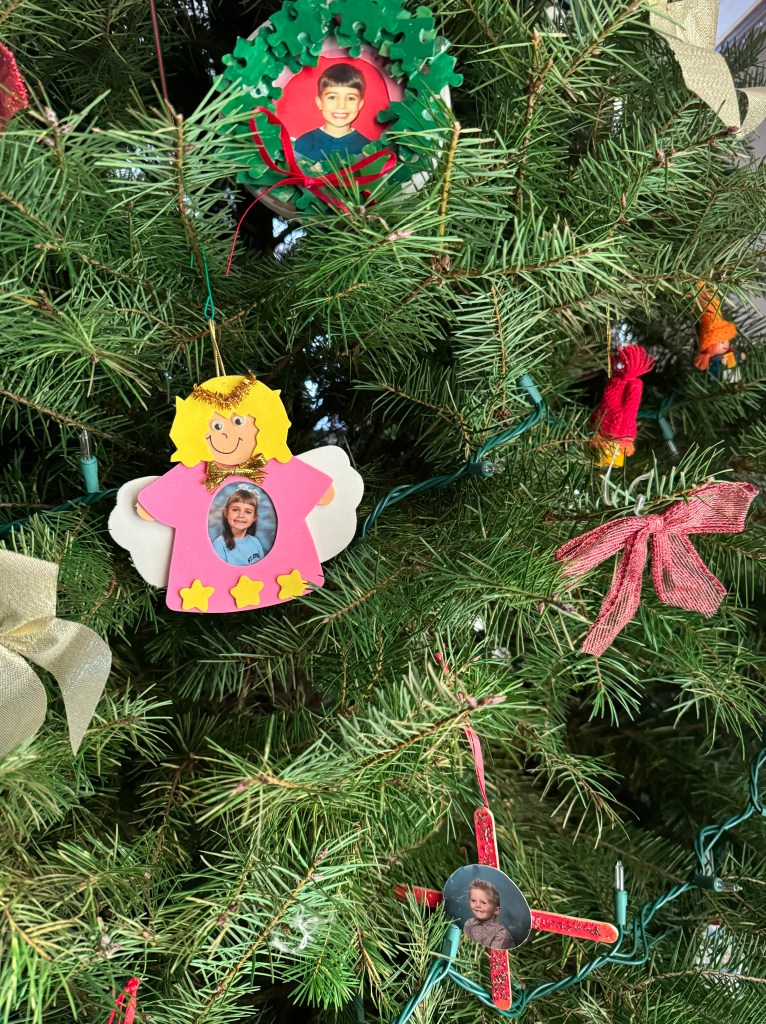
I have adored Haruki Murakami for nearly twenty years, when one of my AP students introduced him to me as her favorite contemporary writer and Hard-Boiled Wonderland and the End of the World as her favorite book. Start there, she suggested. So I did, stopping at the bookstore on my way home from work because my library didn’t carry a copy and I did not want to wait who-knows-how-long for a hold. 

Hubby will tell you–Patience is my inconsistent virtue.

I read Hard-Boiled Wonderland over maybe three days, and since then, I’ve read nearly all of Murakami’s canon, eagerly anticipating each new book and sharing recommendations with my fellow bibliophiles. However, Wonderland remained my favorite and the title I most reread and recommend.

No surprise then, that I preordered a copy of The City and its Uncertain Walls, his first novel in almost six years, as soon as it became available early March 2024. It arrived a few days after its November release, but I tucked it on my TBR shelf until January. I was trying to reach my self-inflicted Goodreads goal, remember, and wanted to savor reading The City, not binge. 

I read it over not quite seven days. Does that count as savoring?

How about this? I’ve been thinking about that book nearly every day since I finished.

Those people will be the ruin of us all.’

An aside: Sometimes I am remarkably patient. I freeze treats like chocolate or cookies for later. I wait until after Thanksgiving to decorate for Christmas. I never hint at surprises I’m planning for others, nor bug others for clues about those they may be planning for me. And if you send me a birthday card or gift me a gaily wrapped package, I will wait to open them until the calendar decrees it’s time.   

In other words, sometimes you delay because you’re prioritizing, not procrastinating, and sometimes you just need time to figure out the best way forward. 

Like Murakami and the forty years he needed to write The City and Its Uncertain Walls.

As his afterword explains, the book began as a novella that he regretted agreeing to publish. Its 1980 form didn’t feel finished to him. It didn’t tell the story he needed it to tell–the “something vital” he felt he then “lacked the skills as a writer to adequately convey”–and he determined “someday” to return to it. Someday arrived in 1982, following publication of A Wild Sheep Chase, yet the revision he anticipated became instead an entirely new novel, Hard-Boiled Wonderland and the End of the World.

That explained the deja vu I experienced reading The City and Its Uncertain Walls, which some reviewers claim is a watered down version of Wonderland. The City IS the End of the World, wherein mystical beasts roam the boundaries, inhabitants must sever their shadows to enter the town gates, and a dream reader tends his wounded eyes in a nearly empty library. And yet it’s neither the same story as Wonderland nor a sequel, but rather, Murakami says, a “response to the original [immature novella] … that “[coexists] with and [complements] each other.”  

Having not read the original City (which was published in Japanese and never, I believe, translated into English), I can’t speak to those  complementary natures. I can say, however, that this iteration felt as if it could have been written only when and how it was, during the enforced stillness and isolation of pandemic quarantines. There is such a quiet in the novel’s parallel worlds, a deliberate allocation of movement. Not much action, yet so much meaning. As if its unnamed protagonist recognizes the fragility inherent in his external, physical world and so must burrow carefully inward to create the one he desires.

Much like Murakami as he wrote, beginning in March 2020 and finishing nearly three years later, during which time he “rarely set foot outside my home and avoided any lengthy trips…. Those circumstances might be significant [to the novel’s creation]. Or maybe not. But I think they must mean something. I feel it in my bones.” 

I felt it, too, yet I can’t quite articulate how. I want to, though, which is why I’ll most likely reread both books. As a citizen of the world, I appreciate the author’s honesty and fallibility. His trying to animate that “something vital.” I do still prefer Hard-Boiled Wonderland, but I found much to admire in The City and in the story of its creation.

Murakami describes his 40-year inability to rework his 1980 novella as “like a small fish bone caught in my throat, something that bothered me.” Yet there he was, 71 and stuck at home–literally and metaphorically–like you and me and the rest of the planet as Covid assaulted our worlds. And what does he do? 

He creates. 

He strives not only to clear his throat, so to speak, but add to our collective understanding of what it means to be human in an (often) inhumane world. 

I’m thinking specifically of The City’s strange young boy who occupies the “real” world’s library for hours on end, never speaking. He seems a stereotype, shallow and uninteresting.

Different, and unworthy–perhaps–of notice.

Until the protagonist notices him.

Interacts with him, human to human, and in so doing discovers the boy has answers to questions the protagonist didn’t necessarily know to ask. Discovers he is made better by their connection.

Such are my kind of characters and my kinds of people. Creators, not destroyers. Doers, not whiners.  I am heartily sick of those who build their greedy happiness on others’ misery and degradation.

You know who I mean.

Those people will be the ruin of us all.

*****

What I’m reading now…

Jane Austen’s Bookshelf: A Rare Book Collector’s Quest to Find the Women Writers Who Shaped a Legend by Rebecca Romney.

Also, four stories a month of The Best American Short Stories (2024). Twelve down, eight more to go!

A recent library haul…

As of today, I’ve read all of them except The Unicorn.

A book I recently abandoned… 

White Ivy by Susie Yang, which has been on my Want to Read List since 2020. I liked the premise but not the style (which was heavy on telling, rather than showing), and the library wanted it back so…

Three books I’m really looking forward to reading when they’re released later this year…

The Maid’s Secret by Nita Prose, because the first two in the series were so much fun.

Notes to John by Joan Didion, because Joan Didion, obviously!

Twist by Colum McCann, because people who know what I like recommended it to me.

Some stories that aren’t books…

Last month, I mentioned the Good News Network as an antidote to negativity and bad news. Check out some of my favorite stories from recent issues:

Scientists Discover Low-Cost Way to Trap Carbon Using Common Rocks

Maine Nonprofit Cancels 19 Million in Medical Debt for 1500 People

Countries are Breathing the Cleanest Air in Centuries and Offer Lessons to the Rest of Us

Fighting Cancer Without Fighting: Scientists switch Tumor Cells Back to Healthy Ones at Critical Moment

World Record Jump Roper Uses His Double Dutch Jump Ropes to Save Teen in Icy Pond

Fun fact–One of its morning newsletters contained a story that helped me plug a plot hole in my WIP. Now that’s good news indeed!

Coming up on MY NAME WAS SUPPOSED TO BE ELIZABETH ANN…

Next up in April, I’m celebrating National Poetry Month and deciding which poem to put in my pocket.

And of course, I’ll share a reading and writing update 😉

Speaking of which, like Murakami’s The City and Its Uncertain Walls, my WIP has evolved through multiple iterations. It began as a short story, then it became another short story featuring a different protagonist in a different time period, and then it became a series of linked short stories, and then I realized it needed many more words and many more characters and it became something else entirely. That was January’s starting point, and I’m liking the current iteration a lot. Bonus, I’m still having fun playing. February, I finished writing all my chapter and scene summaries (color-coded cards for each POV character), and I even (yay me!) wrote and shared its opening scene with my critique group. 

Next up, writing a very rough but complete draft by the end of June. I’m giving myself two-ish days to handwrite each chapter and one day to type, and I plan to share more of it each time my group meets.

Here’s a peek at some of the scene cards I mentioned:

The top card contains notes for required scene elements, per KM Weiland. I created the bottom card to help me write and organize each scene by chapter and POV character.
Some of my completed scene cards, along with a Save the Cat-based graphic organizer I drew to help me keep track of where I am in the story and what each scene should be contributing to the overall structure.

*****

Thanks for reading! Thanks for sharing!