
The last time I talked to my mom, I told her my book club was reading Tom Hanks’ new book, The Making of Another Major Motion Picture Masterpiece, and her eyes lit up like I knew they would. She’s loved Tom Hanks ever since ‘Bosom Buddies’ and has watched, I think, nearly every movie he’s been in except maybe Green Mile and Road to Perdition. She never did like scary movies or violence. iPad, she whispered, which meant she wanted me to add it to her Audible account, but I told her I’d wait until after I’d read it. She might not like it, I said, and she already had five or six books in her queue.
As I spoke, I stood to the right of her hospital bed and helped her sip ice cold ginger ale, a grayish brown and white toy dog tucked into the crook of her arm. My daughter and younger sister, eyes red-rimmed and damp, sat on a blue vinyl couch beneath a viewless window.
Mom died the next day, January 11, at 10:54 PM. She was eighty years old.
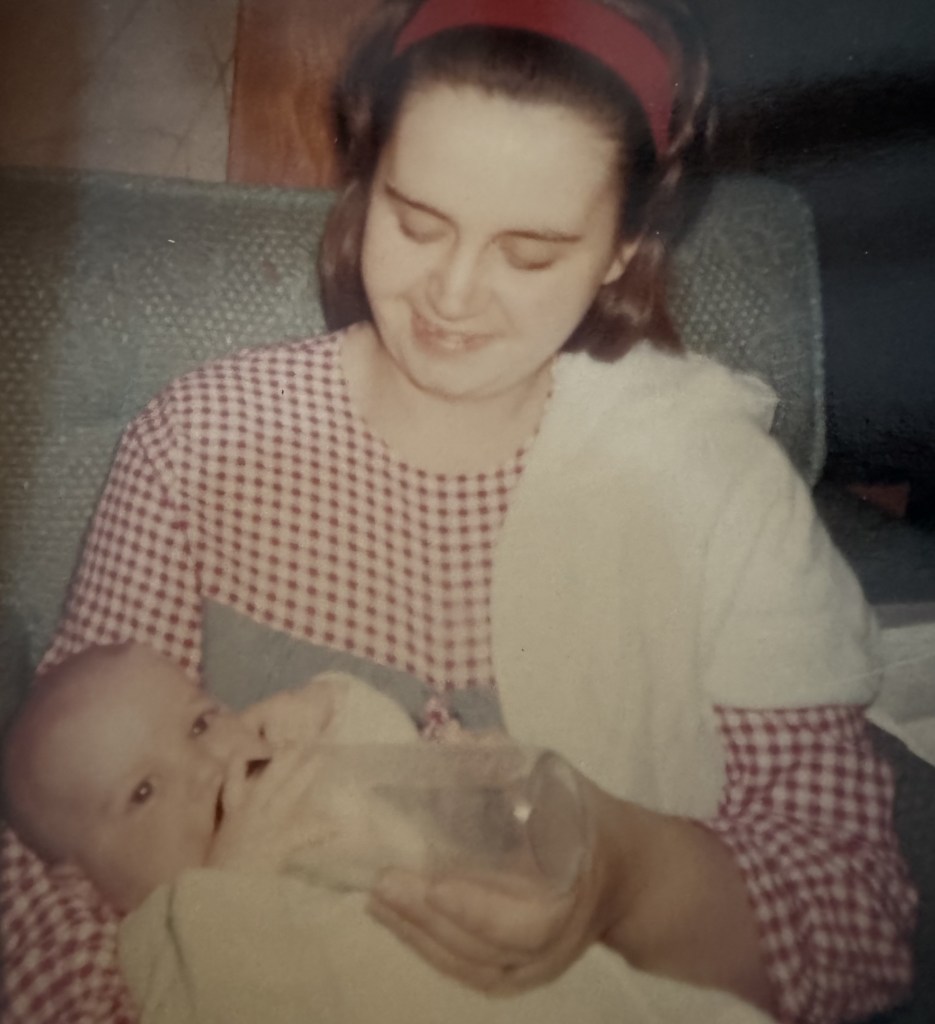
My mother Helen Judith was named after her maternal grandmother and never really knew her own mother. The youngest of two brothers and a sister, she was born to Irma Rose and Stuart Rowen on Halloween 1943 and was, according to family lore, a complete surprise to both parents and doctor as no one had realized Irma was expecting. Though my grandmother had been feeling more poorly than usual, she and her doctor falsely attributed her nausea and bloating to the ovarian cancer for which she had been receiving treatment and from which she would die a mere two years later. My grandfather, a busdriver for the Philadelphia Transportation Company, hadn’t funds sufficient to bury his wife and so her brothers stepped in, not only burying her at a considerable remove from what had been her marital home, but also erasing her marriage from her grave. SISTER, her headstone reads, beneath the requisite name and dates.
As a mother of two preschoolers, I visited my grandmother’s grave with my mother and one of her brothers. The cemetery was difficult to find, the grave even more so, at the end of a rocky path and overrun by weeds. To Mom, however, it was beautiful, for until that day she hadn’t even known her mother’s exact birthday. That same day, we visited her father’s grave at a different cemetery. For several years following his wife’s untimely death, he had struggled to work and raise his children, relying on his two boys to care for their younger sisters. Mom adored her big brothers. Idolized them. They combed the girls’ hair and helped them with homework. Walked them to and from school and prepared their meals–mayonnaise sandwiches for lunch. Oatmeal for breakfast and supper. Eventually she recovered from the sandwiches, but until the day she died, she loathed the taste and texture of oatmeal, the memory of deprivation it conjured.
Eventually, my grandfather embarked on a marriage of convenience to a widow with three children–my mother’s aunt by marriage. She needed a paycheck to feed and shelter her babies. He needed a nanny to feed and clean the shelter for his. The family did not blend. Eventually, it ruptured, scattering the children, with much of the blame placed at the feet of the woman I eventually learned to love and call Gramma.
Meanwhile, my grandfather’s stroke orphaned my 21-year-old mother a few months before her marriage to the 19-year-old boy who would become my father. I’ve often wondered about their timing, whether losing her father precipitated her rush into a completely unsatisfactory and dysfunctional union. Or perhaps it was the drumbeat of Vietnam’s conflict escalating in the background, a soundtrack to life’s irrationality. I never wanted to disrespect her by asking and so will never know.
There’s a lot about my mother I do not know. A lot she would never discuss. Of this, however, I can speak with certainty: Her greatest joy lay in her children and grandchildren. She bore three of her own and adopted two more from foster care, though to be precise, the adoption was never formalized. While Mom tried repeatedly, their biological father balked at terminating parental rights and Mom, fearful that a protracted fight could result in the children’s removal from our home, abandoned her efforts. Regardless, she always–always–considered them as much her own children as those of us who shared her DNA. Likewise, when divorces and remarriages introduced stepchildren into her circle, she counted them as family. Heart stood equal to blood.
In fact, Mom’s guiding principle was love. As much as she could, she lived a life of service. She was a Girl Scout leader and church deacon. She crocheted blankets and scarves for those in need. She drove neighbors and friends to grocery stores and doctors appointments. She donated to causes she believed in, and she opened her home to those without one. Adult children and grandchildren, yes, but also their friends. When I was in seventh grade, she welcomed a mother and her three children escaping their abusive husband and father. They stayed with us for several days before moving in with family in a nearby town.
None of which is to say my mother was perfect.
She wasn’t.
She was no more perfect than you or I or anyone whom I have ever known or known of. Sometimes Mom’s generous (and somewhat naive) perspective made her vulnerable. She could be cranky and selfish, impatient and passive aggressive, and sometimes she’d put her foot in her mouth or avoid difficult conversations because she loathed conflict. After declining health and mobility forced her to sell her home in 2016 and move first with me and then with my younger sister, those negative traits bloomed like weeds, fed by grief over her eroding independence, the loss of a life and home she’d worked so hard to achieve. It could have choked her relationships with us children, yet it didn’t.
How on earth? as Mom used to say.
The answer is as messy and complicated as any of life’s big questions but involves, I think, our basic awareness that none of us are perfect, that eventually we’re all going to mess up. We’re going to disagree and argue and throw up our hands in frustration.
Okay, but then what do we do about it? We have to find a way to move forward. We have to think about our gardens. After all, we know you don’t only reap what you sow, you reap what you cultivate. You can’t just scatter seeds and hope for the best. You have to work at it, and sometimes you succeed and sometimes you fail, but if you envision a certain kind of harvest–if you really want to achieve it– you have to do your part to grow it. And sometimes it won’t be fair. It won’t be equitable. And sometimes despite your best efforts, the elements seem to be conspiring against you. Okay then. Go ahead and quit.
Or don’t. It’s up to you.
That’s kind of, I think, what Mom was like. The kind of example she tried to set, just by going about the ordinary business of living and working and raising children. She wasn’t flashy or preachy about it, she just…did it. Just tried her imperfect best to be a decent human being, and we children followed her lead.
The so-called evil stepmother I mentioned?
She’s an example of what I mean about Mom:
While I would never presume to weigh in on Nell’s relationships with her other stepchildren, Mom never lost touch with her stepmother-aunt and eventually, gradually, in a process whose details I was never told, the women came to an understanding based partly on Nell’s willing admission of guilt and responsibility and partly on Mom’s willing offer of forgiveness and reconciliation. My junior high and high school summers, Gramma Rowen slept in my room on the matching white wood twin that used to be my older sister’s, before she married and moved across the river. We’d go to the mall and Friendly’s with Mom and my younger siblings, and evenings we’d sit on the back porch watching fireflies or downstairs watching reruns, and sometimes we’d stay up late trading stories. Me, about boys and school and what I planned after graduation. She, about WWII and her family’s exploits. About being widowed young and living her golden years in her daughter’s home.
My grandmother is long gone, and now my mother is too, but those stories? Those memories?
I will treasure them until the day I die.
*****
My mother’s passing and funeral were not happy occasions, but they were accompanied by many happy moments, many moments of grace. Each, like seeds, anticipating a harvest of peace.
Surprisingly, reading Hanks’ Masterpiece was one of them.
I hadn’t really wanted to read it. The reviews were mixed, my interest in its plot merely tepid. I’d bought it only because my book club had selected it, and I’d mentioned it to Mom to distract her because I knew she was scared. Scared of the dark and of dying alone. Not of death itself. Moments before my daughter and I walked into her hospital room, she’d told the nurse to remove the wires and tubes connecting her to a chirping monitor. She was tired and she was ready and my younger sister burst into tears. My daughter, too.
We knew. We all knew.
But goddamnit, I would not cry. Not yet. I would hold myself together, not for myself but for my daughter and sister. For Mom, because I knew the thing that scared her the most wasn’t herself but whether we would be okay, after. Whether we would be okay when she left us, even though we were all grown and gone and with children of our own. ‘Yes’ was a gift I could give my mother. She deserved that, after all she’d endured the last year.
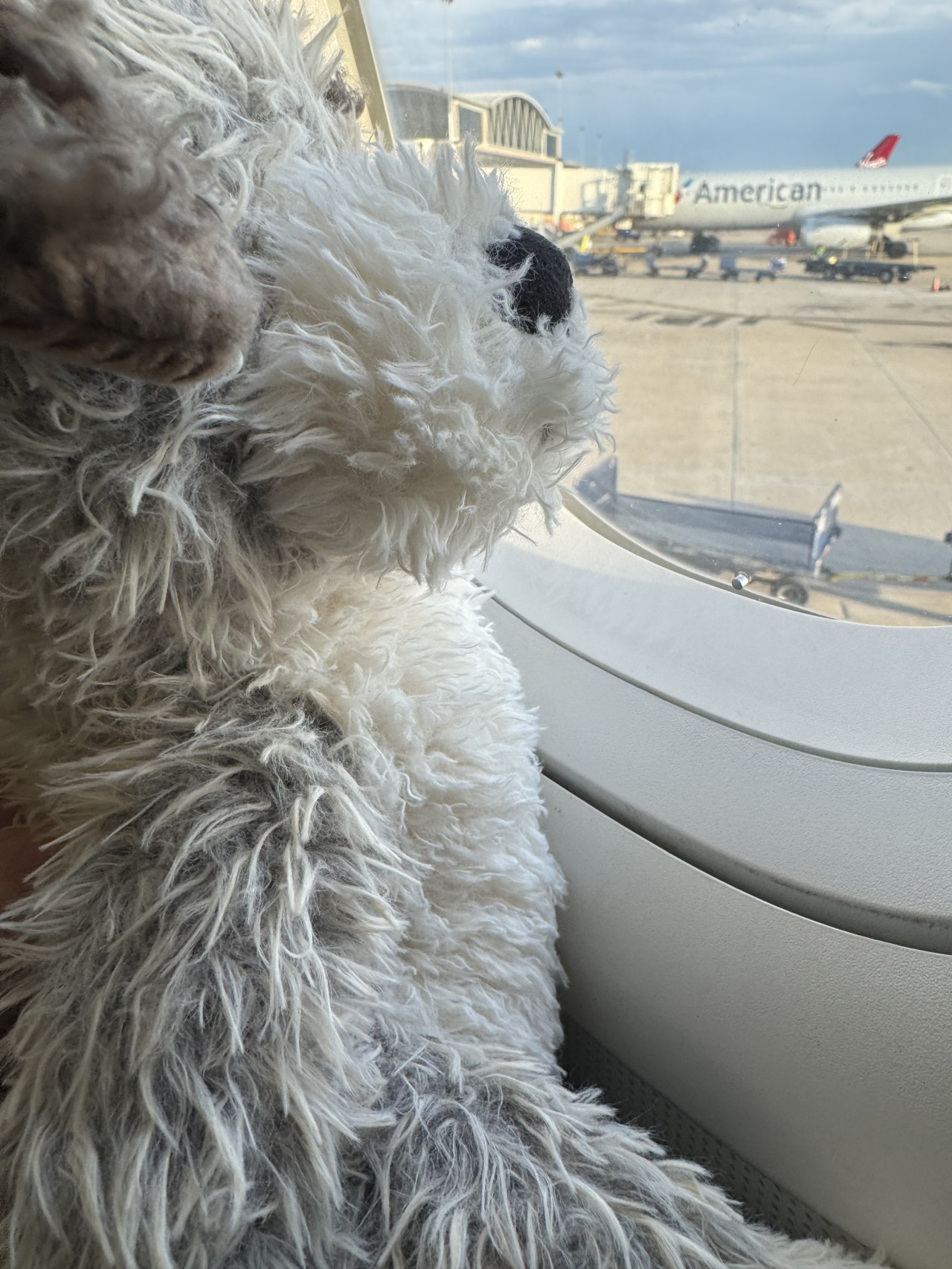
I gave her a concrete gift, as well, a soft grayish brown toy dog she named Daisy, after her last, beloved pooch. It even looked like Daisy, which is why I had picked it from the hospital gift shop. She clutched it to her side, one finger stroking its fur, as I talked about ordinary things and held a cup to her lips and told her she could sleep if she was tired, we weren’t going anywhere. We loved her, and we’d be there when she woke up.
Except she didn’t, not really, and eventually I wept, and when I flew back home I tucked Daisy in my backpack, wondering what my fellow passengers must be thinking seeing me, a 56-year-old woman, carrying a stuffed dog through airport security, its floppy ears bouncing behind my head. Mom would have laughed. Paybacks, she’d have said, for that time in the grocery store when my younger sister and I were kids and a geyser of Pepsi had exploded in front of Mom’s cart, soaking her in sticky brown cola while sister and I ran off, hysterical, laughing so hard we cried and snorting giggles each time Mom’s shoes wEEk-wEEked along the aisles as we finished shopping. Needs must, after all. She had a family to feed.
Forty years later, and I’m smiling as I write that.
I never did make it to book club, but I did read the book when I arrived back home, even though I struggled to get into it and almost quit several times. Like Mom, I needed a distraction, and I’d promised I’d tell her what I thought about it–that mattered to me–so I kept reading and ended up liking the book, really liking it, even though, structurally, the reviewers are right–it’s a hot mess.
Masterpiece is about a boy who meets, then is abandoned by, his WW II veteran uncle and who, eventually, creates a comic book depicting said uncle’s war exploits. Meanwhile another guy–a big shot movie producer–eventually stumbles upon a dog-eared copy then writes and films a screenplay loosely based on the uncle, the eponymous masterpiece (SPOILER ALERT!) whose script appears at the end. There are too many characters, too much backstory, and you no sooner get vested in one person’s conflict than someone else interrupts. Then there are the comic books, which Mom would have most likely skipped had she been reading a hard copy, and the footnotes, which she would have found distracting while listening, and the QR code at the back, which she would not have known how to access. In her last year or so, Mom preferred straightforward plots with straightforward characters, and Masterpiece has neither.
Tom Hanks notwithstanding, Mom would have hated it.
Why on earth did I like it so much, despite its flaws and inconsistencies?
Because it spoke to when and where I was at that moment, a daughter both mourning and celebrating her mother. Trying to read the map of a world I’d known about but never visited, trying to plot my way forward.
Because Masterpiece is messy, but so is life. Messy and complicated but so very beautiful, if you know where to look. If you’re willing to even try.
So often we place ourselves at the center of humanity’s narrative, our births and deaths the bookends of complete and tidy lives, but the truth is we are all supporting cast in each other’s throughlines. Like the book’s made-up film and my metaphorical garden, we cannot flourish without intervention, without food and light or someone–many someones–willing to get their hands dirty, then gather the harvest in boxes or baskets. Take it to the markets. Feed it to the masses, then repeat the process again and again and again, until eventually someone’s turn ends and someone else’s begins.
I thought about that in the days leading to and the day of Mom’s funeral, as I spoke with so many people–dozens of people–to relay the news, to thank them for gifting my mother with their friendship. Mom treasured that–treasured them–so very much. And in the way people do, they shared their stories with me, each different in content and presentation but not form. All of their stories were love stories, and in each retelling I found such peace. Such joy. Thank you, all of you, for those gifts.
Mom’s life mattered, in more ways than I had ever known.
That’s the real masterpiece, I think.
*****

Discover more from My Name was Supposed to be Elizabeth Ann
Subscribe to get the latest posts sent to your email.
 My Name was Supposed to be Elizabeth Ann
Hi
I loved this. It took me awhile to get to reading it. I always save your emails.
I would like to put you as a recommended newsletter in Thru the Window. I was thinking about doing it for May, because that is motherâs day and then maybe putting an excerpt of this letter. How do you feel about that?
If you like this idea, I need your landing page and perhaps what part of this letter I could include.
If you donât want me to do this, that is ok too.
(now I have to go and find the one you just sent. I am really behind in my emails)
~~~~~
Be the kind of person that when your feet hit the floor in the morning, the devil says,
âOh, CRAP! Theyâre up!â
And, remember to have a great day!
Brenda Rech
Curious as to what this trio is looking at??https://dogged-trailblazer-3243.ck.page/40b88a63ab
[cid:image001.jpg@01DA709B.22ED26A0]
LikeLike
I’ve been a fan yours for awhile, so yes. I would be honored to be included, thank you!:) I’ll email you the details.
LikeLike