

I have adored Haruki Murakami for nearly twenty years, when one of my AP students introduced him to me as her favorite contemporary writer and Hard-Boiled Wonderland and the End of the World as her favorite book. Start there, she suggested. So I did, stopping at the bookstore on my way home from work because my library didn’t carry a copy and I did not want to wait who-knows-how-long for a hold.
Hubby will tell you–Patience is my inconsistent virtue.
I read Hard-Boiled Wonderland over maybe three days, and since then, I’ve read nearly all of Murakami’s canon, eagerly anticipating each new book and sharing recommendations with my fellow bibliophiles. However, Wonderland remained my favorite and the title I most reread and recommend.
No surprise then, that I preordered a copy of The City and its Uncertain Walls, his first novel in almost six years, as soon as it became available early March 2024. It arrived a few days after its November release, but I tucked it on my TBR shelf until January. I was trying to reach my self-inflicted Goodreads goal, remember, and wanted to savor reading The City, not binge.
I read it over not quite seven days. Does that count as savoring?
How about this? I’ve been thinking about that book nearly every day since I finished.
‘Those people will be the ruin of us all.’
An aside: Sometimes I am remarkably patient. I freeze treats like chocolate or cookies for later. I wait until after Thanksgiving to decorate for Christmas. I never hint at surprises I’m planning for others, nor bug others for clues about those they may be planning for me. And if you send me a birthday card or gift me a gaily wrapped package, I will wait to open them until the calendar decrees it’s time.
In other words, sometimes you delay because you’re prioritizing, not procrastinating, and sometimes you just need time to figure out the best way forward.
Like Murakami and the forty years he needed to write The City and Its Uncertain Walls.
As his afterword explains, the book began as a novella that he regretted agreeing to publish. Its 1980 form didn’t feel finished to him. It didn’t tell the story he needed it to tell–the “something vital” he felt he then “lacked the skills as a writer to adequately convey”–and he determined “someday” to return to it. Someday arrived in 1982, following publication of A Wild Sheep Chase, yet the revision he anticipated became instead an entirely new novel, Hard-Boiled Wonderland and the End of the World.
That explained the deja vu I experienced reading The City and Its Uncertain Walls, which some reviewers claim is a watered down version of Wonderland. The City IS the End of the World, wherein mystical beasts roam the boundaries, inhabitants must sever their shadows to enter the town gates, and a dream reader tends his wounded eyes in a nearly empty library. And yet it’s neither the same story as Wonderland nor a sequel, but rather, Murakami says, a “response to the original [immature novella] … that “[coexists] with and [complements] each other.”
Having not read the original City (which was published in Japanese and never, I believe, translated into English), I can’t speak to those complementary natures. I can say, however, that this iteration felt as if it could have been written only when and how it was, during the enforced stillness and isolation of pandemic quarantines. There is such a quiet in the novel’s parallel worlds, a deliberate allocation of movement. Not much action, yet so much meaning. As if its unnamed protagonist recognizes the fragility inherent in his external, physical world and so must burrow carefully inward to create the one he desires.
Much like Murakami as he wrote, beginning in March 2020 and finishing nearly three years later, during which time he “rarely set foot outside my home and avoided any lengthy trips…. Those circumstances might be significant [to the novel’s creation]. Or maybe not. But I think they must mean something. I feel it in my bones.”
I felt it, too, yet I can’t quite articulate how. I want to, though, which is why I’ll most likely reread both books. As a citizen of the world, I appreciate the author’s honesty and fallibility. His trying to animate that “something vital.” I do still prefer Hard-Boiled Wonderland, but I found much to admire in The City and in the story of its creation.
Murakami describes his 40-year inability to rework his 1980 novella as “like a small fish bone caught in my throat, something that bothered me.” Yet there he was, 71 and stuck at home–literally and metaphorically–like you and me and the rest of the planet as Covid assaulted our worlds. And what does he do?
He creates.
He strives not only to clear his throat, so to speak, but add to our collective understanding of what it means to be human in an (often) inhumane world.
I’m thinking specifically of The City’s strange young boy who occupies the “real” world’s library for hours on end, never speaking. He seems a stereotype, shallow and uninteresting.
Different, and unworthy–perhaps–of notice.
Until the protagonist notices him.
Interacts with him, human to human, and in so doing discovers the boy has answers to questions the protagonist didn’t necessarily know to ask. Discovers he is made better by their connection.
Such are my kind of characters and my kinds of people. Creators, not destroyers. Doers, not whiners. I am heartily sick of those who build their greedy happiness on others’ misery and degradation.
You know who I mean.
Those people will be the ruin of us all.
*****
What I’m reading now…
Jane Austen’s Bookshelf: A Rare Book Collector’s Quest to Find the Women Writers Who Shaped a Legend by Rebecca Romney.
Also, four stories a month of The Best American Short Stories (2024). Twelve down, eight more to go!
A recent library haul…

A book I recently abandoned…
White Ivy by Susie Yang, which has been on my Want to Read List since 2020. I liked the premise but not the style (which was heavy on telling, rather than showing), and the library wanted it back so…
Three books I’m really looking forward to reading when they’re released later this year…
The Maid’s Secret by Nita Prose, because the first two in the series were so much fun.
Notes to John by Joan Didion, because Joan Didion, obviously!
Twist by Colum McCann, because people who know what I like recommended it to me.
Some stories that aren’t books…
Last month, I mentioned the Good News Network as an antidote to negativity and bad news. Check out some of my favorite stories from recent issues:
Scientists Discover Low-Cost Way to Trap Carbon Using Common Rocks
Maine Nonprofit Cancels 19 Million in Medical Debt for 1500 People
Countries are Breathing the Cleanest Air in Centuries and Offer Lessons to the Rest of Us
World Record Jump Roper Uses His Double Dutch Jump Ropes to Save Teen in Icy Pond
Fun fact–One of its morning newsletters contained a story that helped me plug a plot hole in my WIP. Now that’s good news indeed!
Coming up on MY NAME WAS SUPPOSED TO BE ELIZABETH ANN…
Next up in April, I’m celebrating National Poetry Month and deciding which poem to put in my pocket.
And of course, I’ll share a reading and writing update 😉
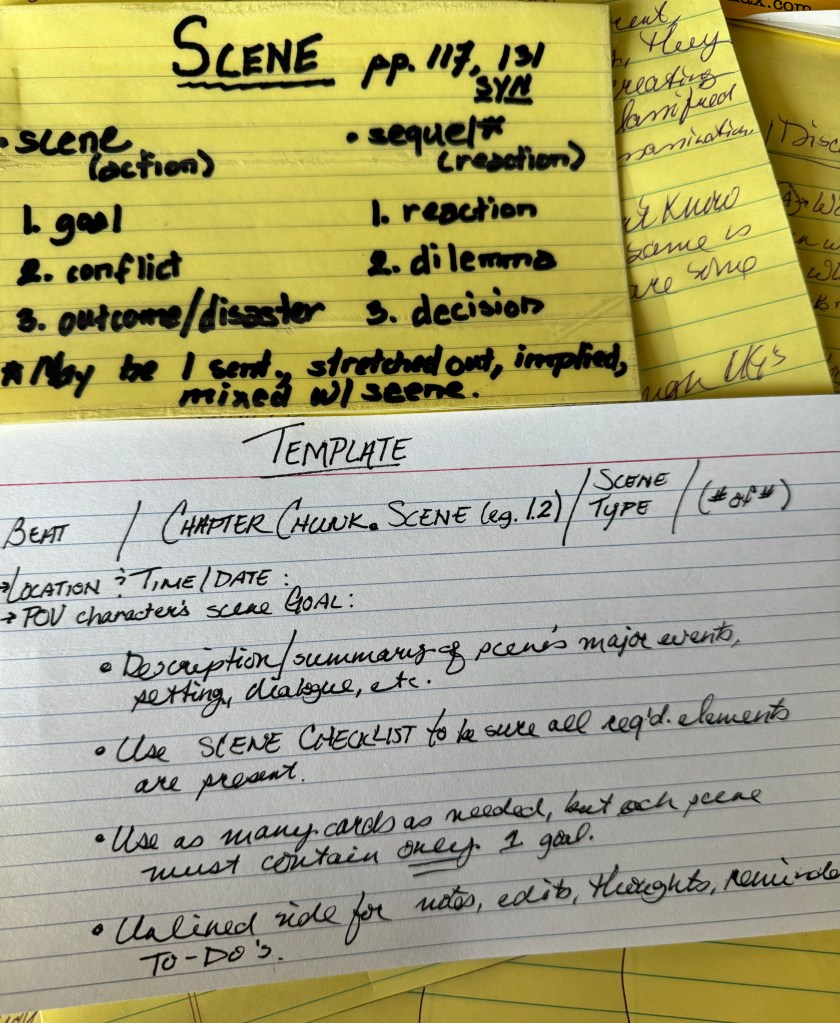
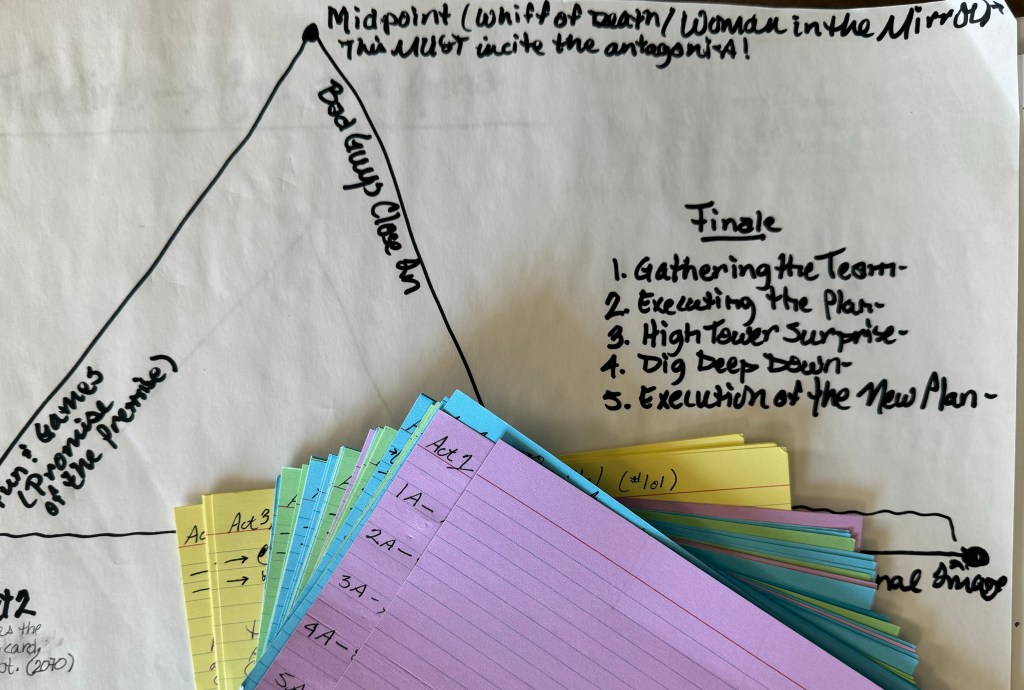
Speaking of which, like Murakami’s The City and Its Uncertain Walls, my WIP has evolved through multiple iterations. It began as a short story, then it became another short story featuring a different protagonist in a different time period, and then it became a series of linked short stories, and then I realized it needed many more words and many more characters and it became something else entirely. That was January’s starting point, and I’m liking the current iteration a lot. Bonus, I’m still having fun playing. February, I finished writing all my chapter and scene summaries (color-coded cards for each POV character), and I even (yay me!) wrote and shared its opening scene with my critique group.
Next up, writing a very rough but complete draft by the end of June. I’m giving myself two-ish days to handwrite each chapter and one day to type, and I plan to share more of it each time my group meets.
Here’s a peek at some of the scene cards I mentioned:
*****
Thanks for reading! Thanks for sharing!
Discover more from My Name was Supposed to be Elizabeth Ann
Subscribe to get the latest posts sent to your email.
 My Name was Supposed to be Elizabeth Ann
Hi. Rightly or wrongly, I don’t read books that have been translated into English, unless the original author has their hands in the translation. I read one of those last year: Roman Stories, by Jhumpa Lahiri. She wrote it in Italian, and a few years later translated it into English.
LikeLike
I hear you! The quality of the translation definitely makes a difference. I’ll have to check out Lahiri’s collection.
LikeLiked by 1 person