My Name was Supposed to be Elizabeth Ann

I write stories about stories–Reading them, writing them, living them

Drum roll, please!

I won my 2024 Goodreads reading challenge.

Sort of.

I said I wanted to read 100 books.

I read 104!! 

Barely.

I read the last word of the last book at 8:26 PM December 30, Susanna Clarke’s Jonathan Strange & Mr Norrell. Probably not the best end-of-challenge choice, considering the holiday crush and the tome’s 864 pages.

And don’t get me started on its teeny tiny font-notes.

Goodreads tells me it was my longest read. Claire Keegan’s 89-page Foster was my shortest.

Of course, statistics tell only part of the story. 

My AI-generated Spotify Wrapped stopped listening to me in March and ignored my playlist go-tos. I thought I’d done something wrong until my techie son explained the kerfuffle.

Goodreads tells me I read 38,160 pages this year, which doesn’t count the pages I finished before abandoning Ahab’s Wife (261) and Still Life (83), among other DNFs. It doesn’t count all the poetry I read (1-2 each day), or the essays and short stories (um, can we say–A lot?). Nor does it consider the size of each page or the number of words within, or the number of times I had to reread a paragraph because I wasn’t really paying attention, or had to go back a chapter to find the name of the character whose name I couldn’t recall.

Not to mention, fudging your stats is both tempting and easy. I mean, you can even ‘cheat’ with Spotify. Just because a song plays in the background doesn’t mean you’re actually listening to it. You may instead be explaining to Hubby for the umpteenth time that yes, the WHATEVER he cannot find is exactly where you told him it would be. See?

But I digress.

Although I’ve used the Goodreads app since 2013, I’d never participated in its annual challenge and can’t exactly recall why or when I decided to join this year. My mom died January 11 following a long and heartbreaking decline, and I found myself reading more, partly diversion. Partly escape. Such a relief, honestly, to set grief momentarily aside and immerse myself in other worlds, other perspectives. I would finish one book, then almost immediately begin another, using my three newly acquired library cards to be sure I never depleted my pile. One day I realized I’d been reading at least two books a week. Why not try for 100?

For those unfamiliar with challenge guidelines, you set a want-to-read goal then record when you start and finish each book. Any book of any genre, medium, or length counts toward your goal. Even rereads, and you can edit your progress throughout. Bonus–your Goodreads ‘friends’ can cheer your milestones. Double bonus–you get a participation trophy, aka fancy results graphic, that you can share on social media for more accolades.

Or not.

Confession:

I knew I would read 100 books because I decided I was going to read 100 books. I am a very fast reader, always have been, and if a book captures my attention sufficiently–if its structure and syntax aren’t terribly complex, requiring I slow down to ‘get it’–I can read an average-length novel in a few hours at most. Thus, Salman Rushdie’s Victory City (336 pages) took me ten days to finish. Freida McFadden’s The Housemaid (329 pages) took me less than one. 

Confession, part 2:

I didn’t actually want to read 100 books. I wanted to read 104. Two per week, for 52 weeks. I also didn’t want to cheat by only reading what for me are ‘easy’–albeit delightfully entertaining–books. I wanted to read what I wanted to read: well-written books with characters and themes that resonate, books that make me want to continue reading long past my bedtime, regardless of their genre or length or style, or how many hours over how many days I require to finish.

In other words, I wanted–needed, actually–a challenging brain workout, and I wanted–needed, actually–to have fun.

Yay, me!! I won on both fronts.

But that’s only part of the story.

After I posted my Year in Books graphic, a FB friend and former student asked whether reading Clarke’s book was worth it, considering. 

The short answer? 

Yes, although it wasn’t one of my favorites. I agree with the Goodreads reviewer who described its pacing as like ‘molasses, with flashes of brilliance.’ Its premise and scenes were dazzling. Its narration and backstory, not so much.

The long answer? 

When my mom was alive, she loved to craft, crochet, and read. Macular degeneration gradually–cruelly– stole her ability to do the two former. Stroke and a series of other health issues gradually–cruelly–stole her ability to read.  I bought her a retro record player with a CD drive so she could listen to her music and book ‘tapes.’ I replaced her Nook with an Audible account and stocked her TBR (TBL?) library. 

And when I went for walks I would call her, and we would talk about what we were reading and what we wanted to read next. Book talking was our love language, until gradually–cruelly–she lost her fluency. She couldn’t remember how to operate her devices. She couldn’t remember how to concentrate. Trying flooded her with anxiety, so she stopped trying. She even stopped talking, for a while before she passed. 

I am not glad my mother is gone, but I am glad she’s at peace. 

I’m not there yet, but I am making progress. It’s complicated, you know? 

I go for walks and think, I’ve got to tell Mom about… and then I remember I can’t. Not anymore.

But I talk to her anyway. In my head. Sometimes out loud. The neighbors must think I’m a bit off.

I am, a little. It’s been that kind of year, you know?

So when my FB friend asked about book 104, I wasn’t just thinking about book 104. I was thinking about how Mom would have gotten a kick out of my doing this challenge, even though she would have hated most of the books I read. I was thinking about how I had slogged through 104’s slow sections and how I had been transported by its magical scenes (pun intended). I was thinking about how 104 mirrored my 2024, which wasn’t–to be honest–all terrible and sad even though I miss my mother terribly, and I was thinking about how I continued through both the book and the year because continuing–refusing to quit–is the only path forward, if you want to see how your story unfolds. I mean, sometimes you just have to make yourself do the tough things. Right?

How else are you going to get to the good parts?

*****

Every good story has a moral.

Here’s mine: 

Time is treasure, so invest it with whom and what you love, and spend your minutes wisely.

You know that already, right?

Me too.

But some years, your bones ache with that truth. 2024 was that year for me.

While considering how to answer my FB friend, I was also thinking about 2025. 

See, Mom always used to ask me about what I was reading. She always used to ask me what I was writing, and about whether and when I would send her a copy to read. She genuinely cared and was genuinely interested. Moms, you know–if you’re lucky–are a unique kind of cheerleader. I don’t have anyone like that, not anymore, but my story hasn’t ended. I still have pages to turn and pages to write, and I don’t want to wear regret to my next New Year’s Eve party. Regret is just not my color.

Which is why I’m redefining my reading goals. I still want a mental challenge, and I still want to have fun, but I’m striving for quality, not quantity. I’m going to tackle my (as of today) 168-book Want to Read list, but I’m giving myself permission to abandon those that don’t bring me joy and to spend as much time as needed with those that do.

I’m also committing to a new goal with my writing. I’ll still be here the first Saturday of each month, and I’ll still devote creative time to writing short fiction. But this year–Even though I have A LOT going on, Even though the universe has submitted its list of objections in triplicate–I’m writing that novel I’ve always wanted to write. I’ve started it already, but I want to see how it unfolds. Even if it’s terrible. Even if no one ever reads it but me. I just want the challenge, and I just want to have fun trying.

But first, I need a plan.

Come back next month and I’ll tell you all about it 🙂

*****

More Lessons Learned From My Year in Books:

You are never too old to read something–or someone–new. I already have a list of authors I adore and whose new books I will always read, and this year I added a few more. Liz Moore (hahaha!) tops the list. Her The God of the Woods, which I bought on a whim, was one of my year’s favorites.

Unless it’s for your degree or your job, life really is too short to read books you hate. Honestly, toward the end of the challenge, I would have abandoned several titles on my READ list, had I not needed to read my quota. Also, it’s okay to not like a book about which Everyone Else is raving. For me, that was Kristin Hannah’s The Women. Loved the premise, but found the protagonist underwhelming. Also–SPOILER ALERT–that whole surprise at the Wall? I read a similar twist in Diane Chamberlain’s The Dream Daughter, which was published in 2018. Also, I read The Dream Daughter first.

That said, sometimes books–like people–deserve a second chance. Or a third. In March 2020, my college friend Rose started an online book club she called The Great Coronavirus Book Club. Celeste Ng’s Little Fires Everywhere was our first book. It looked good, I bought a copy–and couldn’t get past the first chapter. I tried again in 2022 and couldn’t get past the first chapter. In April 2024, I forgot I’d bought a copy, signed out a copy from the library, and decided to make myself read it this time. I LOVED it and finished in a few days, after which I found my copy on my bookshelf, alphabetized between Murakami and Oates.

When striving toward a goal, accountability helps. Initially, I kept track only on the app and only for myself. But then I started telling my family and some of my reading friends. I told some of my writing friends, and then I told you. And then, of course, I had to do what I’d promised!! That’s why I let you in on my 2025 goals–I’m hoping you’ll keep me on track. Thanks in advance!!!

My Top Ten Favorite Reads of 2024:

Okay, so I’ve listed way more than ten. You’re welcome!! All met the criteria I mentioned earlier and are books I could see myself rereading. (In fact, two of them are rereads*.)

But don’t take my word for it–check them out for yourself 🙂

Absolution by Alice McDermott

After Annie by Anna Quindlen

The Backyard Bird Chronicles by Amy Tan

The Book Thief by Markus Zusak

A Christmas Carol by Charles Dickens*

The God of the Woods by Liz Moore

Foster by Claire Keegan

Here One Moment by Liane Moriarity

How Strange a Season by Megan Mayhew Bergman

Husbands & Lovers by Beatriz Williams

James by Percival Everett

Knife: Meditations After an Attempted Murder by Salman Rushdie

Little Fires Everywhere by Celeste Ng

Long Way Down by Jason Reynolds

North Woods by Daniel Mason

The Postcard by Anne Berest

Remarkably Bright Creatures by Shelby Van Pelt

The Story of Edgar Sawtelle by David Wroblewski*

Tell Me Everything by Elizabeth Strout

The Vaster Wilds by Lauren Groff

The Wedding People by Alison Espach

Want to see my full list? Check it out here: Michele’s 2024 in Books

And while I’m recommending things I love, check out this gorgeous print by my reader-writer-artist friend Marta Pelrine-Bacon. Be sure to zoom in on her lower left skirt. I love this print so much I recently bought a second copy for my home-away-from home writing nook:

Marta blogs, writes short fiction, and creates beautiful art. She’s also written a novel, The Blue Jar. You can see more of her work HERE and HERE.

What I’m reading now:

Haruki Murakami’s The City and Its Uncertain Walls. I bought a copy as soon as it came out, but waited to start until after the challenge so I could savor it. He is one of my FAVORITE contemporary authors.

The Best American Short Stories 2024, edited by Lauren Groff. In December, my second online book club (through StoryADay’s Superstars) began meeting online to discuss four stories a month. Speaking of accountability (see LESSONS, above) you might want to listen to what Storyaday founder Julie Duffy has to say on the subject.

Coming up on MY NAME WAS SUPPOSED TO BE ELIZABETH ANN:

In February, ‘I Love It When a Plan Comes Together: JaNoWriMo & my DIY Retreat’

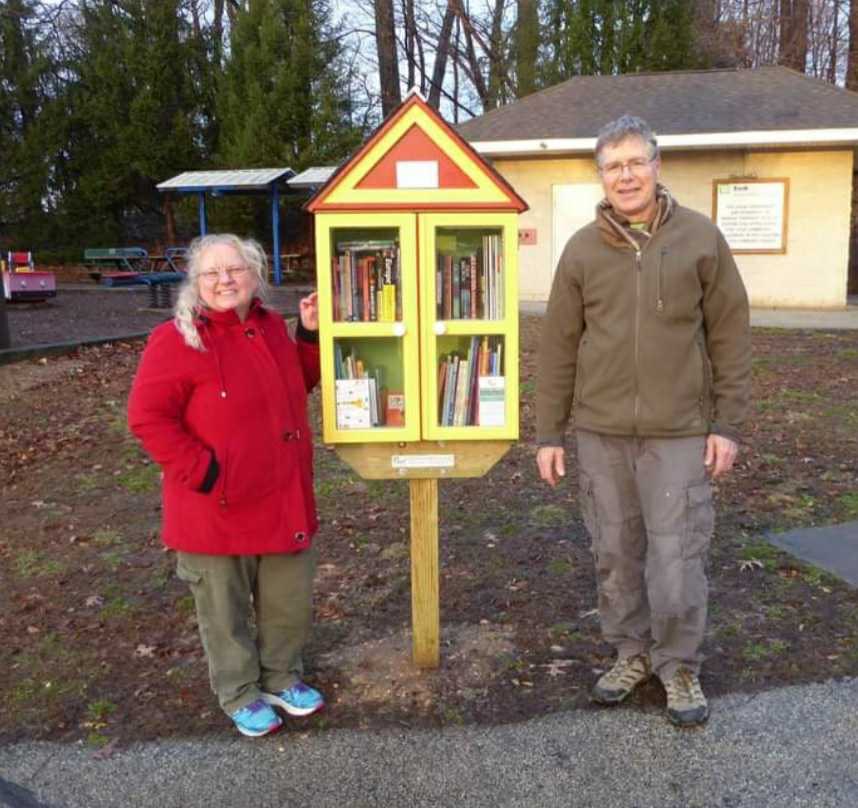
And later in 2025, more conversations with my reader friends and ‘Reading through America: A Little Free Library Adventure.’

Before you go

I have a challenge for you.

Imagine it’s December 31, 2025. Looking back, what’s the one thing you’re most proud of having accomplished?

Now tell me the story of how you got there.

Thanks for reading!! Thanks for sharing!!

*****

(third in an occasional series on Media Literacy)

During the Big Brother season 26 live finale, the two remaining contestants vying to win its ninety-day competition were reunited with their previously evicted housemates. Seven sat on a jury that would vote to select the $750,000 winner, while the other seven had been sent home following their evictions. Whereas the latter watched the series unfold, even watching and rewatching earlier episodes, the jury and final two remained secluded, cut off from news about current events to which the others were privy.  

Their jaws gaped when show host Julie Chen Moonves revealed Vice President Kamala Harris had become the Democratic candidate after President Biden dropped out of the race. 

The election was only 23 days away. 

To paraphrase Matt Kelly’s Pogo, ‘I have met the enemy and they is us.’

Wearied and worried about misinformation online, in the months and weeks leading up to November’s election I ‘snoozed’ some of my FB friends who continuously posted false, misleading, and confrontational content about issues facing our nation. The teacher in me wanted to correct them, to remind them to check their sources and to stop painting anyone who disagreed with them as somehow to blame for every single wrong in their life. The realist in me knew the futility of that approach. 

I mean, what if I told you that you are wrong about everything? 

If I said, You are to blame for everything that is wrong with my life and in my world?

Would you believe me? Change your behavior? 

Would you even continue reading this post?

Probably not. People believe what they want to believe and it’s really, really difficult to change their minds when they are vested in being RIGHT. Particularly regarding subjects about which they care deeply. 

Difficult, but not impossible. 

If you’re willing to try. If you’re willing to work at it.

Interested? 

Good!

Then let’s start with changing YOUR mind.

Let’s start with Big Brother. 

The series derives its title from a character in George Orwell’s 1949 classic, 1984, who–much like the 94 HD cameras and 113 microphones in the Big Brother house—monitors everything and everyone 24/7. 

Full disclosure: Love the book and used to teach it to my honors sophomores many moons ago. Not a fan of the show, however. Its manufactured drama, backstabbing, and self-serving manipulations celebrates and encourages the worst of human nature then pays them for it, and I do not find that mindset entertaining. And yet, my husband finds the contestants’ wrangling funny, occasionally tuning in when nothing else is on. Cue the finale, Hubby wanted to see who would win.

Still not a fan, but I am glad I watched, because the series and its finale demonstrate why many of us get our facts wrong, why many of us feel threatened by those who differ from or disagree with us, and what we can do to push back against those destructive tendencies.

Let’s consider those parallels.  

WE CHOOSE TO LIVE IN FILTER BUBBLES.

For contestants, that means the Big Brother house, wherein they agree to isolate themselves from everything except each other and the host–no TV, radio, or internet, and minimal (monitored) communication with family for approximately three months. THEY DON’T KNOW WHAT THEY DON’T KNOW because new ‘information’ is fed to them by other contestants, the host, and the AI instigator, and they have no way to verify its accuracy or seek additional perspectives–they can’t leave the house, they can’t check sources, they can’t glean information about events outside of the Big Brother house. 

For us non-contestants, that means getting our news and information from the same few sources, often those with worldviews similar to our own. 

In both scenarios, the loudest voices control the narrative, shouting down dissent and amplifying extreme views. 

WE DON’T DISTINGUISH FACT FROM OPINION.

We claim we ‘can’t.’

Instead, we conflate them, aka LIE. 

Like the contestants, we lie deliberately and we lie by omission and we lie to further our own interests. We lie to harm or distract others and to protect ourselves from discovery, and sometimes we lie because we think we’re speaking the truth. Because the source was convincing or agreed with us or echoed something we heard (and believed) before. Or because it feels good to be right. Or because, recognizing the difference is impossible so why bother?

On Big Brother, no one knows who said what or why they said it–whether it’s rumor, speculation, or fact–because not every contestant is privy to every interaction or conversation, particularly those soliloquies delivered in the confidential ‘Diary Room.’ And—see above—they have no reliable means to check.

Until after they’re evicted.

If sent home, the evicted can watch the recorded season. If sent to the jury, they can talk to other jurors–openly, without being recorded or watched. As do viewers, evictees have greater access to facts and evidence and can therefore decide more accurately which contestant they believe deserves to win. Which contestant deserves their vote.

You’re already home. You can watch whatever, read whatever, look up anything and everything you need to know. Trust, but verify. You check reviews before buying. Recommendations before bookings, records before switching doctors.

But when it comes to the accuracy and objectivity of your news feed?

Nah. Too much work.

WE SIT WITH THE SAME KIDS AT LUNCH EVERY DAY. 

Big Brother contestants are a diverse group: different genders, sexualities, religions, ethnicities, careers, educations, opinions, hobbies, families, preferences and prejudices. Personalities and life experiences. Yet all sixteen share one goal–to win the game and claim its three-quarter million dollar prize. They’re competitors, yes, but they need allies to win, so they forge alliances with like-minded contestants and try to influence weekly eviction votes, which viewers at home get to cast.

Yet, mob mentality often results, because contestants consistently fed misleading, false and incomplete information about their competitors become compelled to target communal ‘threats’ or dog-pile on ‘weaker’ contenders–claiming doing so is the best path forward for ‘the’ game, when what they really mean is, It’s the best path forward for ‘their individual game.

Of course, the flaw in that me-first reasoning is ultimately, only one contestant can win. Which is fine when you’re strategizing gameplay, not brainstorming solutions to real world problems like inflation or immigration or gun violence or healthcare or education.

Problems that affect all of us, regardless of age, gender, ethnicity, socio-economic class or political party.

Problems that WE CANNOT FIX, if we continue living like Big Brother contestants. With that approach, odds are we will ALL end up losing, like the 15 contestants who DON’T win the prize. 

WE IGNORE OUR VULNERABILITIES.

Sure, one of the sixteen earns the money, but the actual winner of  Big Brother isn’t actually a contestant, because Big Brother isn’t actually a game, it’s a business. 

Each episode is a product sold by the show’s creators to CBS to advertisers to viewers on their couches or devices. The more viewers, the more advertisers. The more advertisers, the more money earned. Oh, and the more money each contestant can earn. 

Remember those cameras and microphones? 

Show producers know everything about everyone because they have access to every word and every second of those 24/7 recordings. They design questions for the ‘confidential’ booth interviews, and they design the reward and Head of Household challenges, and each season they switch up the rules. Season 26, they added an AI instigator, one contestant whom viewers selected to spread rumors and misinformation that said instigator falsely attributed to other players.  

Likewise, even viewers are manipulated.  Producers edit and arrange what audiences see each episode to increase ratings and ad revenues because—remember— it’s a business whose product is entertainment, not food or cars or tech. 

Or information. 

Ever wonder why wartime leaders and their militaries prioritize accessing, scrambling, and destroying enemy communications? Because effective communication is both weapon and defense, the pillar upon which truly free societies must stand. Without it, the edifice falls and chaos ensues. 

Likewise, when you allow algorithms to dictate your feed, when you allow one person, one news outlet, one POV to shape your thinking, to determine your actions and how you perceive those who disagree with you, that, my friend, erodes that pillar as well.

To paraphrase Matt Kelly’s Pogo, ‘I have met the enemy and they is us.’

So what can we do to avoid those mistakes? To change not only others’ minds about issues that matter, but our own? 

First, MOVE OUT OF YOUR ‘HOUSE.’

Curate your news and information from a variety of sources, not just your go-to. Not just the ones that agree with the way you see the world. Just like show producers limit what viewers see, so too do media outlets—not enough minutes, not enough space, not enough interest. Being well informed is your responsibility and your choice.

Remember players’ shock upon learning Biden dropped out? 

Second, GROW YOUR ‘ALLIANCE.’

Talk WITH and LISTEN TO people whose opinions on hot-button issues differ from your own. You can’t expect others to listen to and agree with you, if you aren’t also willing to  listen to them, to see them not as your enemy but as human beings distinct from labels and categories. Who knows? You may learn you share similar struggles, concerns, and interests. You may decide it makes more sense to pool our resources, rather than try to win the game by and for ourselves. 

Remember how players’ attitudes towards their ‘enemies’ changed in the finale, when they talked to each other face to face? 

Third, PUSH BACK AGAINST AI.

Deep fakes and algorithms blur truth and discourage logic, but you can control and influence your news feed.

Read beyond headlines, whose connotative language provokes emotion and clicks. 

Check your facts. Who else is reporting the story and how?

While reading, listening or viewing, consider whether the story is telling you about events OR telling you how to feel about events. The latter is opinion, which may or may not be derived from fact.

Admit you don’t always get it right. Look again. Try again. Find out more information. Be willing to change your mind. 

Remember how players’ reacted to learning the AI instigator’s identity? Some claimed they’d suspected. Some claimed total surprise. All admitted they would have behaved differently with and toward that contestant, had they known his identity and motives while competing. 

*****

I read 1984 in 1983 when Ronald Reagan was president and the Cold War raged, and like so many other readers found the novel’s prescience chilling. Winston’s Oceania mirrored the Soviet Union, wielding torture, imprisonment, and death as consequences for free speech, independent thought, and challenges to authoritarian rule. At novel’s end, despite his rebellion, despite his relationship with Julia, Winston is captured then broken in Room 101. The lovers have betrayed each other, but he feels no remorse upon crossing paths later, only love for Big Brother.

Forty years later, the Soviet Union exists only in memory and history books, but its destructive ideologies prevail. Countries like China and Russia weaponize misinformation to sow distrust in our institutions. Me-first ideologues peddle hate to manufacture scapegoats, and AI seduces us with shortcuts and diversions, eroding our ability to reason and discern. In the weeks and months leading to November’s election, I saw too many handmade signs calling for a second Civil War. Calling for violence. Celebrating it, in fact. 

I can’t speak for you, but that’s not the kind of world I want to live in. That’s not the world I want to bequeath to my children.

I ‘snoozed’ Facebook friends whose content I found troubling. I didn’t call them out on social media or unfriend them in real life. Maybe someday I’ll need to, but for now I’d rather leave the door open for conversation.

Call me naive or overly optimist, I don’t care. I have never regretted encouraging people to become their best selves. 

I hope you’ll join me.  

*****

Looking for more posts in this series?

You can find them here and here.

Looking for ways to combat misinformation and bias?

If you want to learn what the ‘other side’ is thinking, you might also want to check out Tangle, “an independent, subscriber-supported politics newsletter that summarizes the best arguments from across the political spectrum on the news of the day,” then shares its founder’s “Take.” Readers are encouraged to weigh in, ask questions, and point out errors. Some of its content is behind a paywall, but most is free.

And if you want to learn how to talk to strangers, check out StoryCorps. StoryCorps is a non-profit “committed to the idea that everyone has an important story to tell and that everyone’s story matters. [Its mission is] to help us believe in each other by illuminating the humanity and possibility in us all — one story at a time.”

*****

ICYMI, excited to share….

My short, short story ‘He Could Have Read Her Signs’ appears in a recent issue of Quail Bell Magazine. You can read it here.

*****

Next up on MY NAME WAS SUPPOSED TO BE ELIZABETH ANN….

Reading, Writing, and Resolutions: As I write, it’s December 5th and lake effect snow continues to fall outside my home away from home window. I am thiiiis close to meeting my goal to read 100 books in 2024, but honestly, I’d rather watch cheesy, feel-good Christmas movies. January, I’ll share  highlights, insights, and book recommendations from my 2024 reading challenge, as well as reading and writing goals for 2025. Will I make it? Will I want to do it again? Check in next year to find out!!

Speaking of writing-…

I’ve shared stories about participating in StoryADay May’s annual writing challenge and its wonderfully supportive writing community, Superstars, both founded by my friend Julie Duffy. Julie’s asked me to share information about some exciting opportunities she’s offering, available only for the next few weeks. If you’re a writer like me, with a need to prioritize your writing life, you might want to check them out. Full disclosure, should you join I may be compensated, but that’s not why I’m suggesting you take a look. I’ve been a member of StoryAday’s Superstars community since 2019, and my only regret about joining is not joining sooner!!

*****

Thanks for reading!! Thanks for sharing!!

See you next year 🙂

*****

(fifth in an occasional series on BOOKS THAT MATTER & THE PEOPLE WHO LOVE THEM)

Lorita Foster and I met late August 2003, when she interviewed for a position in my district’s English department.

It had been a chaotic summer. Our principal was out on an indefinite, health-related leave and my six-member department had been decimated. One teacher retired, one’s contract wasn’t renewed, one took a position closer to home, and one teacher out on medical announced she wouldn’t return–two weeks before school started. As the newly installed chair—a title more decorative than supervisory—I was expected to sit in on each round of interviews, a process complicated by the interim administrators’ lack of planning, organization, and communication. They rarely scheduled interviews in batches, or even with more than a day’s notice, and a few times we needed to restart the hiring process because our board–or a candidate–said no. 

((Sigh))

I was exhausted and frazzled and tired of cobbling care for my six- and eight-year-olds, who didn’t understand why our normal carefree summer had been upended. Tired of explaining to my husband why I had to work, even though I wasn’t being paid. Even though I wasn’t being reimbursed for tolls or gas or childcare, or given compensatory time. School would start in little over a week, and I still had curriculum to write, lessons to plan, classrooms to organize, new teachers to orient, my own children to back-to-school prep. Not to mention read a dozen or more books for AP Lit, which I’d never before taught and which had been added to my teaching load the day before this latest round of interviews. 

So I have to confess that I was not in the best of moods when Lorita arrived wearing an elegant periwinkle pantsuit and carrying a twelve-inch thick binder teeming with unit plans and credentials. 

I’m exaggerating its size, but not its contents. The woman clearly knew her sh*t. Clearly had herself way more together than I. 

Of course, you know what they say about books and their covers.

*****

For nearly twenty years, Lorita and I taught in across-the-hall classrooms, and I was right, she did know her sh*t. In fact, she was the kind of teacher I wished my own children could have had, yet she was no more ‘together’ than any of us are, meaning she’d worked many years and overcome many obstacles to create that persona facing us across the interview table.

As a child, she struggled to read even the simplest texts, baffled by her classmates’ magical ability to conjure sound and meaning from squiggles on the page, until she was fitted with trifocals in second grade. As a high school sophomore, she became pregnant and was kicked out of her Christian school for marrying her baby’s father. As a young adult, she divorced, earned her GED, and left her retail job for community college, then university and a career in education. “I was a single mom,” she explained. “And I needed something that would enable me to take care of us both.” At West Chester, she double-majored in her two loves, English and math, then focused on English after trying and failing to master Calculus II. 

After graduating, she taught several years at Philadelphia’s Girard College, developing curriculum for that binder I envied and a rapport with students and colleagues she hated to leave. However, she’d recently remarried and moved to New Jersey, and needed a manageable commute. She laughs about it now, but that ‘F’ on her transcript nearly cost her the job in my district, when a board member initially balked at the anomaly.

She shares those stories with her students because she wants them to understand she once sat on their side of the desk, worried and struggling and trying to navigate a future she could barely see let alone plan. Yet success–however each individual defines it–is achievable, she tells them. If they work at it, if they’re willing to learn from their mistakes and setbacks. If they prioritize their education and strive to be active readers.  

“Reading opens up your world,” she explained during our video chat earlier this year. “It gives you insight into times and places you’ve never lived. The more you read, the better a writer, communicator, and thinker you become. Reading really is fundamental to everything, not only your career, and I love finding books that students fall in love with.”

That philosophy informed her teaching practice. Long before differentiation became an educational buzzword, Lorita recognized that “not every story speaks to every child,” and not every child learns the same way, which is why students must have access to libraries with all kinds of writers and all kinds of books. Even in a formal classroom setting, students should be allowed a measure of choice in their reading, which explains why walking into her classroom was like walking into a library. Bookcases lined most of its wall space, their shelves crammed with hundreds of books she’d begged, borrowed, or bought with her own money, then loaned to her students. Sometimes for their own enjoyment, sometimes for her quarterly independent reading units, wherein her juniors (with parental or guardian approval) selected their own books to study. 

Each September, she asked students to evaluate their learning styles and preferences. Each June, she asked her students to evaluate their progress. What had worked best for them and why? Invariably, independent reading topped students’ lists of most valuable, favorite units. 

Which is why I developed and incorporated independent reading units within my own curriculum. 

*****

Unfortunately, the chaos of summer 2003 leaked into fall. 

The eleventh grade teacher whom Lorita had been hired to replace had taken with her every teacher resource, every edition, every key. Every unit plan and every bit of unit material and assessment a new hire should rightfully expect. Gone. Not even copies remained. Only dog-eared student paperbacks that teetered in haphazard piles on the floors and on top of student desks. 

My former colleague had even taken all the materials I would need, despite knowing I’d never taught AP Lit, despite knowing I’d be tasked with rebuilding our department. But she was angry with administration, angry with the direction it had begun to steer our district, and she’d retaliated, intending to send a message to our aforementioned principal. 

However, he never received it–Lorita and I did. And so would our students, if we didn’t quickly figure out what to do next. 

Thank goodness for Lorita’s binder. Thank goodness for Lorita. 

She challenged me to become a much better teacher than I could have otherwise been. 

Eventually, she and I became friends as well as colleagues, commiserating about work and life struggles, brainstorming lesson plans and student discipline, chatting about books and recommending authors. I told her about The Bean Trees, which she incorporated in her reading circles. She told me about The Kite Runner, which became one of my two all-time favorite books to teach. 

Back and forth across the hall we went, until Covid shut our doors in March 2020 and September 2020, she moved across the parking lot to head the district’s program for at-risk students, a much different teaching assignment than classroom instruction. The curriculum is prescribed and self-paced, the student cohort limited to twelve students from grades nine through twelve. Yet she excels as their instructor just as she did when a classroom teacher.

“I know you don’t miss grading essays,” I said. “But is there anything you do miss? Anything you wish you could teach again?”

“Independent reading,” she said, almost immediately. “So often students would come to me, after one of those units, and they’d be so proud of themselves. So amazed. ‘That’s the first book I’ve ever read cover to cover,’ they’d tell me. Can you imagine? Being sixteen, seventeen years old and never reading a whole book? That tells you something, doesn’t it? About what we’re teaching our kids? About what we should be teaching them?”

Throughout our nearly two hour conversation, she’d leaned forward eagerly, but now a weight shuttered her expression. Her arms knotted, her focus turned off-camera.

“There would be such a … hole … in my life, if I didn’t have books.”

**********

a few BOOKS THAT MATTER to Lorita Foster:

Jane Eyre by Charlotte Bronte

Invisible Man by Ralph Ellison

The Heaven and Earth Grocery Store by James McBride

The Catcher in the Rye by J.D. Salinger

While Lorita’s reading tastes used to skew toward realistic and historical fiction, now she’ll read almost any genre. “I may not like every book I read, and I may not finish every book I start, but I like learning new things and meeting new ‘people.’” Stories set in non-American cultures and containing multiple POV characters number among her favorites, and she admits to binging writers whom she particularly adores. These days, audiobooks are her preferred medium because she can listen while engaged in other hobbies and have-tos, and because they drown out noise from the television.

“Shhh,” she said, mock serious. “Don’t tell my husband.”

*****

Looking for more posts in this series?

You can find them HERE, HERE, HERE, and HERE.

*****

Reading Challenge Update:

As of October 31, I’ve read 91 books toward my 2024 goal of 100, which Goodreads tells me is eight ahead of schedule. I recently finished  Judi Dench’s Shakespeare: The Man Who Pays the Rent and Salman Rushdie’s Victory City, and I’m waffling on what to pick from my TBR pile next. I should probably tackle Ahab’s Wife before it’s due back at the library next week, but I’m not sure I’m up for its 666 pages after also recently finishing Lev Grossman’s The Bright Sword—which was a fun but long read at 673!! pages. 

*****

ICYMI, excited to share….

My short, short story ‘He Could Have Read Her Signs’ appears in a recent issue of Quail Bell Magazine. You can read it here.

*****

Coming up on MY NAME WAS SUPPOSED TO BE ELIZABETH ANN….

Next up in December, I’ll be revisiting a series on media literacy I began in 2021 (but never finished!!). You can read the first posts here and here.

And in January, highlights, insights, and book recommendations from my 2024 reading challenge, as well as reading goals for 2025.

*****

What are you reading now? And how do you pick from your TBR pile? Drop a comment below 🙂

PS–The picture above depicts my classroom reading nook, before I retired.

Thanks for reading!! Thanks for sharing!!

Shortly after I finished cleaning up my backyard secret garden, hubby and I sat on the bench enjoying a beautiful mid-spring evening when a little black and brownish bird hopped among the limbs of a nearby pine, then darted into the birdhouse I’d suspended for decoration. I thought it was a chickadee but couldn’t say definitively. There was too much distance and too little light, and I worried I would scare it off if I moved closer to see. When I posted online, asking for help naming my visitor, several friends recommended the Merlin app, which allows you to identify birds by sight and sound. 

I downloaded it right away, but unfortunately never discovered my new birdie friend’s name.

Funny isn’t it, what you learn when you pay attention? When you’re open to new ideas and experiences?

According to its jacket blurb, Amy Tan’s The Backyard Bird Chronicles is “a gorgeous, witty account of birding, nature, and the beauty around us that hides in plain sight.” I purchased a copy on a whim, about the same time I worked on my garden, because I wanted to learn more about birds and was curious about Tan’s fascination with them, which began “in 2016, [when] Tan grew overwhelmed by the state of the world.”  

It took me over three months to read. Partly because of its structure, mainly because I wanted to savor it. I wanted to learn. The book contains no chapters, rather dated entries punctuated by Tan’s penciled illustrations, all distilled from five-plus years of her observing and recording her meditations in journals she originally never intended to share. I would read only a few pages at lunch each day, or at night before I resumed whatever novel I was mid-binge. 

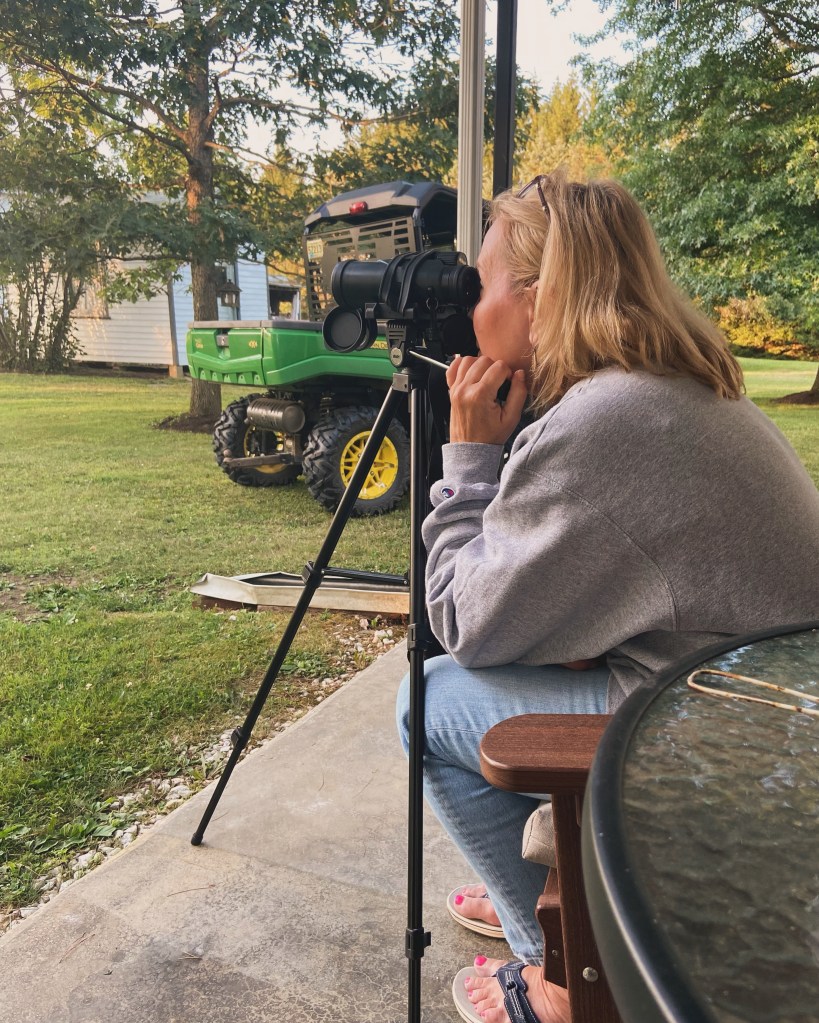
And I began my own birdie chronicles. At our place upstate, I filled my new feeders with two different kinds of seeds and waited on the back porch–coffee in hand, binoculars at the ready–to meet my new birdie friends. The sparrows arrived first, three days later, followed by mourning doves and finches, cardinals and grackles, chickadees and tufted titmice, red-winged blackbirds and rose-breasted grosbeaks among others. Of course, I knew none of their names initially. I would use the app to identify them by sound or feature, then–thrilled by each discovery–add each visitor to my ‘Life List.’ I would listen to their chirps and calls, and learned to distinguish a blue jay from a chipping sparrow, a chickadee from a chimney swift. 

Funny isn’t it, what you learn when you pay attention? When you’re open to new ideas and experiences? 

For years and years–our whole lives, actually–hubby and I heard the hoo-hoohs from within the fields and finger woods surrounding his family home and said definitively, That’s an owl. Even though we’d never seen said owls, never observed them hitting those mournful notes. Never questioned why we heard ‘owls’ at all times of day, even though owls are nocturnal.

Turns out what we thought were owls hooting were actually mourning doves cooing. 

Turns out, I didn’t know there were so many varieties of sparrow, that birds ‘bathe’ in dirt, that–magnified–blackbirds are iridescent. I didn’t know that bird voices are similar to human voices, in that they change depending on why they’re vocalizing, on ‘whom’ they’re addressing. That squirrels, when agitated, chitter like monkeys.

Back home a few weeks later, I bought more feeders, more seed, and a conical squirrel baffle to discourage invaders, then sat on my deck–coffee in hand, binoculars at the ready–to meet my new birdie friends.

Turns out suburban birds aren’t as sociable.

Enjoying my coffee and admiring my new birdie friends upstate. Hubby let me borrow his binoculars.

The same bookstore trip I bought Chronicles on a whim, I on-purpose bought Salman Rushdie’s Knife. I’ve read nearly all of his other works and had agonized about his recovery from the August 2022 knife attack that almost killed him. I wondered, how on earth can anyone move on after such deliberate, personal violence? Not just physically, but emotionally. Psychologically. How do you answer a world seething with hatred, with destruction? 

I read his memoir over two days. Turns out, he and Tan have similar outlooks. Similar motivations for their most recent books. 

Whereas Rushdie had been literally, physically attacked by a black-clothed, would-be assassin he calls the A–, Tan felt figuratively attacked by a world she no longer recognized. Which is not the same thing, of course, not at all, yet here’s my point–Either or both could have answered violence with violence. Could have sought revenge or their attackers’ destruction. 

Instead–

Tan sought peace in the natural world outside her window. 

Instead–

Rushdie sought healing, not only of his body but of his psyche. Not so much asking himself, Why did this happen to me? But rather, What is the meaning of this thing that happened to me? 

His answer? “One of the most important ways in which I have understood what happened to me, and the nature of the story I’m here to tell, is that it’s a story in which hatred–the knife as a metaphor of hate–is answered, and finally overcome, by love…. One has to find life….One can’t just sit about recovering from near death. One has to find life.”

Yes, I say. Absolutely. 

*****

I too become overwhelmed  by the barrage of hatred and division in our world. 

I too choose to push back against it.

I garden and hike, I observe the natural world and build my backyard sanctuaries because doing so settles my anxious, fretful brain.

I read to find answers, to discover new voices and perspectives, because while I may sometimes feel alone in my journey, I know I am not.

Some call those pursuits hobbies. I call them engines. They power me out of my first person default and remind me I am part of something bigger. That there are forces, yes, beyond my control, but also that the creative impulse–the urge to “find life”–possesses greater power, greater healing, than the urge to destroy, and that I have an obligation to share that understanding.

Which is why I write.

Which is why Tan shared her journals and Rushdie shared his recovery.  Both recognize that the creative urge is a life force, the antidote to despondency and chaos. 

“It has been said, I have said it myself,” Rushdie explains, “that the powerful may own the present, but writers own the future, for it is through our work, or the best of it at least, the work which endures into that future, that the present misdeeds of the powerful will be judged. But how can we think of the future when the present screams for our attention?…A poem will not stop a bullet. A novel cannot defuse a bomb. Not all our satirists are heroes. But we are not helpless. Even after Orpheus was torn to pieces, his severed head, floating down the river Hebrus, went on singing, reminding us that the song is stronger than death.”

But we are not helpless.

Yes, I say. Absolutely. 

*****

A day or two after my birdie friend and her mate occupied my birdhouse, rain moved in and hubby and I headed upstate once more. I looked for them upon our return home several weeks later, but they had vanished. The house’s back door lay on the ground, twigs and fluff from their nest lay scattered upon it. Within, there were no eggs nor remnants of shells. Had they been chased off? Or had they flown off willingly, their babies successfully launched? I never discovered their fate. 

Meanwhile, red and gray squirrels had circumvented my feeders’ defenses. They had learned to unlatch the suet cages, to jump on the feeder roofs and scatter their seeds to the ground. A few diehard sparrows pecked at the leftovers, but other songbirds refused to visit, instead settling as was their habit on the tallest branches of the surrounding pines and maples. No matter where I moved my feeders, no matter the variety of seed I offered, they remained determinedly aloof. Now fall has arrived, and the night skies fill with migratory flocks while I sleep.

No matter, I’ll keep trying. I’ll continue building my backyard sanctuary. Because spring will return and so will they.

I hope.

I’ll keep you posted. 

*****

Reading Challenge Update:

As of September 30, I’ve read 82 books toward my 2024 goal of 100, which Goodreads tells me is seven ahead of schedule. I’m nearly finished Judi Dench’s pseudo-memoir Shakespeare: The Man Who Pays the Rent, and I’ve just begun Victory City, which Rushdie had finished shortly before the events discussed in Knife. 

*****

Excited to share….

My short, short story ‘He Could Have Read Her Signs’ appears in a recent issue of Quail Bell Magazine. You can read it here.

*****

Coming up on MY NAME WAS SUPPOSED TO BE ELIZABETH ANN….

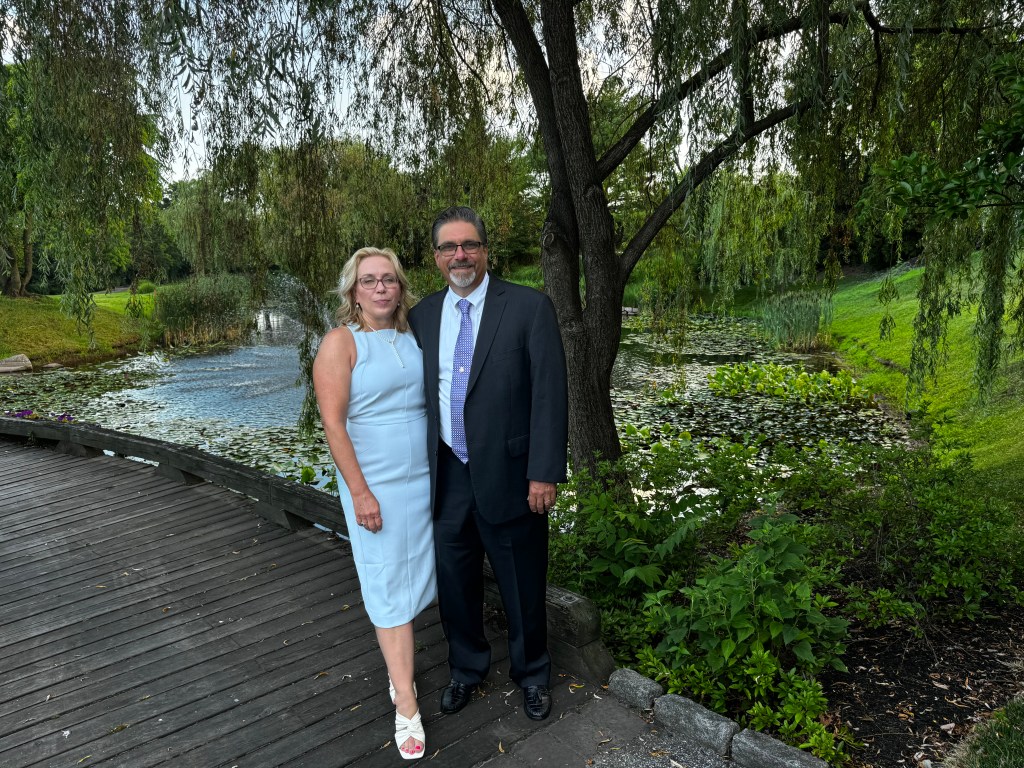
Yep, this post is a week later than normal–Hubby and I were away celebrating our 35th!! wedding anniversary. Because when you find a good one, you hold on and you definitely, definitely celebrate. Here we are back in July, celebrating our friends’ daughter’s wedding:

And here we are on our own wedding day, back in October 1989:

*****

Next up in November, a profile of one of my reader friends (fifth in the occasional series ‘BOOKS THAT MATTER AND THE PEOPLE WHO LOVE THEM’),

And in December, I’ll be revisiting a series on media literacy I began in 2021 (but never finished!!). You can read the first posts here and here.

*****

Any impulse books in your TBR pile? Any books you’d recommend I add to mine? Drop a comment below 🙂

Thanks for reading!! Thanks for sharing!!

At a recent online book club meeting, after we’d discussed Remarkably Bright Creatures but before deciding on titles for the fall, the group’s moderator—a friend of mine from college—raised the issue of character versus plot driven books, which type we preferred and which authors we believed “better” at it, which led us to chat about classic literature–meaning, the ones we’d studied in college– and how authors of Western canonical texts seemed more focused on “big ideas” than people. Their themes, she said, seemed both the construct of and rationale for their narratives’ unfolding.

You’re the English teacher, Michele, she said. Why do you think that is?

Uhhh…

Mid-answer, our Zoom session abruptly ended. 

Conversation trumps diatribe every single time. 

In literature as in life, WHO tells the story is as important to understanding its meaning as is HOW, WHEN, and WHY authors and characters tell their stories the way that they do. 

Historians would agree. So would children. Just ask any kid trying to wheedle permission from a reluctant parental. 

Perspective matters. So does audience. 

Ever read Life of Pi? A writers-blocked author’s quest for a story idea frames the wondrous first-person tale of Piscine Patel, who as a young man survives a shipwreck that kills his immediate family and nearly everyone else on board. In one story Pi tells, “everyone else” means an orangutan, a zebra, a hyena, and a Bengal tiger named Richard Parker. When insurance agents challenge that version, he tells another story, wherein animals become metaphors for human survivors and his own base nature.

Which version of events do you prefer? Which version of events do you believe?

Answers to those questions in no way change the “facts” of his survival. However, they reveal oceans about you, the reader.

Consider Gone Girls Nick. I bet your interpretation of his character changes  once Amy “returns” from the dead. I bet your interpretation of hers changes, as well, once you “meet” her in first person. 

What about The Handmaid’s Tale, also first POV? When Offred steps into the dark van, is she headed to freedom or death? Readers speculated for over 30 years until its much-anticipated sequel, The Testaments, was released in 2019. Were you vindicated? Mistaken? Duped? How do the sequel’s new voices color your understanding of Offred’s, and how has YOUR life and worldview changed since meeting her?

Yes, the first person narrator is a puzzle and an imp. Frequently–but not always–unreliable. I’m thinking specifically of The Kite Runner’s Amir, who reveals his flaws rather than excuses them. Initially to make himself feel better, but ultimately to atone for his mistakes, to address the harm his actions cause the innocent Sohrab. It’s like he realizes we can’t avoid repeating his mistakes unless he reveals the darkest, ugliest parts of his soul.

Perspective matters. So does audience. 

What do you think Huck thinks about James?

That’s why I love dual and multiple timeline stories, dual and multiple POV narratives, because no one’s story belongs solely to the individual. 

Protagonists in Kate Morton’s novels never resolve their present-day conflicts until they confront those initiated by people and events long-buried. The protagonist of Anne Berest’s The Postcard  must do the same.

Cold Mountain belongs to Ada AND Inman. You can’t understand why he comes back without understanding why she stays.

Annie dies on page one of After Annie, yet she is the lodestar by which her daughter, husband, and best friend navigate their grief, each journey as unique as their relationships.

A giant redwood and a New England cabin are central characters in The Overstory and North Woods, respectively. Their arcs are revealed over centuries, through dozens of interactions with dozens of human characters, most of whom remain ignorant of their connections and the scope of their influences. Readers, know, however, because of their authors’ deft storytelling.

And let’s not forget the brilliant symphony that is Girl, Woman, Other. Twelve different women, twelve seemingly disparate melodies. And then… the volta midway through the novel when suddenly, naturally, everything harmonizes.

Literary critics might quibble with my definition, but I consider those narrative structures modern iterations of the traditional Western literary canon’s omniscient voice. You know, that all-seeing, all-knowing god-like narrator who’s going to tell us like it is. Going to tell us THE TRUTH. 

Usually–eh-hem–that voice belonged to a certain kind of narrator, with a certain kind of educational, cultural, and ethnic background similar to its author’s. 

In grad school, we used to call them DWEMs.* 

Now, don’t get me wrong. I love quite a bit of DWEM canonical literature. I on-purpose enrolled in three separate Shakespeare seminars, I have devoured nearly everything by Dickens and Hardy, I find Strindberg’s plays oddly compelling, and Blake and Frost are two of my favorite, favorite poets.

Yet.

For two years after earning my Master’s in English Lit, I strived to read primarily women writers and writers of color. International writers and writers whose worldviews and experiences were foreign to my own. Some of them I absolutely hated. Some of them I absolutely loved.

I appreciated all of them, however, because they illuminated this valuable perspective: 

Conversation trumps diatribe every single time.

*****

To paraphrase Thomas C. Foster in How To Read Literature Like a Professor, every story ever told is actually a variant of only one story–the story of what it means to be human. 

When Zoom restarted, I finished my micro-summary of literary history, how stories used to venerate the gods and their mortal stand-ins, how narrative structure and voice have changed (in part) because our world has changed–because our experiences of what it means to be human have changed. 

Story, therefore, is a means through which we can discern others’ worldviews and values in other places and times. Through which we can maybe–maybe–discern our own more clearly by comparing and sharing our understandings.

If we listen, and if we are listened to. If we welcome those conversations.

Some critics argue that contemporary narrative structures reflect cultural fragmentation–that stories are cobbled from pieces because we are in pieces. Others suggest their complex constructions reflect our increasingly complex (and complicated) daily lives.

I think both explanations are valid, but I also think such stories highlight our yearning to connect. Our need to feel like we are part of something bigger, something communal, that first POV can’t quite pull off. I think that’s part of the reason why The Heaven and Earth Grocery Store resonates–not despite the fact of its many, many characters, but BECAUSE of them. At least, that was my book club’s consensus, about McBride’s book and about Creatures, even though Creatures is partly narrated by an octopus.

Perspective matters. So does audience. And in real life, as in literature, no one’s story belongs solely to the individual. 

I liken contemporary writers’ multiple POVs and timelines to the classical Greek Chorus. Remember how they trod onstage and commented on everything the tragic hero did and should have done instead? Remember how the hero always ignored the Chorus’ insights, because the hero always thought he knew better?

If only those arrogant bastards would have listened to each other, perhaps tragedy could have been averted.

Truth.

*****

If you haven’t already, check out some of these terrific reads I mentioned in this post. I’d love to hear your thoughts and recommendations:

Remarkably Bright Creatures (Shelby Van Pelt)

 Life of Pi (Yann Martel)

Gone Girl (Gillian Flynn)

The Handmaid’s Tale & The Testaments (Margaret Atwood)

The Kite Runner (Khaled Hosseini)

James (Percival Everett)

Kate Morton (I’ve read all her books, but my favorite is The Clockmaker’s Daughter.)

The Postcard (Anne Berest)

Cold Mountain (Charles Frazier)

After Annie (Anna Quindlen)

The Overstory (Richard Powers)

North Woods (Daniel Mason)

Girl, Woman, Other (Bernardine Evaristo)

How To Read Literature Like a Professor (Thomas C. Foster)

*****

*Dead White European Men, in case you were wondering

*****

Reading Challenge Update:

As of Wednesday, I’ve read 72 books toward my 2024 goal of 100.

I’m also about midway through Judi Dench’s SHAKESPEARE: The Man Who Pays the Rent and 60-some pages into The Water Dancer by Ta-Nehisi Coates, which has been in my TBR pile FOREVER. 

*****

Next up on MY NAME WAS SUPPOSED TO BE ELIZABETH ANN–

I have no clue! I’m working on several different pieces and haven’t yet decided. I’m as curious as you are to find out, lol 😉

*****

Thanks for reading!!

(fourth in an occasional series on BOOKS THAT MATTER & THE PEOPLE WHO LOVE THEM)

Forecasters had called for up to three inches of snow and high winds the mid-February day I spoke with Abigail Greenwood. A cozy fire flickered against one wall of  her virtual background, while through the windows of another, a cheerful snowman embraced softly falling snow. She apologized for being late. Her six-year-old daughter had been sick the previous day and she’d been debating sending her to school, thinking with the impending storm the district would close or at least delay opening. Yet neither occurred, and she rushed getting her daughter ready and on time for school.

The last time Abby and I had spoken at length, she was a student herself, a sophomore in my Honors English, and I was the frazzled mom trying to get my kiddos out the door. I remembered her as a quiet, diligent student, more focused on science than literature yet always eager to invigorate our discussions with thoughtful, insightful commentary. We’d reconnected over Facebook some years after she graduated, exchanging only occasional comments as ‘friends’ do on social media. Imagine my delight then, when she began posting original poetry and art and asking for feedback. She’d created a blog and a website, and now a page for her creative endeavors using the pen name Mindful Muser. 

Of course I wanted to know more.

Smiling, she adjusted her ponytail. “I’ve been writing for years,” she said. “But it took me a while to openly share what I write because it’s so personal.” Now, she “[likes] to prove people wrong,” but her younger self was more of a pleaser, lacking confidence and unwilling to speak out in class or ask questions when unsure of her understanding. 

She attributes much of that hesitation to her struggles with reading and grammar in first grade, when she was nearly made to repeat the year. “Reading became work then,” as she tried, successfully, to keep herself from being held back. However, she loved being read to and recalled with much fondness the variety of stories her librarian grandmother shared. “She just never wanted to limit me,” Abby said. “She wanted me to see how big the world really is” and would offer African folktales alongside Stewart Little and Abby’s favorite book about rocks and minerals. 

It’s an approach she now takes with her own daughter. While Abby shares childhood favorites and books that reflect her and her daughter’s experiences, she also shares titles representative of disparate cultures and worldviews as a way to develop empathy and encourage conversations about difficult topics. “I want her to see things from all different angles,” she said. “Age appropriately, of course.” 

Abby recognizes the role that literature has played in helping her to find her voice and recalled a pivotal moment during our study of Harper Lee’s To Kill a Mockingbird. My sophomores typically misread the scene in which Bob Ewell dies, incorrectly concluding–like Atticus Finch–that Sheriff Tate’s official version of events is a coverup intended to shield adolescent Jem Finch from prosecution. Sometimes I would act out the scene for them. Sometimes I would call on students to play each role, directing them as if on stage to act out Scout Finch’s in-the-moment narration.

Breaking down the scene like that allowed them not only to see events unfold as Scout does and identify Bob’s killer, but also to understand why Bob’s death must be determined accidental. For Abby, understanding went further. She began to see books differently, not merely as informational texts nor for entertainment, but as puzzles. A way to further her understanding of herself and the world beyond her own experience of it. “I also found myself admiring [authors’] different writing styles. [Doing so] gave me insight as to how I wanted to cultivate my writing style.”

I saw that insight evidenced in our post Mockingbird research project. Assigned to investigate an element of 1930s American culture, Abby wrote a series of carefully researched and compelling letters detailing a fictional character’s struggle with her mixed race heritage, which was published in an edition of our school’s newspaper and literary magazine. (Then, I was also its advisor.)

However, although she enjoyed writing creatively and wanted to devote more time to it, the demands of college and career took precedence. Eventually, she told herself, she would prioritize her writing, but it wasn’t until her daughter’s birth that “eventually became now.”  

And just a few weeks ago, she self-published an e-book of her poetry, Built With Broken Pieces, a debut several years in the making and attributed to her pen name, Mindful Muser. Each of its 27 somewhat autobiographical poems meditates on her complex relationship with love’s many manifestations, and arose, in part, from a desire to face her fears and “lingering self-doubt. To build self-confidence [and] push past [her] insecurities.” She also hopes that sharing her writing will encourage others to “feel seen” and share their own stories, which experience has taught her requires tremendous courage. 

I love that, and I love that her creative journey continues. Currently, she is developing short story ideas on Wattpad and working on a print edition of Pieces that will include additional poems. 

“I also want to write children’s books,” Abby said. Unlike her writing to date, however, “I won’t be using my pen name for those.”

Her younger self would be justifiably proud.

*****

ABIGAIL GREENWOOD is an aspiring author and poet who enjoys books that make her think,

especially those that ask tough questions about civilizations’ ugly chapters. “Seeing different perspectives helps us see and feel the humanity of the experience and to understand why people do what they do–even the bad guys. It helps us understand life’s ‘grays’ and act accordingly.”

She also enjoys books devoted to self-help, self-care, parenting, meditation, and DIY. A recent favorite was Gardening for Dummies. “This is not a joke,” she said. “I really killed every plant I owned, including bamboo.”

Connect with her at Siren Song Poetry, through TikTok or on her Facebook page, “Don’t Talk. Just Write.

a few BOOKS THAT MATTER to Abigail Greenwood

For children:

How to Train Your Dragon series by Cressida Cowell

My Bed by Rebecca Bond (pictures by Salley Mavor)

Love You Forever by Robert Munsch

What Would Darla Do? by Ganit & Adir Levy

For anyone:

The Book of Night Women by Marlon James

The Painted Girls by Cathy Marie Buchanan

Sarah’s Key by Tatiana de Rosnay

Looking for more posts in this series?

You can find them HERE, HERE, and HERE.

Coming up on MY NAME WAS SUPPOSED TO BE ELIZABETH ANN–

It’s A Matter of Perspective: On omniscience, unreliable narrators, and the ownership of ‘TRUTH’

Thanks for reading!

While I’m away, a story from the archives…

To give a thing a name, a label, a handle; to rescue it from anonymity, to pluck it out of the Place of Namelessness, in short to identify it—well, that’s a way of bringing the said thing into being.

— Iff to Haroun in Salman Rushdie’s Haroun and the Sea of Stories

This is the story my mother told me:

A few weeks before their due dates, my twenty-three-year-old (almost) mother chatted long-distance with her friend, Dorothy, whom she met at Fort Bragg. After Uncle Sam drafted their baby-faced husbands and shipped them off to Vietnam, Dorothy returned to Ohio and my mother to Philadelphia, where she lived with my father’s family while awaiting my birth. My mother tells me the friendship was a source of comfort despite their geographic distance. Though both women were surrounded by family, each felt an isolation that only the other could understand. Which partly explains why my mother never told Dorothy how angry and hurt she was by what happened next. Dorothy, who hadn’t decided on baby names as of that conversation, delivered her daughter first and named her Elizabeth Ann–the name my mother had reluctantly revealed she had always intended for her own child.  

So I became Michele Elizabeth. Michele with one L. Remember that. It’s important.

*****

In Salman Rushdie’s Haroun and the Sea of Stories–a wonderful book, by the way. You should read it–Haroun’s father Rashid, a professional storyteller, “[runs] out of stories to tell” after his wife runs off with the neighbor. Iff the Water Genie reluctantly agrees to help  Haroun reconnect Rashid’s access to Story Water, the magical source of Rashid’s extraordinary gift, and tells him to select their means of transport. “Pick a bird…any bird,” Iff insists, which makes no sense to Haroun. They’ve met accidentally in a houseboat bathroom, and the only bird Haroun sees is a wooden peacock bed, incapable of flight.

“Iff [gives] a snort of disgust. ‘A person may choose what he cannot see,’ he [says], as if explaining something very obvious to a very foolish individual. ‘A person may mention a bird’s name even if the creature is not present and correct: crow, quail, hummingbird, bulbul, mynah, parrot, kite. A person may even select a flying creature of his own invention, for example winged horse, flying turtle, airborne whale, space serpent, aeromouse. To give a thing a name, a label, a handle; to rescue it from anonymity, to pluck it out of the Place of Namelessness, in short to identify it—well, that’s a way of bringing the said thing into being. Or, in this case, the said bird or Imaginary Flying Organism.’”

The Genie opens his fist, and Haroun’s “eyes almost [fall] out of his head.” Creatures smaller than fingernails cavort on Iff’s palm.

Names, you see, are magic.

*****

Here is another story:

When I was four and my brother was three, my mother told us we would be getting a new big brother and sister. The details arise in my memory like photographs looping through a slideshow. Me seated at my play table behind the front door, Barbie on my lap. Philip sprawled on the floor pushing a truck. My mother, hair headbanded and looking equal parts flustered and severe. My father is absent, though he could not have been. The doorbell rings. The dogs scamper and bark. A matronly social worker enters with two children. Share, Mom had told me and Philip. And be nice. So I ask my new big sister if she wants to play Barbies.

Her name is Michelle, with two Ls.

*****

Big Michelle sticks.

Little Michele does not.

I become Michele Elizabeth, all one word. Micheluhlizabeth. Then Elizabeth, but only within the family. Not in school, not among my friends, never at work. I meet my husband and tell him, I’m Michele. People who know these stories ask, Why didn’t you change your name? Surely it was confusing, a sister with the same name? How on earth did you manage?

By a P2C2E. A Process Too Complicated to Explain. This is Iff’s answer to all of Haroun’s impossible questions, and it is partly the answer to my own. Truthfully, part of me did not acknowledge the chaos.

Most of me delighted in it.

*****

The summer I meet my new big sister, the six of us, our two dogs and a turtle travel to Ohio, where I meet Elizabeth Ann. A year or two later, her family travels to Philadelphia. Eventually, our families lose touch. Why, my mother does not recall. Nor do I recall much about the girl. She was nice enough and had brownish hair. 

Now, I wonder whether she knows the story of her name. Whether her mother knows that in stealing from my mother, she magicked a unique landscape for my childhood.

*****

My name was supposed to be Elizabeth Ann.

I’m glad it’s not.

*****

What’s the story behind your name?

Drop a comment below! I’d love to hear it 🙂

I have a confession to make.  

In April and May,  I watched waaay too much (for me) Monday night television. 

More on that in a bit, but first–StoryADay.

For years, I had put off joining the May challenge because I mistakenly thought I had to write a ready-for-readers story every day for thirty-one days and there is no way—NO WAY—I can do that. Other people, maybe, but not me. 

In 2019, however, I decided to try, and I’ve participated every year since.

Turns out there are only two basic rules for the StoryADay May writing challenge: 

First, Make your own rules for the challenge and, 

Second, If you miss a day DO NOT GO BACK.

Seems contradictory, right? I mean, what if one of your rules is that you can go back if/when/whenever you want? 

I mean, that’s what I do sometimes.

Anyway, this year I knew I wouldn’t be home much during the challenge, and I knew I wanted time to finish a separate project, so in April I decided I wouldn’t worry about writing stories, per se, with beginnings and middles and ends. Instead, I would take any one or more of seven characters I’d outlined, then plop them into each day’s prompt and play with them like dolls to see how they’d behave.  I would read the daily prompts with my morning coffee, but I would complete them whenever I could. Sometimes that was first thing, and sometimes that was the end of the day. I gave myself permission to skip any prompt that just didn’t seem to work for that framework, and permission to return to prompts I didn’t want to skip but couldn’t complete on that particular day. 

Most importantly, I would complete more of the prompts than I skipped, and I would not under any circumstances just quit. 

Oh, and I would have fun.

Complicated? Maybe. But it was a challenge, you see, and I wanted to win.

The challenge isn’t just about winning StoryADay May, it’s about winning StoryADay next–whatever that means to each participant.  

Speaking of winning,  I don’t watch a lot of television–I’d much rather read–but one day last winter when I was out of books and it was too icy and dark to be outside, I started watching ‘The Voice’ with my husband, who had turned it on for background noise. 

If you’re unfamiliar with its premise (I was), ‘The Voice’ is a competition wherein amateur and/or semi-professional singers vie for a recording contract and $100,000. Four celebrity musicians select and coach their teams, then pit teammates against each other in order to decide who advances and who goes home. After each coach wittles their team to three, the show’s viewing audience assumes control, by using an app to vote for their favorite performers during the competition’s final live broadcast weeks.

Yes, I downloaded the app and yes, I voted. And when season 25 began, I watched that too, and on Mondays I sometimes watched ‘Deal or No Deal Island,’ a different pseudo-reality competition which came on after ‘The Voice.’ THREE HOURS of television, but I had to watch. I had to see who won. Such validation, yes? in winning. Not just for the competitors but for their supporters. All that reflected glory. 

Sadly, however, none of my preferred contestants won, though they were all in the top four of both series. Oh well. More time to read, I thought, and continued on with my life, but then a few days after their finales, my Instagram feed highlighted a photograph of one series winner showered in confetti. I clicked on the comments, which I almost never do, and was unsurprisingly appalled at the level of vitriol and animosity directed at the winner and the voting process. To paraphrase, the comments’ authors either agreed that the winner deserved to win, or they insisted that the voting was rigged because their preferred contestant lost. Clearly their candidate was the best winner ever, so what other explanation could there be for his/her/their/loss?

People, puh-lease.

Candidates usually lose because more people voted for the other guy.  

*****

While the daily StoryADay prompts followed a structure similar to past years’ (mornings, you get an email with the prompt and a few tips), 2024’s challenge came with an optional Handbook containing not only more detailed versions of each prompt, but also explanatory videos, warm-ups, and brainstorming activities. During May, Handbook content was unlocked one day at a time (no cheating!), but come June 1 (today, in fact) anyone with access can revisit any of its resources whenever and however they want. 

I love that, because you see the challenge isn’t just about winning StoryADay May, it’s about winning StoryADay next–whatever that means to each participant.  

In other words, winning isn’t only defined by doing ‘the thing’ or being showered with confetti and accolades. That’s part of it, of course, and lovely when it happens, but that approach, I believe, is only appropriate for toddlers and t-ball competitions, not life. Winning, I believe, is defined not by participation trophies but by what you learn while striving. By how you’ve grown and evolved, and how you’ll apply those lessons to the next challenge you face or accept. 

And, let’s not forget, by how you respond to others’ successes.  

*****

I still prefer classical music to most genres, and reading to watching television.  

I still can’t write a reader-ready story in a day, and sometimes life is so distracting I can’t concentrate to read. 

However, in May’s thirty-one days, I read nine and half books, abandoned six at about their 50-page mark, and started three more. I wrote to 23 StoryADay prompts, plan to return to two more, and have a more complex and detailed understanding of my seven characters’ characters. I’m almost finished with that other project I mentioned, and I’ve added several previously unknown artists and less familiar genres to my music playlists. 

Oh, and I definitely, definitely had fun. 

This time last year, not so much.

So what do you think? 

Do I win?

*****

So how do you define success? Of what recent accomplishment are you most proud?

Drop a comment below 🙂

Coming up on MY NAME WAS SUPPOSED TO BE ELIZABETH ANN —

I usually post the first Saturday of each month, unless LIFE.

Next up in July: Part four of my occasional series on BOOKS THAT MATTER AND THE PEOPLE WHO LOVE THEM, a profile of one of my reader-writer friends. Look for it the third Saturday, lots of LIFE for me and mine between now and then.

And coming up in August: It’s All A Matter of Perspective

Thanks for reading!

Here in my corner of Pennsylvania, the first half of April was rainy and cold, but the second half was beautiful. Sunny blue skies and (mostly) seasonal temperatures, perfect for digging in the dirt. Hubby and I weeded and trimmed and mulched, and then I turned my attention to spring cleaning my secret garden, so named because low-hanging pine branches used to hide its hillside entrance. 

My secret garden, pre-makeover

At some point, I took a break from yard work and headed to the bookstore to spend my gift card stash on several titles whose April releases I’d been eagerly anticipating: Knife by Salman Rushdie, Table for Two by Amor Towles, The Backyard Bird Chronicles by Amy Tan, and Shakespeare: The Man Who Pays the Rent by Judi Dench.  I also wanted to buy a new journal for the upcoming StoryADay writing challenge, the fifth year I’ve participated. After considering each one on offer, I picked the perfect notebook for me: lined, small enough to tuck in my bag, with an appealing cover and a just-right thickness, weight, and number of pages. 

But when I arrived back home–after I’d already written on page one–I realized my perfect journal had been bound upside down. 

Ugh.

I tried not to think about it.

I thought about it all the time, each time I opened to the next blank page and couldn’t write a word. Receipt in hand, I returned it to the bookstore, explaining what had happened. How I just couldn’t, once I’d realized. The clerk smiled, and gave me my money back, which I then used to buy another journal just like the first one, except properly upside-up bound. (I checked!) The clerk smiled again, then handed me the imperfect copy. I could keep it, he told me. Use it for whatever. He’d have to throw it away otherwise.

So now I have two copies.

Can you guess which journal I’m using for StoryADay?

During the pandemic and those awful months of quarantine, my concentration suffered dreadfully. I, who once-upon-a-time simultaneously read multiple books in multiple genres, struggled to read anything longer than poetry, essays, and short stories. I abandoned more novels than I could make myself finish. I read only one thing at a time, one thing after another.

This year, however, I’m making up for lost words. I’ve read nearly forty books so far, and I’m striving to read 100 or more by year’s end. My five favorites so far: Remarkably Bright Creatures by Shelby Van Pelt, After Annie by Anna Quindlen, The Book Of Lost Names by Kristin Harmel, James by Percival Everett, and The Postcard by Anne Berest. Each beautifully depicts flawed yet powerful characters shackled by pasts none of them created, each of them struggling mightily to break free and to forge better tomorrows–Whatever that means for each of them and whatever that could mean for their readers. I love that. I love books and characters who speak to me long after I’ve turned their final page, and each of those five definitely do. 

As I write this, I’m about halfway through The Love Songs of W.E.B. Du Bois by Honoree Fanonne Jeffers, which has been on my TBR shelf (yes, I do have a designated shelf in my library) since 2021. I have to say, Songs is pretty intense. Unsettling. I considered, briefly, putting it aside, but Ailey and her ancestors hollered at me, DON’T YOU DARE. Clearly, they have something important to tell me. Clearly, I need to read through to the end to discover just what.

I’ll keep you posted.

My TBR shelf, though–CONFESSION–several other titles lie scattered throughout my house, and my phone lists about twenty more I have yet to acquire 😉

Raking, weeding, and tidying my secret garden took about a day and five lawn and leaf bags. Everything else took about a week and three trips to the garden store. I’m still waiting for the table I ordered, and I’ll probably need more stone and topsoil and maybe a bird feeder. I don’t know.

Meanwhile, if you want to talk books or StoryADay, you know where to find me: 🌸

My sunny day happy place. The table is on loan from my deck.

*****

What are you reading and writing this month? Anything you’d recommend I put on my TBR shelf?

Drop a comment below 🙂

Coming up on MY NAME WAS SUPPOSED TO BE ELIZABETH ANN —

I usually post the first Saturday of each month.

Next up in June: EYES ON MY OWN PAGE & ALL THINGS STORYADAY MAY

And in July: part four of my occasional series on BOOKS THAT MATTER AND THE PEOPLE WHO LOVE THEM, a profile of one of my reader-writer friends

Thanks for reading!

(third in an occasional series on BOOKS THAT MATTER & THE PEOPLE WHO LOVE THEM)

Leslie Stack speaks in tongues.

Not like that. 

Like this:

While listening to audiobooks, Leslie has a subconscious tendency to assume their voices, mimicking them with convincing accuracy. Once, when her two sons were boys, they drove to Washington DC to visit the Smithsonian and tried using the Metrorail to navigate the city. After missing their train, they perused the schedule board to determine a better route, and as she considered their options a man nearby interrupted to ask what part of London she was from.  Chagrined, she blushed and admitted to playacting. She’d been channeling Jim Dale, narrator of the Harry Potter series she and her boys were reading. 

Her boys just rolled their eyes. “They’re used to me,” she said, shrugging. “I do it all the time.”

And no wonder. 

When I asked Leslie to explain her bio’s claim that her books are “plotting to take over,” her description of her house sounded like a description of a library, with bookcases in every room and every shelf teeming. There’s a memoir shelf, a biography shelf. Shelves for history and inspiration. For travel and quotations. Fiction and how-to. There’s even a book closet and a shelf that contains only books she rereads. 

Smiling, she leaned toward the camera and tapped a black ballpoint against her mouth. She’d wanted to be prepared for our video chat and had taken detailed notes. “It used to be much, much worse,” she confessed.

Worse? I wondered. 

That sounded like heaven.


“[You should] put as many books as you can in front of kids. You need to give them that opportunity.”

In books as in life, there are people who try to learn from their mistakes, and people who won’t. People who reflect on their own and others’ tribulations and determine to do better, and people who use their own suffering as justification for self-interest. No one helped me, those latter types say. Why should I help anyone else?

In books as in life, I am no fan of those types.

Leslie, however?

Her, I like.

While Leslie’s relationship with books is a signature theme of her adult life, influencing personal and professional endeavors as a musician, educator, writer, and mom, she wasn’t always as possessed by books as her Metro memory suggests. 

In fact, she told me “reading was not a big thing” in her childhood family. Her history teacher mother’s resources populated a single bookcase, and their Maryland home’s isolated location made acquiring books difficult. “Other than school, you couldn’t really go to the library. You couldn’t really walk anywhere.” Nor did her elementary school seem to encourage reading for pleasure, instead limiting access to its library to scheduled turns. “And if you missed your turn for whatever reason,” she explained. “You had to wait.” Middle and high school routines followed similar patterns.

So what changed? 

She recalled reading My Side of the Mountain and the Little House series, then borrowing her mother’s books on the Holocaust at around age twelve. But it wasn’t until she earned her driver’s license at about 17 that the literary world began to open up. She began driving herself to bookstores and libraries, and reading about significant American events and figures such as Kent State, Woodstock, and JFK. However, she didn’t really fall in love with books until her early twenties, when she moved to Norfolk and began working full time in Virginia’s Old Dominion library.

“That [experience] was definitely a turning point for me,” she said. 

Decades later, the memory still evokes a noticeable joy. Typically, she explained, you go to a library or bookstore and you head to the same sections because that’s what you like. That’s what you know. When you work in a library, however, you have to shelve books. All kinds of books in all kinds of genres about places and people and subjects you’ve never heard of, let alone known to imagine. She would peruse the carts of new titles and titles needing to be reshelved, then investigate the sections of ODU’s library where they were housed. “I saw what I’d been missing,” she said. “And from that point on, I was hooked.”  

A self-described lifelong student, Leslie constantly seeks opportunities to learn something new and to create those opportunities for others. She gravitates toward stories about overcoming and about people (real and imagined) striving to make our world a better place for all of us because such works inspire and challenge her to be her best self. 

And that’s one of my favorite parts of Leslie’s story.

While she “didn’t have the mentors or teachers [she] needed,” she loves “helping others to become lifelong learners” and tries to be the type of role model her younger self needed. That theme is key to understanding why books matter to her and why she believes you should “put as many books as you can in front of kids. You need to give them that opportunity.”

Just as she did in her own classrooms and with her own family.

“Because you can’t have peace without hope,” Friday nights, she, her husband, and boys would have dinner at Peace A Pizza and dessert at Hope’s Cookies before heading across the street to Borders. The four of them would scatter to their favorite sections, then gather their finds and meet in the store’s cafe to compare notes. While her sprawling home library includes works from some of those forays, most were discovered in independent bookstores or secondhand at the flea markets and thrift shops she and her husband love to treasure hunt.   

Eventually, her collection numbered in the thousands, spilling from the shelves into the hallways and stacked in teetering columns. Even the basement housed the portion of her collection intended for students and other recipients. Whenever someone expressed an interest in a new (for them) subject, she’d recall her own reading and scurry downstairs to retrieve titles she thought might meet their needs, then she’d allow them to borrow or have her copies, or note the titles and authors so they could find copies later on their own. 

Adult Leslie often wonders how child Leslie’s life might have unfolded had someone done more of that for her. 

*****

While Leslie occasionally still mimics her favorite audiobook personas, her boys are now in their early thirties and she’s cut back a bit on buying books, instead increasing her library patronage because physical copies remain her preferred medium. A few years ago when her books really threatened to take over, at least in terms of square footage, Leslie began purging her collection, donating between six and seven hundred books through the Little Free Library her husband built and installed near their local Veterans’ Park. At the time, she was serving as her Rotary Club’s president, with education and literacy issues the focus of her term, and becoming an LFL steward seemed a fitting project. You can see Leslie and her husband, Chris, in the photo above.

As our scheduled time drew to a close, I asked whether she had anything else she wanted to share. Anything else she wanted me to know. “Oh yes,” she said, rifling her notes. “My favorite quote.” 

She didn’t need those notes to recite the line perfectly. “‘Make me a blessing to someone today.’ It’s from [Jan Karon’s] Mitford series. Father Tim says it after every prayer.” She explained that the line reminds her the world’s needs are greater than the individual’s. That she shouldn’t just ask for or expect change, but rather act on things that matter most. 

I could understand why that line resonates with her and suggested it’s the thematic thread weaving together her life’s many ambitions. I’d certainly noticed it while reading drafts of her own fiction and essays over the five-ish years I’ve known her.

“Hmm,” she said, nodding and tapping her pen once more. “I like that. I never thought of it that way, you may be right. I may have to write that down.”

*****

LESLIE STACK is a musician and retired teacher who is surrendering to her love of writing. You can usually find her doing research behind dark glasses on a park bench. She lives with her husband in a house in Pennsylvania where the books are plotting to take over.

two BOOKS THAT MATTER to Leslie Stack 

MOUNTAINS BEYOND MOUNTAINS, by Tracy Kidder

The non-fiction narrative focuses on doctor and humanitarian Paul Farmer, who spent much of his life fighting disease in Haiti, Peru, and Cuba. 

A YEAR BY THE SEA, by Joan Anderson

This memoir recounts the author’s experience reinventing herself after her sons have grown and her husband takes a job far from home.

*****

Looking for more posts in this series?

You can find them HERE and HERE.

Coming up on MY NAME WAS SUPPOSED TO BE ELIZABETH ANN–

I’m working on a couple of pieces and am not yet sure which I’ll be posting next month. However, I do know I’ll be participating in May’s StoryADay challenge. This year marks founder Julie Duffy’s fifteenth challenge, but only my sixth. You can learn more about StoryADay’s annual writing challenge HERE.

Fun fact, I met Leslie through StoryADay’s online writing community.

Thanks for reading!