My Name was Supposed to be Elizabeth Ann

I write stories about stories–Reading them, writing them, living them

I’m thrilled to share that two of my stories were recently published.

The first, “Ask and Ye Shall Receive” appears in TulipTree Publishing’s 2019 anthology, Stories That Need to Be Told, available on Amazon.

The second is “The Daffodils,” featured in the November 15, 2019, edition of Prometheus Dreaming. You can read it here:

https://www.prometheusdreaming.com/the-daffodils

Happy reading!

CONFESSION: I want to write a novel.  

I have been concentrating on writing flash and short stories. But this year, I seriously considered joining  NaNoWriMo to force myself to start a longer project.  Besides, all the cool kids hang out at NaNo. They have private groups and private chats. Buddy systems wherein they delight and agonize over daily word counts and their terrible, dazzling prose.  

NEWS FLASH: I am not a cool kid.

But that’s not why I passed on NaNoWriMo.

Creatively speaking, I am more of a plantser. Which for my non-writer friends means a combination of a plotter and a (fly-by-the-seat of-your) pantser. 

Before sitting down to write, I need at least an idea of where my story’s heading, though not all the details. 

Too much planning, I become bored. 

Too little planning, I become distracted. Lost in the “muddled middle” of the first draft.

And when I’m stuck in that dreaded middle, I hear voices. See, my inner critic is not singular. It is a crowd, cacophonous and rowdy. They say, you cannot plot your  way out of this maze because your idea is bunk and you are HORRIBLE at this. Just give it up already. 

Some in the crowd whisper. Their criticisms are icy fingers poking at my confidence, more dangerous because they don’t yell. They are reasonable. Logical. They suggest more practical and quantifiable uses for my time.

Then there are those who say, Who cares? Ray Bradbury tells me, “You only fail if you stop writing.” JK Rowling agrees. “I just write what I want to write,” she says. And Maya Angelou reminds me of the terrible cost of silence. “There is no greater agony than bearing an untold story inside you.” 

Theirs are the voices I strive to hear. 

REALITY CHECK–Pantsing NaNo would be a colossal waste of my time, effort, and fledgling confidence.

There are still only 24 hours in the day. I have papers to grade, family obligations. I need time to sleep, time to read. Take a walk, spend time with the people I love. I also need time to live in my own head, to create a protected space in which my characters can speak and invite me into their worlds. That is my life’s muddled middle. 

Which has what to do with NaNoWriMo? 

THIS: To get there, I need to focus and I need to plan.

So here it is: 

For the next six months, PRACTICE, PRACTICE, PRACTICE.  Continue writing and revising one new short story each month, minimum, and sending out into the cosmos those pieces (I hope, think? Fingers crossed) are ready for the spotlight. 

Spring, NaNo prep, character interviews, and chapter skeletons. 

July, Camp NaNo.

Will it be any good?

No clue!

Wish me luck anyway.

Richard Norris Brooke’s 1881 painting “A Pastoral Visit” depicts an African American family at table with their pastor and is, according to the National Gallery of Art website, his “most celebrated [rendering of] everyday life.” It was also the subject of a Story A Day May prompt and the inspiration for my short story, “Ask and Ye Shall Receive.”

Take a look at it here: The Pastoral Visit

Beautiful, isn’t it? I’m curious–What did you notice first? 

I noticed the girl clutching her father’s knee. Barefoot, face hidden, she seems in need of consolation. Father, chin propped, leans back in his chair and studies the man at the table’s head, neither consoling nor rebuking the child. Meanwhile, Mother is all business. She is Martha, scooping food onto a singular plate as the children watch but do not participate in the meal. Even the cat must wait to eat while Preacher feasts. 

I was struck by the incongruousness of the child’s pose. The others focus on the pastor, the communion-like rituals of a shared meal. The child, however, both holds on to and turns toward her father. Away from the pastor. Why? I wondered, What had she done, just before? Why does Mother have the slightest arch to her brow? What is she thinking but not saying? Why is Sister’s gaze sideways, Brother’s wide-eyed, the look children make when they have seen and heard but are not allowed to say? And why does Father allow the child her transgression? Shouldn’t she be seated, as well, the better to hear the pastor’s inevitable invocations? 

How do we learn to be the adults we become? The more I studied the painting, the more I felt that to be its context. The four seated at the table seem somewhat fixed in their roles. The child ignoring the pastor does not. When I realized that, I heard the girl’s voice in my head. Not as a child, but as a young woman striving to make sense of that moment and its implications for her present. She began telling me her story, and I wrote it down.

Of course, it wasn’t nearly as easy as that. There were spits and starts, multiple revisions, and one Story A Day Critique Week, but by June’s end (about five weeks after the prompt) I had a story. 

You can read it in TulipTree Publishing’s anthology, STORIES THAT NEED TO BE TOLD, available now on Amazon.

I hope you like it.

With a little more than a week to go of the September Challenge, I’m happy to report I’m still in it:

  • Except for one weekend travelling and the morning after a very long Back-to-School Night day, I’ve written every day. So that’s nineteen (nearly) consecutive days–woo hoo!
  • That writing on my phone thing comes in handy. Trying to avoid being stuck in a Bridge #1 opening on my way to work earlier this week, I drove to another bridge. And became stuck in an opening at Bridge that lasted 25 minutes. I opened my Google Docs app and voila! I figured out how to write my protagonist out of the maze she’d created. (I also spilled coffee on my cream pants while I was typing, but that’s irrelevant. Focus, people.)
  • I wrote to the prompts about half of those days. Some days, I used them to generate an idea for a new story. Some days, I incorporated them in a piece I wanted to work on more. 
  • Writing each day’s goals in my planner forced me to hold myself accountable for progress and started off each day with a win.
  • You know that feeling you get when you’re immersed in a good book and you just have to keep reading to find out what happens next? Sometimes writing is like that, too. Some days, I wrote just because I needed to find out where my characters planned to take me.
  • My writing time these last two weeks has focused on “The Fallout,” a speculative short story set in a post-TMI world. It’s a companion piece to my reflection on the near-meltdown in 1979, which you can find in the BOOK TALK tab, above.  “The Fallout” still needs work, but you can find my newest revision in the FICTION tab, above. I’m going to let it sit there awhile before I polish it some more, definitely after the challenge ends. If you have any thoughts about that, I’d love to hear them. And thank you!

As for the remaining eight days…

In the May challenge, one of the prompts suggested we write the story we’ve been wanting to write all month. I have no idea whether that will feature in September, but that’s exactly what I intend to do. Its working title is “Tell Me No Secrets and I’ll Tell You No Lies” and it’s about these two kids who–

Just kidding! You’ll have to read it when I finish.

At dawn’s approach, Liv closes the cabin door behind her but does not bolt it. The Scavengers will break in, regardless, once they divine Grandmere’s passing. Besides, she has almost everything she needs secured at her back and waist. Grandmere had made sure.

She scrubs an arm across her face. Her tongue is thick, her eyes gritty and red from a sleepless night tending the fire. Its smoky remains scar a corner of the garden around which late summer fruits and vegetables riot. Above, stars wink then extinguish as the sun rises.

Once, Grandmere had explained the stars. Seemingly tiny smudges of light from unimaginable ages distant. Suspended like bright feathers, yet dense and pulsing like a heartbeat.  Our sun is a star, she’d said, but Liv could not reconcile its blinding heat with night’s ice blue and black until Grandmere’s death yesterday. Now, she is both numb and hot with grief. 

Unsheathing her knife, she  crosses to a tree and cuts several apples to add to the supplies in her sack, then with its dull edge scoops ashes into an earthen jar.  She seals it tight and secures it beneath her tunic. Ahead, the path from their door wends through the garden to a narrow opening in the fieldstone wall and the thick forest beyond. 

They will come from that direction, Grandmere said, Liv’s soothing tonic slurring her words. Friend and foe. You must be ready. 

But how will I know? A lifetime ago, she thinks.  I’ve never been farther than the next mountain.

You’ll know, child. You’ll hear me, even after.

Through the thick canopy of trees,  footsteps crunch fallen limbs and leaves like bones. 

Liv’s knife hand trembles. 

*****

Great-great Grand’Mere, at least. Older than the Great Melt and the floods and the Green Fire before. A hundred years at least before Liv’s birth. The settlement that they called home lay scarce and scattered throughout the valley, its population mainly children and young adults. Like hothouse flowers, most bloomed too quickly then faded,  still vulnerable to radioactive fallout from that first fatal explosion. 

She’d told Liv her  stories until Liv knew them like her own blood and pulse. How in the Time Before Grandmere and her schoolmates saw the plumes of fire and ash rain annihilating poison. Even when the other nuclear plants exploded, dominoes toppled by bloodlusting enemies, the children thought it was an adventure. Until their driver vomited a stream of red across the wheel and died, sending their school bus crashing into the woods. 

TMI, the ancient woman said. The first one. She lay propped in bed beneath a pile of blankets while Liv crushed berry seeds into a fine powder. Finished, she scrubbed their dust from her fingers and methodically scraped beneath her nails. Mortar and pestle she carried to the hearth, sprinkling its contents into the pot whose steam plastered damp strands across her cheek. Sweat ran like tears between her shoulders. Despite the summer heat, Grandmere shivered. 

Don’t breathe it, child. The fumes–

I know, Grandmere. You’ve taught me well. The broth turned dull brown as she stirred. Finished, she hooked the wooden paddle alongside the hearth and studied the flames. TMI? What did it stand for?

I’ve forgotten, if I ever knew. Too Much Information, I always thought. Those men who dreamed of evolution and created bombs instead. Like Icarus, flying too close to the sun. Her voice was thin and quavery. Metallic, as if pounded flat and vibrating against the blacksmith’s hammer.

Or Pandora? Another of her Grandmere’s tales. Like an embrace, protection from a bleak and troubling world.

Hunh. Don’t blame her. The gods made that box. Like Eve, everyone blames the woman. They tell you what they want you to know. What about the snake? Everyone forgets the snake.

Liv turned. Childhood’s imagination had danced with lost worlds she ached to recreate.  Until Grandmere made her impossible request. What’s a school, she asked instead. What’s a bus? A childhood refrain. Now, she knew the answers as well as her own name. Liv. Both invocation and command. 

But Grandmere explained yet again. She and one of the troublemaker boys had taken charge of the survivors. Children like themselves. The youngest five, the eldest no more than twelve.

David, said Liv, smiling. Grandpere. She dragged a stool bedside and sat. His memory was more parent than her own, gone in the first frost of her infancy. They’d developed blood pox, red balloons beneath their skin that inflated then burst and drowned its victims in an inexorable tide. Grandmere had eased their passing.

Who’s telling this story, child? Your time is coming. 

She shook her head. I’m too young yet. I can’t–

You’re old enough. Old as I was when the Green Fire roared, eating our city and the ones beyond.

Like a monster? 

The worst kind. It belched a green smoke that settled in the water and clung to the air we breathed. Some it killed, some…. Death would have been simpler.

Liv shuddered. The Scavengers, descendants of those corrupted children.  By day they slept, drinking the sun. From dusk through dawn, they glowed yellow-green and hunted. Grandmere they feared, their ancient, in-bred superstitions reading her wisdom as sorcery. They skittered like squirrels in the treetops surrounding the cabin but dared not breach its  grey-walled boundary. Others…They weren’t so lucky. 

The radiation changed us all, the ancient woman said. Me, it made nearly immortal. Once upon a time, when I was a child and not… She waved a blue-veined hand. This. 

She coughed and spat into a red-stained cloth. Liv stood and poured water from a pitcher, bringing it to her side. She held the cup to Grandmere’s lips. 

She struggled to sit upright. I’m not dead yet, child. I can drink. Though when the time comes….

Liv shook her head. I can’t just–

You can. And you must. She grasped the cup and sipped. Soon. Now, you must listen. I haven’t told the whole of it. 

Liv moved the stool closer, setting the cup at her feet. In the absence of the books she’d loved once upon a time, Grandmere had grown adept at reading her world and its occupants. Like a magic potion, her stories from the Times Before and  Since burrowed beneath her skin and made her something she would not otherwise have been. The fallout’s conscience and its guide. Its Protector.

Not just me, child. David as well. In the Time Before, he used to hunt and fish and hike our northern mountains with his father and brothers. He taught me at least as much as I taught him. Those who were not turned owed their survival to him.

Even the Scavengers?

Even they. Though we’d much cause later to regret our benevolence. After the Melt, Sunfire dried the lakes and streams and set the woods aflame. Food was scarce, water even scarcer. Everywhere survivors turned to war, the Travellers told us. But here we banded together. David… The old woman’s eyes glistened.

Liv wove their fingers together and settled beside her on the bed. I know, Grandmere. You needn’t speak it yet. 

But I must face it. You’ll see, that which is not faced will chase you, sure as the sun rises from the east. She cleared her throat. That they could be so brutal to one so kind… You must be careful, child, when you go. The Travellers will help you, but stay vigilant. The Scavengers are the worst of us in every way. 

Liv bit her lip. She could never be as brave as Grandmere. Never as strong. 

You don’t know yet what you can do. I was not always as you see me now, child. Bravery is a skill that must be cultivated and strength the fruit it bears. 

But what you’re asking…How can I… Her voice cracked. A world without Grandmere was as foreign as the Time Before. 

She drew Liv to her and stroked her hair as she wept. There there, child. It’s my time. If not today, then soon. And you must arrive before the snows. Before the Scavengers know I’m gone. I can’t keep you safe, then.

Surely…

She shook her head. There is no other way.

The broth bubbled in its pot as Liv’s tears slowed then stopped. I’m sorry. I should have…

Should have, nothing. It is I who should be sorry. Look at me.

Liv sat up, drying her eyes on her sleeve. Grandmere’s eyes beneath her wrinkled lids were sea-green like her own.

We are alike in more than sorrow. More than just the color of our eyes. I never told you…. When the Travellers came through last spring, they brought whispers of others. There are more like me, I think. Like you.

Me? I’m not–

You are, no matter your fear. You hear me when I do not speak aloud, as I hear you. Have you never noticed our people’s awe? They are drawn to you, to our stories, as they are drawn to me. You will be an Ancient One. A Protector. You need to find the others. Her lungs rattled as she breathed. Refill my cup, child. Please.

Liv crossed to the hearthside table on which the water pitcher sat. The Travellers, a group of ten or so,  had stopped along the path outside the wall as she acted out Grandmere’s stories to the settlement children, bowing to her as they passed. Their reverence made her feel both small and vast. Frightened. Like stones skipped across a pond, sinking, the Travellers had disappeared but lingered in the shadows of her knowing. After, Grandmere grew quiet, studying Liv as  they had done. Deciding. Behind her eyes rose the image of the place Grandmere once called home. To where some were rumored to be rebuilding. For weeks, she had drawn its planes in the air until Liv could read the map as clearly as if printed in one of Grandmere’s fabled, long lost books. But this story had no certain ending. Its words trailed off unseen, unknown, like the meandering path from their door. 

Not just a path, child. A trail. The Appalachian Trail, it was called. Like a river it carried wanderers from the country’s head to its feet Before. David knew its markings. He led us here, away from the winds. The Travellers use it still. They–

Violent coughing choked her words. Once more Liv offered the cup. This time, Grandmere drank without protesting, head bent, her scalp an oozing blackish red that stained the pillows behind as Liv braced her heels to steady her feeble bulk. Soon, it would be time. She saw herself lift the ladle from its hook, fill it from the pot, and pour.

Grandmere? You said you weren’t always brave. I need to hear the story.

Her gaze tracked the corners of the room, then settled on the hearth. David, she confessed, it’s my fault he was killed. Pregnant with the child who lived, Grandmere who wasn’t Grandmere then but Livvy, tired and sick and weak with hunger, forgot to tend the fires whose smoke dulled the Scavengers’ violent appetites. She and their firstborn awoke to screams. Warnings first, then screams of horror. David’s then hers as first the father then the son were devoured like prey as she watched. I froze, she said. I knew what to do but I could not do it, and in that moment they were gone. Fear became rage. I killed the one with our child’s heart between his teeth. Sliced his head clean off. The others scattered. 

She refused to cry, penance for her unforgivable sin, and built a pyre on which she burned their remains. Their mingled ashes she scattered on the mountains David loved, the newborn he would never see strapped to her chest. I bore her that night, to witness my shame. The Scavenger? I dragged his body around our wall to warn the others. And when your great-grandmother was weaned, I hunted them while they slept. I’ve killed them by the hundreds. She turned to Liv. 

And you must do the same.

*****

Dawn blooms.

They will come from that direction. Grandmere’s warning beats in time with Liv’s racing pulse.

Fear can also be a fuel, the old woman had said. Let it burn. Liv, she’d called her. No more a child. Her death was like the sleep she’d promised, when she asked Liv to prepare the foxglove brew. And like Grandmere had done for her own and too many others, Liv built a pyre and wrapped her body in a cloth that smoked, then flamed throughout the night.

She tightens her fist to steady the knife and with her other hand retrieves the alcohol-soaked torch Grandmere had insisted that she make, thrusting its rag-end  against a glowing ember. It flares with a whoosh whose sparks singe the flesh between her fingers. 

The steps grow louder. Friend or foe? The forest hides its secrets.

Body cocked, Liv turns to face the fallout.

The first week of StoryADay September was also the first week of the new school year, so I knew going in I would have to create a workable daily schedule that would not only include writing time but prioritize it.

First off, a confession–I did NOT write to the prompt every day. Some days, I did not write an entire story draft. September is crazy busy for me, so I built those parameters into my challenge plan.

I did, however, write for at least an hour Every. Single.  Day. 

How? 

By planning. 

Because I am more creative and alert in the mornings, each night before I prepped for the next day. You know the drill. Meals and other Working Mom miscellany, including Delay Brew on my good friend Mr. Coffee. I checked off my day’s writing goals, then wrote my next day’s list. I set my writing planner and laptop at my spot, and set my alarm an hour earlier than required.

And then I got up each day and I wrote. Ugly sentences, confusing paragraphs. Bullets, questions, and ALL CAPS NOTES FOR TOMORROW. And then during each day, my brain would pick them up and polish them, or pick them up and toss them in the trash. And some days when I went for a walk or made dinner, my brain would poke and prod then yell, Stop what you’re doing and write this down RIGHT NOW. And I would. Because my brain can be very bossy.

And because sometimes I don’t mind being told what to do, I also learned that I can WRITE ON MY PHONE. I don’t mean text or email, though I can do that too. I mean open my Google drive, open my doc, and write. Not quickly–I’m envious of those who can–but real writing on a WIP (a work-in-progress). And let me tell you, this is an incredible life hack. Almost as incredible as coffee. 

So a good week, all in all. 

When you’re a kid, disaster is the sound of silence. Of adults’ metallic whispers like needles in your ears.  It tastes like soda, sweet and carbonated, tickling your nose and throat as you swallow, then sloshing in your overfull stomach. 

It is also the words of a forbidden book.

*****

It begins as a gift–an early dismissal following an accident at TMI, the nuclear power plant a few miles from our elementary school. We cheer. Mr. Keim tells us to hush. The principal tells us to move quickly to the buses.  Mr. Busdriver (His nickname. We think are clever.) insists we keep the windows closed. It’s hot, we whine. You haven’t seen hot yet, he says. He is sweaty and nervous and hollers when one of the troublemaker boys tries sneaking one open. We pout. How’re we supposed to get out if we can’t open anything?

Nearly home, the bus shudders, then stops along Stony Creek Road. Broken. He radios for a replacement. In March 1979, there are no cell phones and no pay phones along this deserted stretch. We  amuse ourselves. We talk him into releasing us along the roadside, bordered by woods and the actual Stony Creek farther off. The boys scuff their sneakers and hurl rocks into the trees. Some of us remain on the bus, windows wide to the deadly air. 

Some of us joke about green men. About growing extra limbs. Someone pretends to barf. Another covers his hair with his hands. We laugh. We are immortal.

That night, my family evacuates to my aunt’s house near Allentown. 

*****

When you’re a kid, you are the center of your own universe, assigning value to events according to their impact on your own well-being. You grow out of this ideation, of course–at least most of us do–and while “growing up” seems paradoxically an infinite yet overnight process, it is not linear. It is an ongoing series of intersections and detours, wrong turns and roadblocks. 

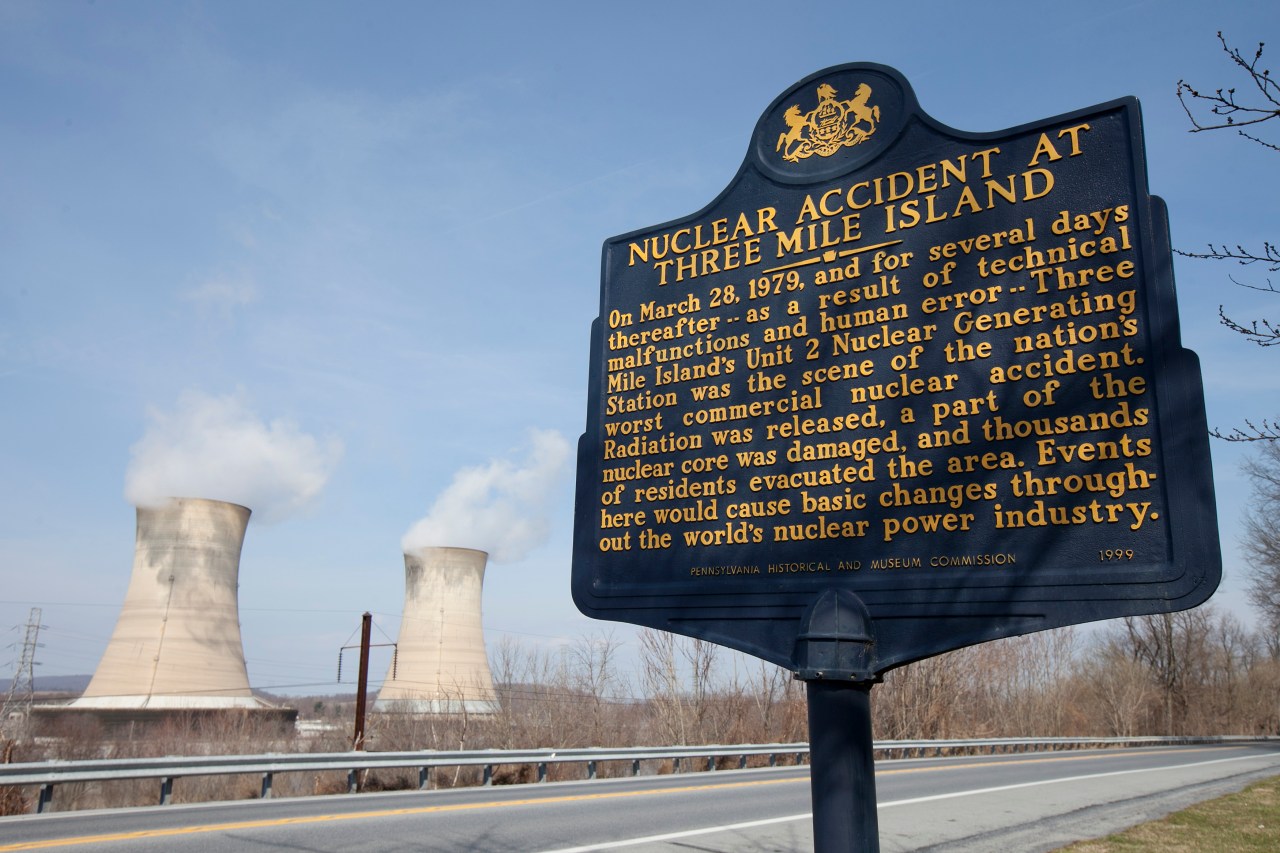
TMI is Three Mile Island, the site of the worst nuclear disaster in US history.

For me it is also, Too Much Information. 

*****

At my aunt’s house the adults watch TV and tell the children to go play or do homework. We pretend to listen. Then, there is no cable TV news, no 24-hour news cycle of updates. Just radio and network news, around which the adults hover. Our questions are ignored or shushed. We can only watch and listen on the fringes, if we want to know. 

I want to know. 

My memory conflates the timeline and pushes everyone to the background except me, my mother, and the man on TV who is also, impossibly, the man on the radio. 

I’m bored. I want something to happen. The bubble to burst. Fire. Catastrophe. Anything except the humming buzz of adults chewing uncertainty, which hurts my stomach. 

My aunt sends me downstairs to pick a book from her shelves because I’ve already finished the ones I brought. I pick Sybil by Flora Rheta Schreiber, an allegedly true story of a woman with sixteen personalities. At 500+ pages, it seems like an amped-up version of the mysteries I love. It isn’t,  but by the time I realize that I am hooked. Part of me knows my mother won’t want me to read it. Most of me doesn’t care. When caught in the web of a particularly good read, I read with a single-minded determination to know, regardless.

Then one night of our stay, I get too brave and bring the book with me into the room where the adults watch the nightly news. Sure enough, my mother takes it from me.

When we pack to return home, I take it back.

*****

By April 9, the crisis has ended. The damaged Unit 2 reactor is secured, everyone returns home, life returns to normal.

Except it doesn’t.

In the intervening years, scientists and politicians  continue to debate TMI’s effects on health and public energy policy as the undamaged Unit 1 continues to produce electricity.  “Sybil’s” harrowing experience of childhood abuse precipitates a spike in reported cases of dissociative identity disorder from hundreds to thousands. 

Then “Sybil” recants her narrative. And by the end of September 2019, TMI’s Unit 1 will close, its owner, Exelon, citing declining profitability.

I wonder, will I still be able to see its cooling tower alongside the Pennsylvania Turnpike, a reminder of my exit?

*****

Home, I finish reading and find, paradoxically, I have more questions than answers. More information than knowledge. I can’t ask anyone about Sybil, and no one can adequately explain the events at TMI. I feel disoriented.  As if in my absence, the landscape of my world has been exploded. Deliberately rearranged by adults trying and failing to hide their culpability and ignorance. 

Why can’t anyone tell me what I need to know?

***** 

Eventually, my aunt calls asking the whereabouts of her book. I am made to apologize.

I do. 

But I am not sorry.

Earlier this year I signed up for May’s Story A Day Challenge, wherein writers receive a daily prompt from its creator, Julie Duffy, and commit to writing a story every day throughout the month. Yee-up. That’s THIRTY-ONE stories. I was excited, nervous, intimidated–and determined. No matter what, I was NOT going to quit. I’d given myself and the group my word.

And guess what? May 31, I had 31 stories.

Granted, none of them were polished. Many of them were more outline than narrative. Some of them were god-awful.  Actually, MOST of them were god-awful. I loved them all. They were like gems in a treasure chest I didn’t know I owned.

Even more valuable? What I learned about my own writing process. 

  1. I HATE drafting. Drafting gives me vertigo, like someone has spun me around and left me to find my way without a GPS. Or a bucket.
  2. Revising is like dessert. And I love dessert.
  3. It’s okay to write a crappy first draft. In fact, ALL of my first drafts are crappy. See #1, above.
  4. Morning is my most creative time. If I don’t start writing in the morning, by day’s end my brain is like, Go away. No one’s home.
  5. Deadlines are my friend. The one who’s always your DD and tells you straight up when you’re a mess. 
  6. The more I write, the more I want to write and the more my brain works like champagne bubbles. Overflowing with ideas, but without the hangover.
  7. I can do this.

Which is why I’m in for Story A Day September. Check back next Sunday, and I’ll tell you how week one went.

Right now, I have a story to write.

(Curious about the challenge? Find more information at https://storyaday.org/)